
Cross-reference the AI certifications of a vendor’s leadership through secure verifiers like Credly, cross-examine technical competencies during RFP scoping, and audit real-world case studies. Relying on unverified paper certificates or surface-level resumes introduces serious compliance and operational risk into high-ticket enterprise outsourcing contracts, above all with vendors that put AI inside outsourced operations.
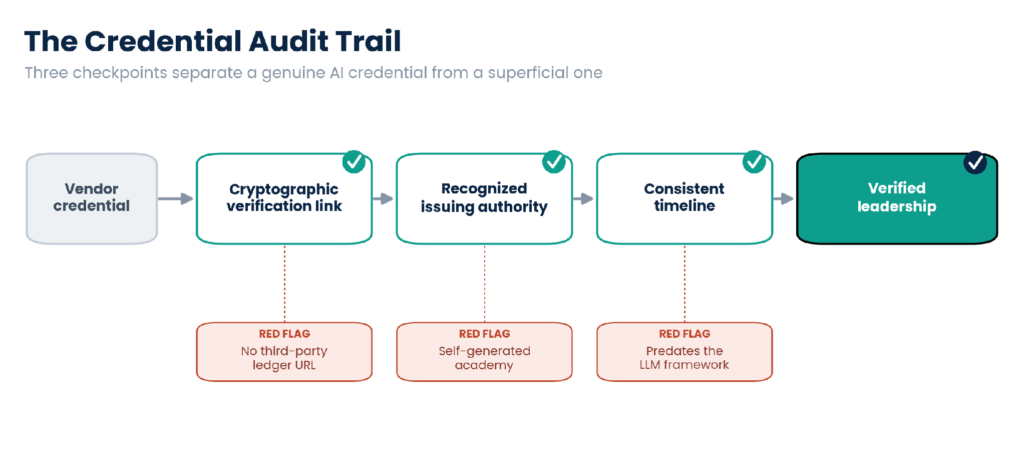
As enterprise AI adoption surges, so does the supply of commoditized certifications that look impressive on a slide but prove little. For a buyer signing a high-ticket contract, the gap between a verified credential and an inflated one is the gap between a partner who can safely scale an LLM workflow and one who cannot. Verification works best as a trail of checkpoints, each designed to catch a different kind of weak credential before it reaches a shortlist. Treated as a sequence rather than a single yes-or-no, the process becomes far harder to game — a weak credential tends to fail at least one checkpoint even when it survives the others.
What Are the Structural Red Flags of Superficial AI Credentials?
Three documentation patterns. Watch for credentials with no cryptographic verification link to a third-party ledger; ambiguous issuing authorities such as self-generated corporate academies; and timeline discrepancies — a certificate dated before the public release of the LLM framework it claims to cover.
The surge in enterprise AI has produced an influx of surface-level certifications that masquerade as elite machine-learning competence. True enterprise-grade deployment demands mathematical, architectural, and operational depth — not high-level familiarity with prompt generation. Spotting the tells early lets evaluation teams eliminate underqualified providers before the RFP shortlist. Three indicators recur:
- No cryptographic verification link. Authentic credentials from hyperscalers or accredited institutions carry a verifiable URL or QR code pointing to a third-party ledger.
- Ambiguous issuing authority. Be cautious of credentials from self-generated corporate training programs or unrecognized digital academies that lack external validation.
- Timeline discrepancies. A certificate that predates public access to the specific LLM framework it covers is an immediate compliance risk.
Against those red flags, a clear framework helps evaluators map each foundational competency to the verification protocol it actually requires. The protocol matters because the cost of a missed flag is asymmetric: a single ungoverned deployment can expose data that no amount of headline savings will offset.
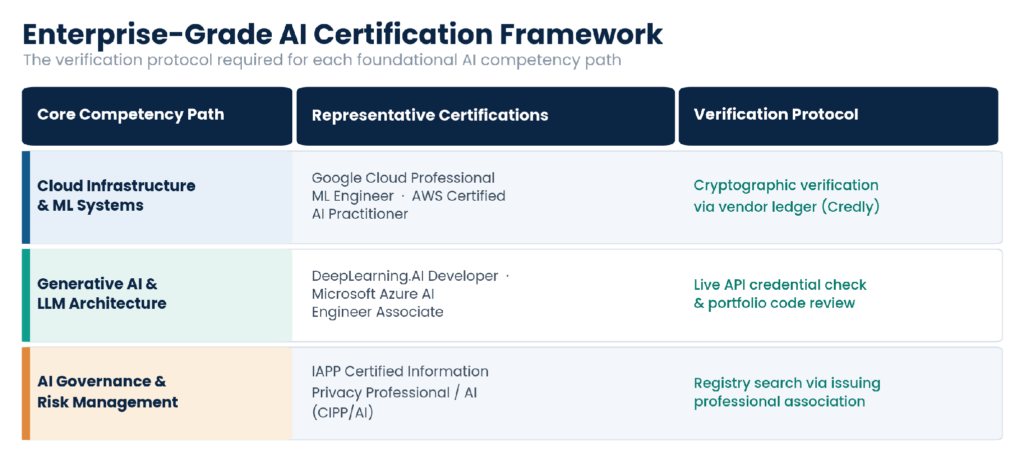
The verification protocol required for each foundational AI competency path.
How Do You Audit a BPO Leader’s Technical Credentials During the RFP?
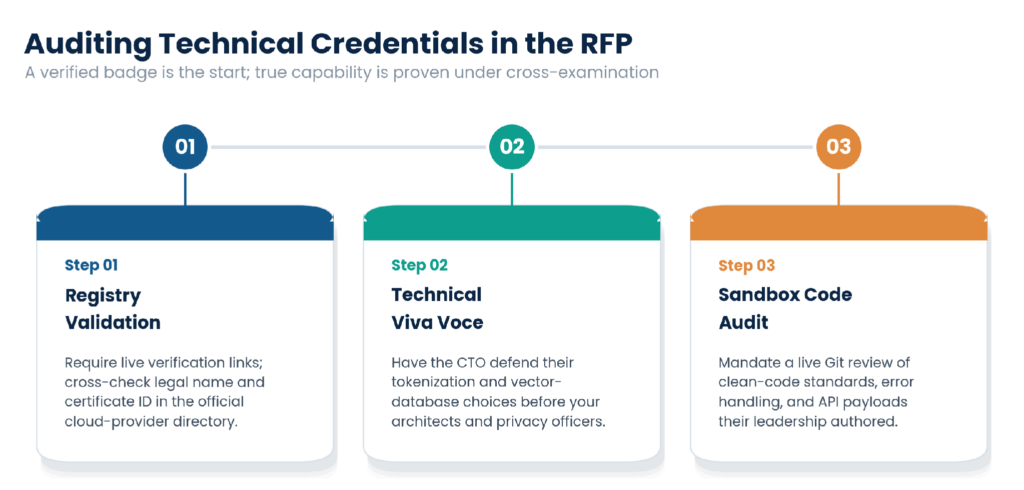
Go beyond the badge. Require live registry validation against the official cloud-provider directory; convene a technical viva voce where the CTO defends their tokenization and vector-database architecture under cross-examination; and mandate a sandbox code and Git-repository audit of work their leadership authored or supervised.
“A certificate proves an individual passed an exam on a Tuesday afternoon; it does not prove they can scale an LLM framework across a 500-agent customer care operation without exposing proprietary enterprise data. True technical auditing demands that leadership defend their deployment architecture under cross-examination.”
— John Maczynski, CEO of PITON-Global
A verified badge is only an initial check; it does not guarantee a leader can architect an enterprise-grade workflow. Procurement teams should fold three structured validation phases directly into their sourcing framework. Each phase tightens the screen: registry validation confirms the badge is real, the oral defense confirms the person genuinely understands it, and the code audit confirms their team can actually build to it.
What Real-World Impact Does Verified AI Leadership Deliver?
Measurable, audited gains. After validating a Manila provider’s leadership on Google Cloud ML and IAPP privacy credentials, PITON-Global oversaw a RAG support deployment that cut Average Handle Time sharply, lifted First Contact Resolution substantially, reduced cost markedly, and logged zero data-leakage incidents under SOC 2 audits.
The difference between theoretical AI capability and operationally proven leadership shows up directly in KPIs and delivery cost. PITON-Global aligned a Fortune 500 fintech with an elite, AI-optimized Manila provider, but only after subjecting the vendor’s executive leadership to a full verification protocol — validating dual certifications in Google Cloud ML infrastructure and IAPP data-privacy frameworks. Under the verified CTO’s direct guidance, the provider deployed a retrieval-augmented generation (RAG) support framework alongside human-in-the-loop content moderators, the kind of digital workforce of AI agents and human teams that verified leaders are expected to run. The sequencing is the point — verification came before deployment, so the results below reflect capability that was proven rather than promised.
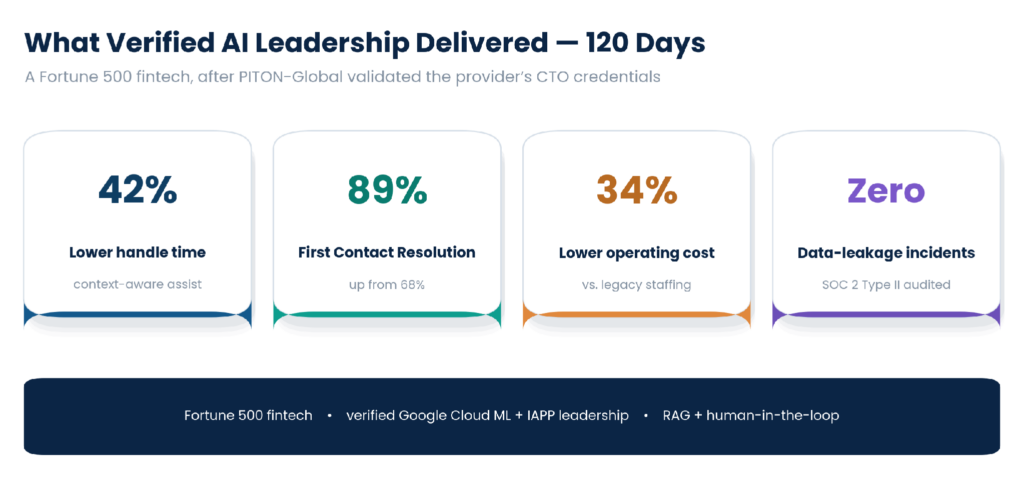
Within the first 120 days, the verified execution delivered substantial, auditable improvements — and, critically, maintained zero data-leakage incidents validated by quarterly third-party SOC 2 Type II audits. The compliance result matters as much as the efficiency gains: it is the part an inflated credential can never guarantee. The efficiency side changes the commercial math too, as generative AI reshapes the Manila seat-cost model.
How Should Future AI Regulations Change Your Verification Framework?
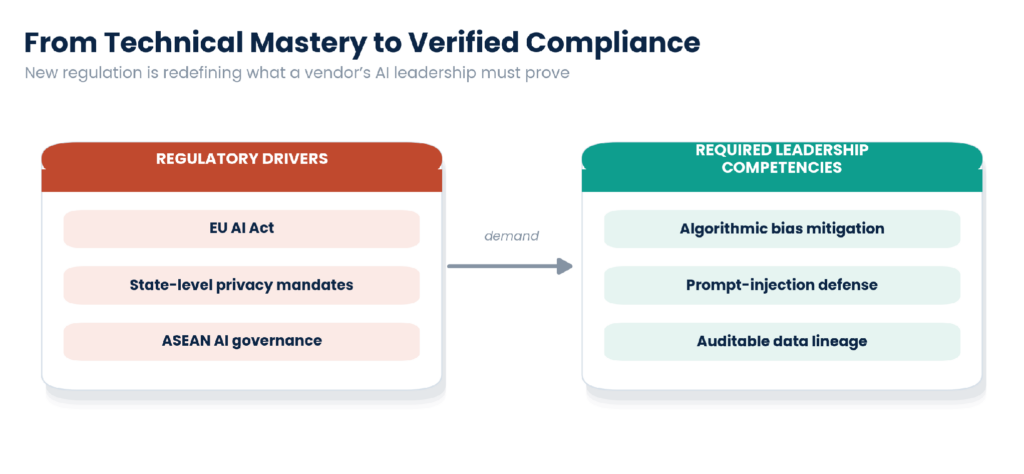
Shift the emphasis from technical mastery to compliance. As the EU AI Act, state privacy mandates, and ASEAN governance guidelines take force, vendor leadership must hold verified AI-risk credentials and demonstrate competence in algorithmic bias mitigation, prompt-injection defense, and auditable data lineage — or they import regulatory and reputational risk.
The regulatory landscape is evolving fast, shifting the definition of executive capability from purely technical mastery toward strict legal and ethical compliance. As comprehensive frameworks introduce real enforcement, future sourcing audits must verify that leadership holds formal AI-risk credentials from recognized compliance bodies — not just hyperscaler engineering badges. Vendors whose leaders cannot demonstrate these competencies import substantial regulatory, financial, and reputational risk into the enterprises they serve. Practically, that means adding compliance-credential checks to the same audit trail already used for technical badges — and treating a gap there as disqualifying rather than a coaching note. The same audit trail should carry through when you move a legacy program to an AI-first framework.