
Back
What Does It Cost to Outsource AI Model Training to the Philippines?

By Ralf Ellspermann / 5 June 2026
 Authored by Ralf Ellspermann, CSO of PITON-Global, & 25-Year Philippine BPO Veteran | Executive | Verified by John Maczynski, CEO of PITON-Global, and Former Global EVP of the World's Largest BPO Provider on June 5, 2026

There is no single rate — outsourcing AI model training to the Philippines is priced per FTE, per task or label, per usable throughput, or on model-outcome terms, with risk shifting to the partner along that spectrum. The Philippines runs 50–70% below comparable onshore labor and converts fixed payroll to variable cost, but the metric that matters is cost per usable label (and per accuracy point), which falls as calibration matures — not the headline seat rate.
Key Takeaways
- Model, not rate. Per-FTE, per-task, per-throughput, and outcome pricing allocate risk differently — the structure drives value.
- Cost per usable label is the metric. Rework and rejects make a cheap label expensive; measure usable output, not raw output.
- Fixed becomes variable. Outsourcing flexes spend with project phase at 50–70% lower labor cost.
- Quality is a cost lever. Higher accuracy cuts epochs and compute — underspending on QA inflates the real bill.
- Outcome pricing needs data maturity. You can only pay per usable unit when you can cleanly measure usable units.
How Is Outsourced AI Model-Training Work Priced?
On one of four models — per FTE or seat, per task or label, per usable throughput, or on model-outcome terms — with operational risk shifting toward the partner as you move from capacity-based to outcome-based pricing.
“What’s the rate” is the wrong opening question; the pricing structure decides who carries the risk. Per-FTE pricing buys capacity you direct and is simple but puts utilization and quality risk on you. Per-task pricing aligns to volume. Per-throughput pricing charges for usable units that pass QA, which begins to align incentives. Outcome-based pricing ties cost to acceptance or model impact and shifts the most risk to the partner — viable only when the operation is mature and usable output is cleanly measurable. Moving rightward trades simplicity for alignment; the right point depends on your data maturity.

Figure 1 — Risk shifts toward the partner left-to-right; outcome pricing needs cleanly measured data.
According to John Maczynski, CEO, PITON-Global, “Everyone benchmarks the per-hour rate, which is the one number that tells you least. A per-throughput model can look pricier per unit and be far cheaper in total, because you stop paying for rework. Pricing structure, not the rate card, is where the money actually moves.”
What Is the Right Way to Measure the Cost?
By cost per usable label and per accuracy point — not the seat rate — because rejects and rework make nominal cost misleading, and the right partner drives usable-unit cost down as calibration matures.
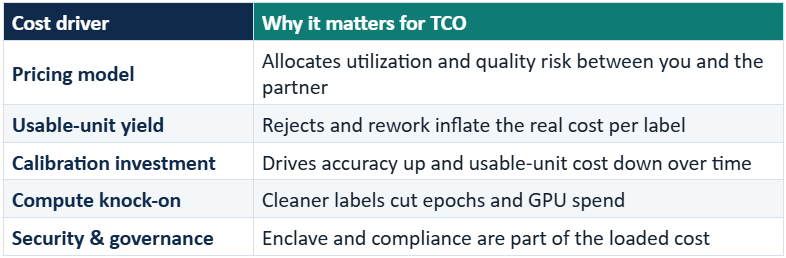
The denominator is everything. A seat rate tells you what an annotator costs, not what a usable, model-ready label costs once rejects and rework are netted out. Cost per usable label captures the whole operation’s efficiency, and it should fall over the engagement as calibration tightens, yield rises, and the team internalizes your ontology. A partner that only sells cheaper seats holds that curve flat; one that invests in calibration bends it down. And because label quality propagates into training compute, the same accuracy gains that lower usable-unit cost also cut GPU spend — the saving compounds beyond the annotation invoice.

Figure 2 — Illustrative: rework falls and yield rises with calibration; usable-unit cost, not seat rate, is the metric.
“Ask not what a label costs but what a usable label costs after QA — and then watch whether that number falls quarter over quarter. If it does, the partner is engineering your cost down. If it stays flat, you have rented seats, not bought a capability,” said Ralf Ellspermann, CSO, PITON-Global.
Where Do the Savings Come From — and What’s the Catch?
From 50–70% lower labor cost and the conversion of fixed payroll to variable spend — with the caveat that under-investing in QA and retention raises error rates, compute, and rework, quietly erasing the saving.
The headline saving is real: Philippine operations typically run 50–70% below comparable onshore labor, and outsourcing converts a fixed payroll into spend that flexes with project phase. But those savings are secondary to the usable-unit curve and carry a caveat — buying the cheapest seats and starving QA and retention raises error rates, inflates downstream compute, and multiplies rework, erasing the headline gain. The right frame for total cost of ownership is the fully loaded cost of usable, model-ready output, trending down — not the lowest seat rate today. Because figures move quickly, validate current pricing against live quotes.
“Track cost per usable label every month and make the partner own the curve. If it is not falling, you are renting seats; if it is, you are buying a capability that compounds,” noted John Maczynski, CEO, PITON-Global.
Frequently Asked Questions
How Is AI Model-Training Outsourcing Priced?
Per FTE/seat, per task or label, per usable throughput, or on model-outcome terms. Risk shifts toward the partner from capacity-based to outcome-based models, and outcome pricing requires mature, cleanly measured usable-output data.
What Is the Right Cost Metric?
Cost per usable label and per accuracy point, not the seat rate. Rejects and rework make nominal cost misleading, and a good partner drives usable-unit cost down as calibration matures — which also cuts training compute.
How Much Does the Philippines Save Versus Onshore?
Typically 50–70% on labor, plus conversion of fixed payroll to variable spend. But savings are real only if QA and retention are funded, so error rates, rework, and compute don’t rise and cancel the gain.
About PITON-Global
PITON-Global helps AI teams structure model-training engagements around total cost of ownership and a falling cost-per-usable-label curve, sourcing from a network of 100-plus leading Philippine BPOs — 20 of them AI-first front-runners. Our leadership carries 6+ decades of combined global outsourcing experience and 25+ years in the Philippines, and our advisory is free and obligation-free, funded by the provider network rather than by you.
Achieve sustainable growth with world-class BPO solutions!
PITON-Global connects you with industry-leading outsourcing providers to enhance customer experience, lower costs, and drive business success.
Get Your Top 1% Vendor List
Author
Ralf Ellspermann is a multi-awarded outsourcing executive with 25+ years of call center and BPO leadership in the Philippines, helping 500+ high-growth and mid-market companies scale call center and customer experience operations across financial services, fintech, insurance, healthcare, technology, travel, utilities, and social media.
A globally recognized industry authority - and a contributor to The Times of India, CustomerThink, and The AI Journal - he advises organizations on building compliant, high-performance offshore contact center operations that deliver measurable cost savings and sustained competitive advantage.
Known for his execution-first approach, Ralf bridges strategy and operations to turn call center and business process outsourcing into a true growth engine. His work consistently drives faster market entry, lower risk, and long-term operational resilience for global brands.
EXECUTIVE GOVERNANCE & ACCURACY STANDARDS
Authored by:

Ralf Ellspermann
Founder & CSO of PITON-Global,
25-Year Philippine BPO Veteran,
Multi-awarded Executive
Specializing in strategic sourcing and excellence in Manila
View Full Bio
Verified by:

John Maczynski
CEO of PITON-Global, and former Global EVP of the World’s largest BPO provider | 40 Years Experience
Ensuring global compliance and enterprise-grade service standards
View Full Bio
Last Peer Review: June 5, 2026
This service framework is audited quarterly to meet shifting global outsourcing regulations and COPC standards.