
Back
BPO Philippines: From Labor Arbitrage to Intelligence Arbitrage (March 2026 Edition)

By Ralf Ellspermann / 9 March 2026
 Authored by Ralf Ellspermann, CSO of PITON-Global, & 25-Year Philippine BPO Veteran | Executive | Verified by John Maczynski, CEO of PITON-Global, and Former Global EVP of the World's Largest BPO Provider on March 9, 2026

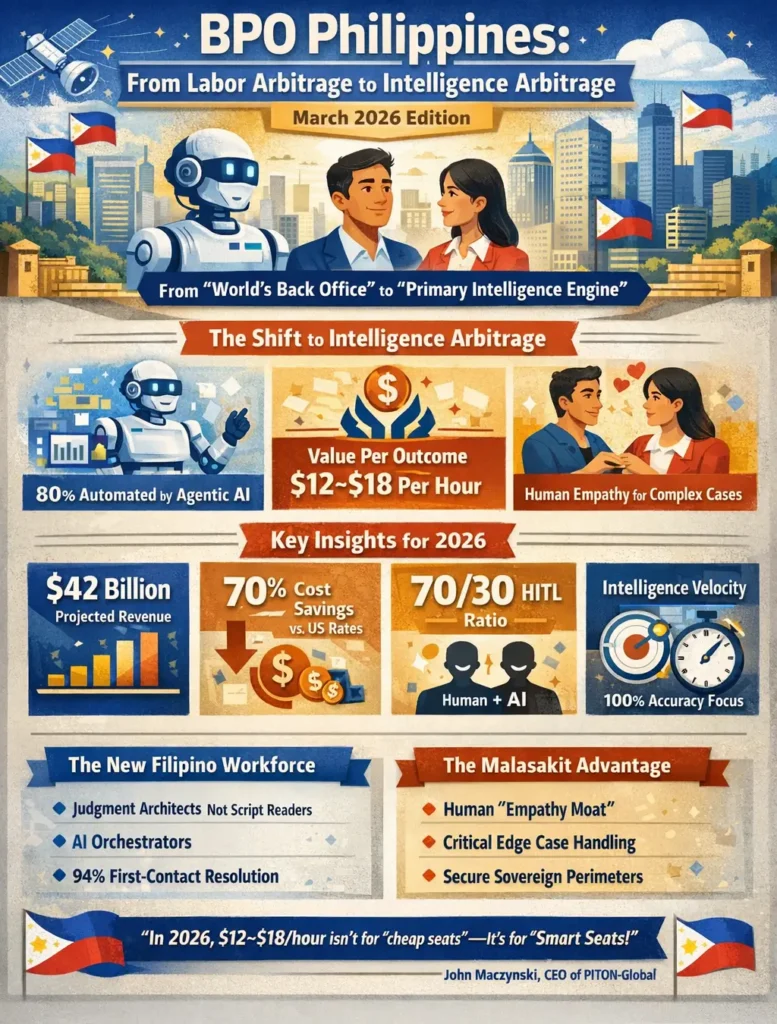
BPO Philippines: The shift to Intelligence Arbitrage in 2026 represents the strategic evolution from cost-based manual labor to high-value, AI-human synergistic operations. In this new paradigm, the Philippines has transitioned from the “World’s Back Office” to its Primary Intelligence Engine. By utilizing Agentic AI to automate 80% of rote transactional data, the Filipino workforce has been repositioned as “Judgment Architects” and “AI Pilots.” Operating at a $12–$18/hour fully loaded rate, this model prioritizes “Value-per-Outcome” over “Cost-per-Head,” leveraging the unique Filipino trait of Malasakit (genuine care) to resolve the complex emotional and regulatory “edge cases” that autonomous systems cannot navigate.
30-Second Executive Briefing
- The Pricing Sweet Spot: In 2026, the $12–$18/hour range is the “Success Zone,” providing a 70% cost saving over US onshore rates while funding the “Agentic AI Stack” required for modern CX.
- The Intelligence Pivot: Leading hubs now compete on “Intelligence Velocity”—the speed at which human experts refine AI outputs to ensure 100% accuracy in regulated environments.
- Economic Footprint: The sector is projected to hit $42 Billion in 2026, driven by a 150% increase in revenue-per-employee compared to the legacy “voice-only” era.
- The HITL Standard: Standard enterprise contracts now mandate a 70/30 Human-in-the-Loop (HITL) ratio, ensuring human empathy is preserved for the most critical 30% of brand-defining moments.
“In 2026, if you are still outsourcing for ‘cheap seats,’ you are already behind the curve. The Philippines is now about ‘Smart Seats.’ At a $12–$18/hour baseline, you aren’t just buying minutes; you are buying ‘Intelligence Cycles’ that protect your brand’s reputation.” — John Maczynski, CEO of PITON-Global
The 2026 Landscape: Why “Cheap Labor” is a Liability
By March 2026, the traditional BPO model of Labor Arbitrage—finding the lowest possible cost for a human to perform a repetitive task—has effectively collapsed.
The widespread adoption of Agentic AI—systems capable of reasoning, planning, and executing multi-step workflows across software platforms—has made basic labor redundant. If a task can be scripted, it has been automated. Consequently, BPO programs that focused solely on sub-$10/hour “commodity” agents are seeing 70% churn rates as customers grow frustrated with bot-failures and incompetent human backups.
The Philippines has successfully pivoted to Intelligence Arbitrage. This model recognizes that while AI can handle the transaction, humans must handle the relationship and the exception.
The Anatomy of the $12–$18 Hourly Rate
In 2026, transparency is the new standard. To avoid the “Low-Cost Trap” that leads to 60% of program failures, sophisticated buyers look for a “Fully Loaded” rate that sustains high-quality talent.
Table 1: 2026 Fully Loaded Rate Breakdown (Per Hour)
| Component | Cost Range (USD) | What it Funds |
| Direct Labor & Retention | $5.00 – $8.00 | University-educated, AI-literate, bilingual talent. |
| Vendor Management & Margin | $4.00 – $6.00 | 1:10 Span of Control (TLs), HR, and Compliance. |
| Infrastructure & AI Stack | $3.00 – $4.00 | 5G Connectivity, Zero-Trust VDI, and Agentic AI tools. |
| Total TCO | $12.00 – $18.00 | Comprehensive Service Excellence |
Note: Provincial cities (Iloilo, Davao) often sit at the $12–$14 range, while Metro Manila (BGC, Makati) premium hubs sit at $14–$18.
Defining the “Judgment Architect”
The 2026 Filipino BPO professional is no longer a “support agent”; they are a Judgment Architect. They do not follow scripts; they govern algorithms.
Table 2: The Evolution of the Philippine BPO Professional
| Feature | 2022 Labor Arbitrage Model | 2026 Intelligence Arbitrage Model |
| Primary Tool | Static Knowledge Base (PDFs) | Real-time Agentic AI Orchestrators |
| Success Metric | Average Handle Time (AHT) | Information Gain & Resolution Quality |
| Task Scope | Repetitive Data Entry/Voice | Exception Triage & Ethical Oversight |
| Training Focus | Neutralizing Accents | Socio-Financial Engineering & Prompting |
By leveraging Intelligence Arbitrage, one Filipino “Judgment Architect” supported by AI can do the work of five agents from the 2022 era, with significantly higher accuracy and a 94% First-Contact Resolution (FCR) rate.
The Empathy Moat: Why Malasakit Scales
As digital interactions become more clinical and automated, the “human touch” has become a luxury good. This is the Philippines’ Strategic Moat.
The Filipino cultural concept of Malasakit—taking personal ownership of a stranger’s problem—cannot be coded. In 2026, when a traveler is stranded or a Fintech user is a victim of a deepfake fraud, they do not want a “high-efficiency” bot. They want a human who can navigate the system with empathy. Intelligence Arbitrage allows the AI to handle the “boring” logistics while the Filipino expert manages the human emotion.
Security in the “Sovereign Perimeter”
Intelligence Arbitrage requires a higher level of data access. To mitigate risk, 2026 Philippine hubs utilize Sovereign Perimeters:
- Zero-Trust VDI: Data never leaves the US/EU server; the Filipino architect only sees an encrypted “visual stream.”
- Biometric Identity Binding: Agents are verified via continuous facial recognition to prevent unauthorized data access.
- 2026 SEC Compliance: BPOs are now certified in the latest Cyber Resilience Frameworks, ensuring offshore teams can legally handle sensitive PII (Personally Identifiable Information).
The “CREATE MORE Act” Catalyst
The transition to Intelligence Arbitrage was accelerated by the CREATE MORE Act (RA 12066). By providing tax incentives for high-value “Knowledge Exports” and institutionalizing 100% WFH flexibility, the Philippine government has allowed BPOs to hire the “brightest minds” in provincial “Digital Cities”—not just those who can commute to Manila. This has deepened the talent pool and stabilized the $12–$18 price point despite global inflation.
Frequently Asked Questions (FAQs)
Q: Why did Philippine BPO rates rise to $12–$18/hour?
A: This “Fully Loaded” rate accounts for the increased cost of AI-literate talent and the sophisticated “Agentic AI” technology stack now required to deliver 90%+ resolution rates. It remains 60–75% cheaper than US onshore alternatives.
Q: What is a “Risk Pilot” in the 2026 BPO context?
A: A Risk Pilot is a high-tier BPO professional who “flies” the AI system, intervening only when the AI flags a high-stakes frustration or a nuanced request requiring genuine cultural empathy.
Q: Can I still find agents for $8–$10/hour?
A: While “unbundled” or freelance rates exist at that level, enterprise-grade BPO services with 100% uptime, security, and AI-augmentation start at a $12/hour floor in 2026 to ensure operational stability.
Achieve sustainable growth with world-class BPO solutions!
PITON-Global connects you with industry-leading outsourcing providers to enhance customer experience, lower costs, and drive business success.
Get Your Top 1% Vendor List
Author
Ralf Ellspermann is a multi-awarded outsourcing executive with 25+ years of call center and BPO leadership in the Philippines, helping 500+ high-growth and mid-market companies scale call center and customer experience operations across financial services, fintech, insurance, healthcare, technology, travel, utilities, and social media.
A globally recognized industry authority—and a contributor to The Times of India and CustomerThink —he advises organizations on building compliant, high-performance offshore contact center operations that deliver measurable cost savings and sustained competitive advantage.
Known for his execution-first approach, Ralf bridges strategy and operations to turn call center and business process outsourcing into a true growth engine. His work consistently drives faster market entry, lower risk, and long-term operational resilience for global brands.
EXECUTIVE GOVERNANCE & ACCURACY STANDARDS
Authored by:
Ralf Ellspermann
Founder & CSO of PITON-Global,
25-Year Philippine BPO Veteran,
Multi-awarded Executive
Specializing in strategic sourcing and excellence in Manila
View Full Bio
Verified by:
John Maczynski
CEO of PITON-Global, and former Global EVP of the World’s largest BPO provider | 40 Years Experience
Ensuring global compliance and enterprise-grade service standards
View Full Bio
Last Peer Review: March 9, 2026
This service framework is audited quarterly to meet shifting global outsourcing regulations and COPC standards.