Enrollment is a deadline. Support has to keep it.
Admissions and enrollment support, financial-aid and student services, LMS and IT help desk, and retention outreach — delivered by Philippine specialists who answer the 2am application question and protect the student from dropping out of the funnel.
BPO Partners
Contacts / Year
Delivery Hubs
Enrolling a student is expensive; losing one is catastrophic — to the learner, the mission and the budget. Most drop-outs send signals weeks ahead: a missed payment, a stalled course, an unanswered question. The job is to reach them before the silence becomes a withdrawal.
Your institution type and your funnel decide where the drift starts.
These are the four education profiles we build for most often — each with its own drift point, each served by the same learner-success, empathy-certified operation.
The full learner-success stack — outbound outreach, empathy gate, integrity oversight.
Enrollment-season surges, aid-office overflow, and the persistence mission at open-access scale.
Safeguarding posture throughout, enrollment and re-enrollment cycles run to the district calendar.
Platform support with completion economics — cross-linked to our SaaS support operations.
From inquiry to graduation — where do you lose them?
Every stage of the learner journey has a drop-off point, and each one sends a signal first. Click a stage to see the moment, the warning sign, and the outreach that keeps the student enrolled.

“A student almost never drops out in a single dramatic moment. They drift — a missed payment, a confusing form, a course they fell behind in and were too embarrassed to ask about. The institutions that retain them are the ones with a warm voice on the other end of the line before the drift becomes a decision.”
A ticket queue vs. a learner-success operation.
Seven dimensions that decide whether students persist or drift away.
Retention keeps the student enrolled. Integrity keeps the credential worth enrolling for.
Every persistence point this page fights for assumes the degree at the end means something — and in 2026, AI-written submissions, contract cheating, and exam fraud are eroding exactly that, faster than most integrity offices can staff for.
AI-enhanced screening across assessments, submissions, and discussion boards — stylometric breaks, impossible submission patterns, recycled contract-mill fingerprints — surfacing the cases a spot-check never would. The same pattern discipline our research desks run on AI-coded survey data and our publishing desks run on fabricated citations: the fake pattern in real data, third theater.
No automated accusations, ever. Every flag lands with a trained integrity analyst who assembles the evidence file — the pattern, the history, the comparison set — for your faculty and integrity office to judge. The machine detects; the analyst documents; the institution decides.
Integrity oversight done right protects honest students most of all: their credential’s value, their cohort’s fairness, and — through early, supportive intervention on first-time flags — sometimes the struggling student themselves, whose shortcut was a warning sign the drift model already knows how to read.
The through-line: the outreach desk reaches the student who went quiet; the integrity desk reaches the submission that got loud in the wrong way. Both are pattern-reading with a human on the judgment.
Course-shell setup, term rollovers, enrollment syncs, proctoring coordination, and user management across Canvas, Brightspace, and Blackboard — run to calendar so the first day of term isn’t a ticket storm. Half of “the LMS won’t load” tickets are really “the course wasn’t set up” tickets; the admin desk retires them at the source.
AI-assisted extraction and processing of applications, transcripts, and supporting documents — verified by human review, tracked to milestone, chased when stalled. Admissions velocity is a yield lever: the admit who waits three weeks on document processing is the admit who melts over the summer — the funnel’s J2–J3 seam, where the journey model says they vanish.
In K-12, every learner comes with a family — and the family calls too.
Enrollment and re-enrollment support, family communications, attendance and portal helpdesk, and program coordination for school networks and districts — with agents trained for the parent conversation, which is a different skill from the student one. Safeguarding posture throughout: FERPA-plus handling for minor records, strict verification before any disclosure, and every interaction logged. A school’s support desk talks to anxious parents at scale; the tone bar is the same as the at-risk-student bar, and we certify for it the same way.
Four ways an institution bleeds — one silent, one loud, one legal, one procedural.
The through-line: the first row is why the desk calls first; the second is why the credential stays worth the call; the third is why every call is logged; the fourth is why the applicant ever became a student at all.
Where does the 6.9× return come from when learners persist?
From four streams a per-contact rate ignores: retained tuition, higher yield, completion outcomes and labor arbitrage. A student who persists one more term is worth a full term of tuition the institution had already nearly lost.
$6.6M net benefit on $955K program
John Maczynski (CEO) · Q2 2026
Here is the cost per contact. Now here is what the silence costs.
Every RFP compares cost-per-contact, so we publish the seat math. Then we price the drift — because the cheapest contact of all is the one the ticket queue never made: the outbound call that didn’t happen to the student who didn’t come back.
The seat lens prices the answer; the drift prices the silence. The ticket queue is cheap per contact and expensive per cohort: it answers everyone who calls and loses everyone who doesn’t — and the ones who don’t call are the ones leaving. Price the student and the four streams a per-contact rate ignores — retained tuition ($1.7M–$3.4M), enrollment-yield lift ($1.0M–$2.0M), completion outcomes ($0.7M–$1.4M), and labor arbitrage ($0.8M–$1.6M) — stack to a $4.2M–$8.4M annual net benefit.
That is how ED-052’s $955K program returned $6.6M (6.9×): persistence up 9 points from proactive outreach at the first warning sign, yield up from fast warm response. A student who persists one more term is a full term of tuition the institution had already nearly lost — and a graduation the mission was built for.
Indicative 2026 rates — the certified roles shown apart from the ticket seat.
Answering a ticket has a market rate; calling a student who went quiet — with the tone that keeps them — does not. Neither does assembling an integrity file a faculty panel can act on. Those are assessed, certified capabilities.
— no generic equivalent$10–$14The outbound call to the student who went quiet — assessment-gated before any live contactRETENTION
— no generic equivalent$11–$15Irregularity review and evidence assembly — the file your faculty judge onINTEGRITY
The two premium rows have no generic equivalent because both are gated by assessment, not ramped by script — the retention specialist passes an empathy-and-FERPA evaluation before a single live student, and the integrity analyst is trained on evidence standards a faculty panel can rely on. A quote at the ticket band for either is the tell. Rates confirmed per engagement against population and program mix.
Price my desk against the learner-success standard →A learner-success desk live in 7 weeks — empathy and FERPA proven before cutover.
A gated stand-up. No agent contacts a live student until they pass an empathy-and-FERPA assessment and the retention-outreach playbook is calibrated.
Does your support reach the at-risk student — or only answer the ones who call?
Three capabilities decide whether learners persist or drift away — and each can be checked before you sign. The students you lose are rarely the ones who called; they are the ones nobody called.

“Ask one thing: how does the desk reach a student who has gone quiet? If the answer is that it waits for them to call, it is not a retention operation — it is a complaints line. The institutions that hold their learners are the ones that pick up the phone first, with warmth, at the first sign of trouble.”
Where the learner-success desk doesn’t fit — and the lines that never move.
A shortlist that includes “no” is the only kind worth having. Four engagements we turn down — and why the refusal is the point.
Grades, aid determinations, admissions decisions, and dishonesty findings are made by your faculty and officers — we assemble, flag, guide, and document, and the judgment stays where the accreditor expects it. A vendor issuing academic verdicts offshore isn’t support; it’s a governance finding.
Retention specialists are trained to recognize distress signals and hand off warmly to your counseling, care, or emergency resources — never to counsel. The outreach desk exists to catch academic and administrative drift; when the signal is something more, the most empathetic act is the fastest handoff to the people trained for it, and the protocol is drilled, not improvised.
The learner-success model pays off measured on persistence, yield, and completion. If the mandate is inbound-only with the quiet students left to fate, a ticket vendor is cheaper — and Maczynski’s test tells you what you bought: a complaints line, priced accordingly.
Reaching the student before the silence requires seeing the signals — under Zero-Trust VDI, inside your Banner/Canvas/Salesforce stack, with student records at zero local residency and every access logged. Without it, we’d be calling blind, or not calling at all — which is the failure this page exists to end.
The student-care desks that lift persistence.
These are the operations that passed an empathy-and-FERPA assessment alongside the complete Seven-Step Vendor Audit — empathy-certified agents, proactive at-risk outreach and a friction-free helpdesk demonstrated, not described. What reaches you is a short list of learner-success names that earned it.
See the education shortlist →Our 24-Hour Response Guarantee — a reply within 24 hours, empathy-assessment pre-screen included.
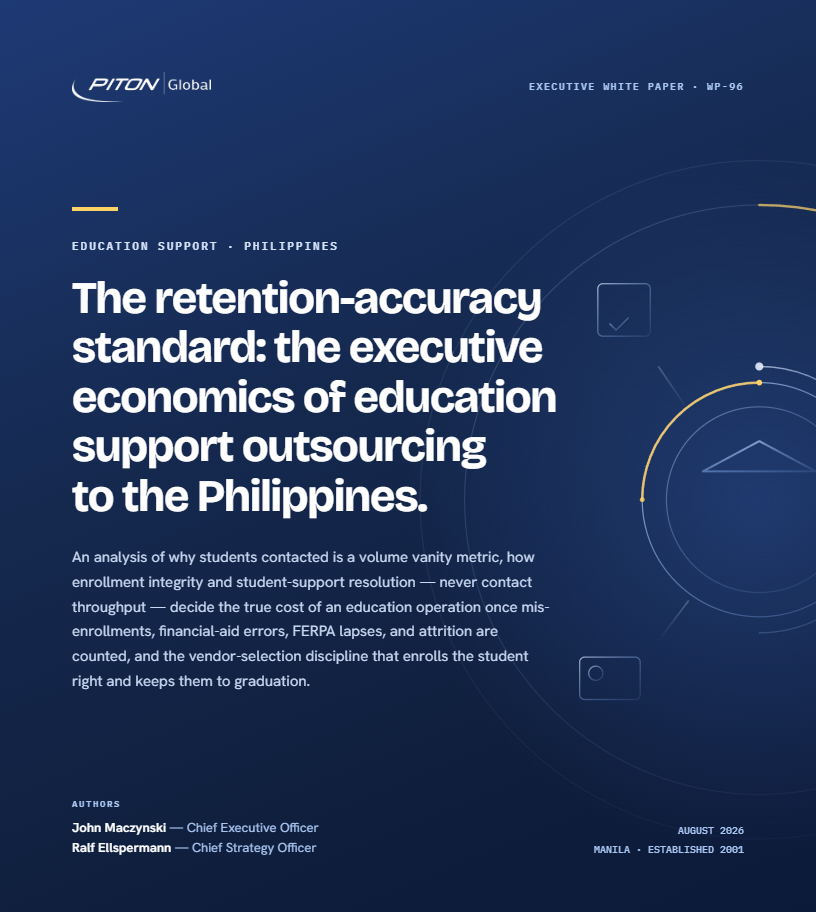
The retention-accuracy standard: the economics of education support outsourcing.
Why students contacted is a volume vanity metric, how enrollment integrity and student-support resolution — never contact throughput — decide the true cost of an education operation once mis-enrollments, financial-aid errors, FERPA lapses and attrition are counted, and the vendor-selection discipline that enrolls the student right and keeps them to graduation. Part of PITON-Global’s Executive White Paper Series, by John Maczynski and Ralf Ellspermann.
Where the education & learner-success conversation is happening.
The questions education leaders ask before they outsource.
In-depth answers to the questions that decide an education support engagement — from the principals who run them.