

Hospitals should benchmark candidate Philippine BPO vendors across four core financial vectors: a substantial fully-burdened cost reduction versus domestic baselines, a top-tier Clean Claim Rate, Days Sales Outstanding under 40 days, and a tightly capped Cost-to-Collect ratio relative to net patient revenue. Read those vectors against how offshore health-admin seats are priced before comparing bids.
Key Takeaways
- Target structural cost arbitrage: The total cost of engagement must deliver a substantial, sustainable structural saving over US onshore operational baselines.
- Prioritize first-pass yield: Long-term viability depends on a partner holding a consistently high Clean Claim Rate to eliminate re-work overhead.
- Optimize liquidity metrics: SLAs must legally bind the offshore vendor to strict Days Sales Outstanding compression caps.
- Evaluate fully-burdened rates: Audit vendor technology capitalization, statutory benefits, and shift differentials rather than relying on raw hourly metrics.
What Comprises the True Fully-Burdened Cost Structure in Philippine Healthcare Outsourcing?
Raw hourly FTE rates understate risk; the right measure is the fully-burdened build-up against the onshore baseline. For complex clinical and administrative work, a competitive all-in FTE rate sits in a premium tier rather than at commodity pricing, a level that signals rigorous compliance, strong talent retention, and robust technology infrastructure.
When US hospital CFOs evaluate offshore pricing, analyzing raw hourly full-time-equivalent (FTE) rates introduces profound financial risk. Comprehensive fiscal due diligence requires mapping the fully-burdened cost structure against onshore delivery baselines to determine the absolute Total Cost of Engagement (TCE). In the primary hubs of Metro Manila and Cebu, institutional-grade healthcare BPO providers use two prevalent pricing structures: FTE fixed pricing or transaction-based variable models. For complex, highly regulated tasks, a competitive fully-burdened hourly FTE rate sits above commodity pricing, reflecting the certified talent and secure infrastructure involved.
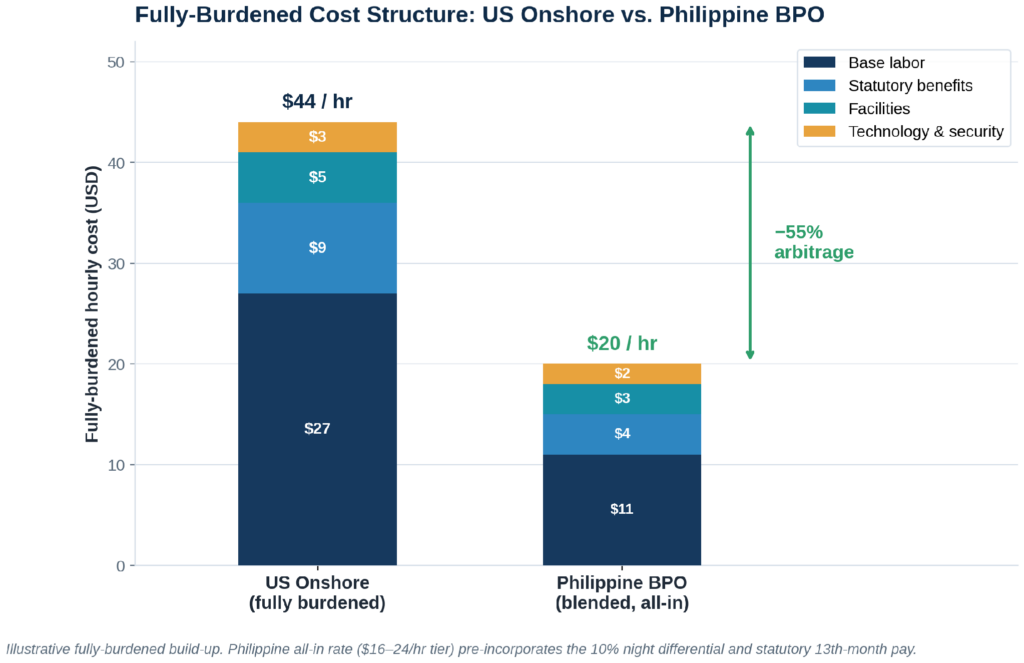
Figure 1 — Fully-burdened hourly cost build-up, US onshore versus Philippine BPO, showing the arbitrage gap across all cost layers.
Critical Statutory and Operational Cost Components
To protect margins from operational inflation, procurement teams must verify that the vendor’s blended rate already accounts for three regional variables:
- Night shift differential: Philippine labor law mandates a night-shift pay premium for hours worked between 10:00 PM and 6:00 AM—essential for teams running real-time US scheduling, live eligibility verification, and clinical documentation.
- The 13th-month pay: A mandatory statutory benefit equal to one-twelfth of annual basic salary. High-tier partners pre-incorporate this into base pricing.
- Technology & security capitalization: Top operators factor in SOC 2 Type II data centers, HIPAA-compliant point-to-point fiber routing, and zero-trust virtual desktop infrastructure (VDI).
Which Revenue-Cycle Management Metrics Directly Impact Hospital Margins?
Four RCM benchmarks should be written into vendor compensation: a high Clean Claim Rate, Days Sales Outstanding under 40 days, a low initial denial rate, and a tightly capped cost-to-collect ratio. Binding pay to these KPIs prevents revenue leakage and maximizes cash velocity.
To ensure an offshore administrative transition yields predictable fiscal returns, hospital leadership must legally bind vendor compensation to specific, quantifiable RCM benchmarks. The matrix below establishes the baseline financial and operational KPIs necessary to prevent revenue leakage and maximize cash velocity.
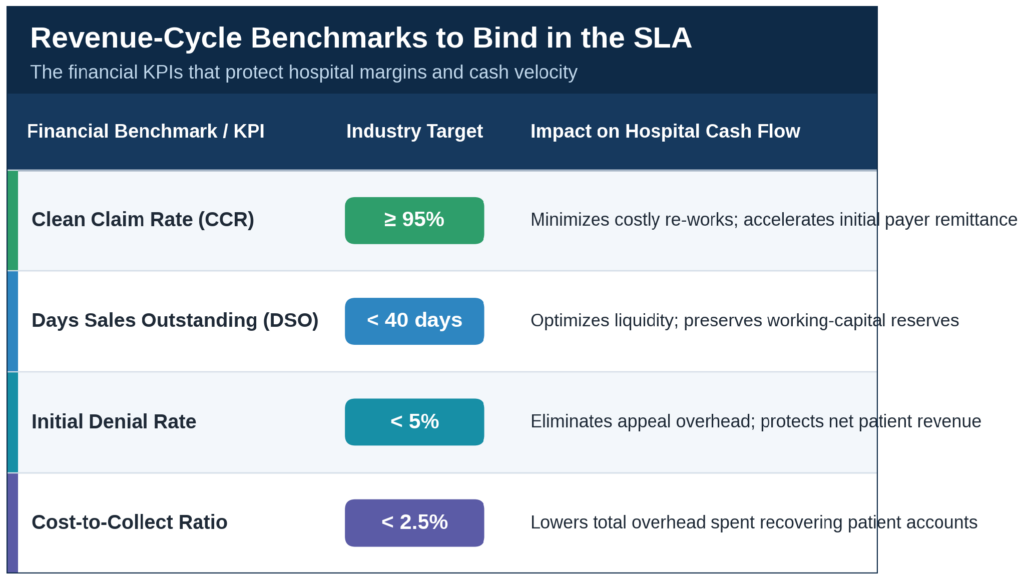
Figure 2 — The revenue-cycle benchmarks to bind in the SLA, their industry targets, and their impact on hospital cash flow.
Many US hospital executives make the mistake of choosing a Philippine provider based solely on the lowest hourly rate. But a cheap rate means nothing if their Clean Claim Rate starts to slide. True financial optimization occurs when you align with a partner whose operational quality protects your top-line revenue while simultaneously lowering your bottom-line delivery costs.
— John Maczynski, CEO, PITON-Global
How Can Hospitals Mitigate the Financial Risks of Offshore Transitions?
Mitigate transition risk with a disciplined 90-day methodology: run 30–60 day parallel onshore/offshore queues to audit accuracy, mandate dedicated certified-coder compliance pools that absorb payer-policy updates at no extra fee, and embed financial clawbacks tying DSO or accuracy failures to rate reductions and exit clauses.
Transitioning sensitive operations like medical coding (ICD-10/CPT), complex utilization review, and front-end patient billing offshore introduces operational and regulatory headwinds if executed through a commodity framework, which is why the risks hospital CEOs should evaluate before selecting a provider belong in the financial model. A structured, checkpoint-driven transition is what protects the financial case, as the phased methodology below illustrates.
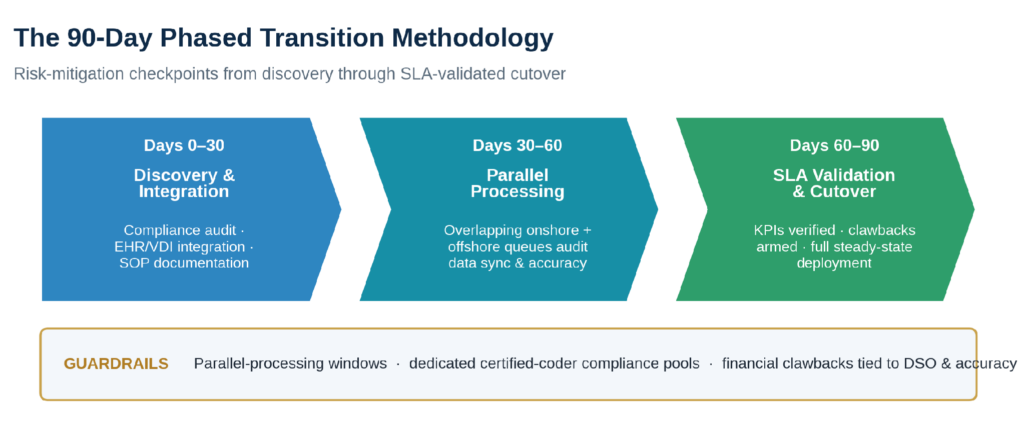
Figure 3 — The 90-day phased transition methodology, with risk-mitigation guardrails from discovery through SLA-validated cutover.
Strategic Risk-Mitigation Framework
- Execute parallel-processing windows: Maintain overlapping onshore and offshore queues for 30–60 days to audit data synchronization, entry accuracy, and system integration.
- Mandate dedicated compliance pools: Ensure the provider supplies continuous training for AHIMA- or AAPC-certified coders to absorb changing payer policies without extra fees.
- Implement financial clawbacks: Embed liquidated damages in the master services agreement tying persistent DSO or accuracy failures to direct rate reductions and contract-exit clauses.
What Do These Benchmarks Deliver in a Real Engagement?
A Mid-Atlantic health system with a double-digit denial rate and a 54-day DSO migrated front-end billing, pre-authorization, and denial management to a 45-FTE Manila team. Within 180 days of steady state, denials fell to a fraction of their starting level, DSO compressed to 37 days, and a significant block of trapped working capital was released.
Client Challenge
A regional US health system faced a severe cash-flow crunch driven by a climbing double-digit claim denial rate and an average DSO stretching to 54 days.
Vendor Selection Process
PITON-Global conducted an exhaustive operational-volume audit and matched the health system with a highly specialized healthcare BPO within its network of 100+ vetted providers, targeting firms with proven complex-EHR-integration experience.
Solution Implemented
A phased migration of front-end billing, pre-authorization workflows, and denial management to a dedicated 45-FTE Manila team operating on a 24/7 cross-functional schedule. The before-and-after results are summarized below.
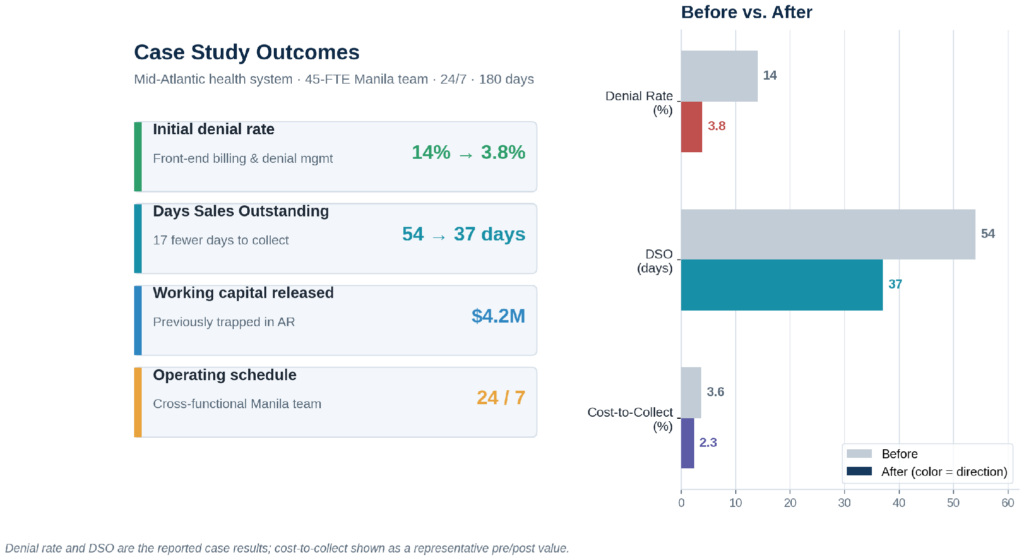
Figure 4 — Quantifiable business outcomes within 180 days of steady-state deployment.
Seamless data transfer relied entirely on deep native integration between the vendor’s secure terminal servers and the hospital’s core Epic EHR platform—proving that technical-infrastructure screening is as critical as labor-cost assessment.
Why Do Enterprise Healthcare Organizations Partner with PITON-Global?
Navigating hundreds of Philippine BPO operators introduces procurement risk. PITON-Global removes it by acting as an advisory-led consultancy rather than a transactional broker—objectively matching hospitals to compliance-verified partners from a network of 100+ vetted providers with proven HIPAA security, US-regulatory, and RCM track records.
Navigating the fragmented landscape of hundreds of BPO operators in the country introduces significant procurement risk for healthcare organizations. PITON-Global removes this uncertainty by acting as an advisory-led outsourcing consultancy rather than a transactional broker. With an elite network of more than 100 vetted, compliance-verified call-center and back-office providers nationwide, the firm guides healthcare brands through an objective matching process.
By aligning hospitals with partners that possess verified track records in HIPAA security, US healthcare regulations, and advanced RCM execution, PITON-Global mitigates transition risk, protects vital hospital margins, and ensures long-term operational success.
Frequently Asked Questions
What is the average cost saving when outsourcing hospital billing to the Philippines?
Most US healthcare systems realize a substantial net structural saving on fully-burdened labor costs when transitioning administrative and RCM roles to a premier offshore provider.
How do Philippine BPO firms guarantee HIPAA and data-security compliance?
Top-tier providers use SOC 2 Type II certified data centers, biometric access controls, zero-trust network architectures, data-loss-prevention software, and diskless workstations to eliminate data-exfiltration risk.
Are medical coders in the Philippines certified to US institutional standards?
Yes. Professional healthcare BPOs employ college-educated talent holding recognized US certifications, including AAPC (CPC) and AHIMA (CCS) credentials. Certification is only one input when judging a vendor’s clinical workforce quality, alongside training depth and turnover.
How does the time-zone difference affect real-time hospital workflows?
Philippine healthcare BPO firms operate on a continuous 24/7/365 schedule, using dedicated night shifts to align with all US time zones for real-time patient engagement and immediate authorization processing, one of the levers behind faster administrative workflow turnaround.
What contract lengths are standard for healthcare BPO engagements?
Enterprise-level healthcare outsourcing contracts typically feature initial terms of 24–36 months, allowing sufficient runway to amortize transition costs and reach steady-state financial optimization.