
Back
Which Factors Should Determine Whether a Company Expands, Renews, or Restructures Its BPO Operations in the Philippines?

By Ralf Ellspermann / 10 July 2026
 Authored by Ralf Ellspermann, CSO of PITON-Global, & 25-Year Philippine BPO Veteran | Executive | Verified by John Maczynski, CEO of PITON-Global, and Former Global EVP of the World's Largest BPO Provider on July 10, 2026

The decision should be determined by partner-delivered process optimization, the sustainability of localized labor-cost arbitrage, security compliance adherence, and structural alignment with enterprise automation goals. Corporate buyers must look beyond static cost-per-hour metrics and weigh performance consistency against evolving operational risks before committing to any path.
Key Takeaways
- Value beyond arbitrage: true partnership viability hinges on the vendor’s ability to drive process optimizations that continuously lower total cost to serve.
- Structural triggers: stagnating quality assurance scores or recurring data exceptions signal an immediate need for operational restructuring over simple renewal.
- Automation readiness: expansion should be contingent on whether a provider’s tech stack can integrate seamlessly with enterprise automation workflows.
- Geographic de-risking: rapid scaling within the Philippines requires multi-city diversification to hedge against localized labor pool saturation and infrastructure risk.
- Attrition is a leading indicator: annualized frontline turnover above 30–35% predicts declining service quality before it appears in SLA reports.
- Audit before deciding: a structured four-phase footprint assessment — cost, attrition, automation, framework — should precede any renewal signature.
What Metrics Reveal If a Contract Warranting Simple Renewal Has Become a Risk?
Contract risk hides beneath surface-level SLA compliance. The revealing metrics are year-over-year process optimization, attrition volatility, and structural data exceptions: a vendor that hits transactional targets but shows flat improvement over 24 months, or annualized turnover above 35%, is a stagnation risk that automatic renewal would lock in.
Many procurement teams default to renewal whenever the provider meets basic service levels. But high-level metrics like average handle time or standard processing speeds can obscure critical operational drift. If process improvement has flatlined for two years, renewal doesn’t preserve the status quo — it locks in stagnation while competitors’ delivery models compound. High turnover within a dedicated Philippine team is the other leading indicator: beyond a roughly 35% annualized benchmark, it drains onshore management resources through continuous retraining cycles and predicts delivery quality decline months before the SLA dashboard registers it. Plotting historical stability against vendor proactivity turns these signals into a clear decision map:
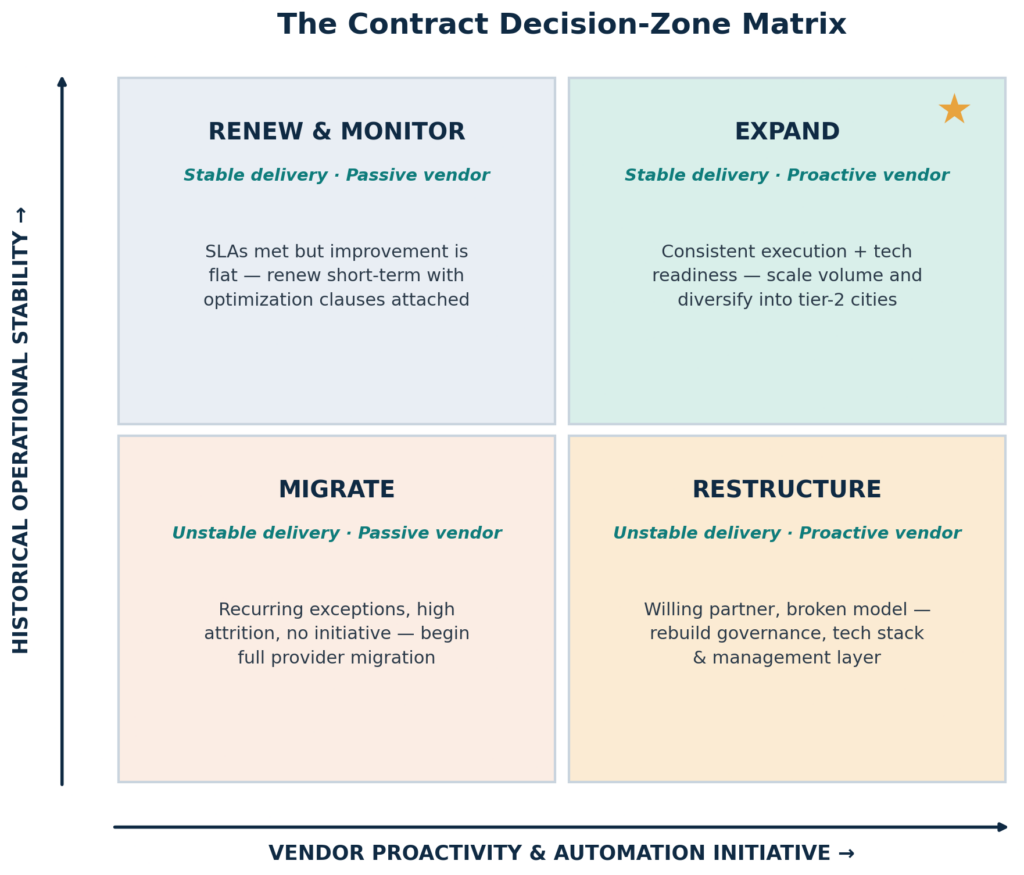
Figure 1. The contract decision-zone matrix: operational stability and vendor proactivity together indicate whether to expand, renew, restructure, or migrate.
How Do Corporate Buyers Select Between Scaling Up or Restructuring Ecosystems?
Expansion is warranted when an offshore unit consistently meets quality benchmarks and can absorb more complex, knowledge-based work — though scaling should diversify beyond a single tier-1 location. Restructuring is warranted when process exceptions recur, optimization stagnates, or attrition runs high; the fault is usually the management layer or tech mismatch, not frontline staff.
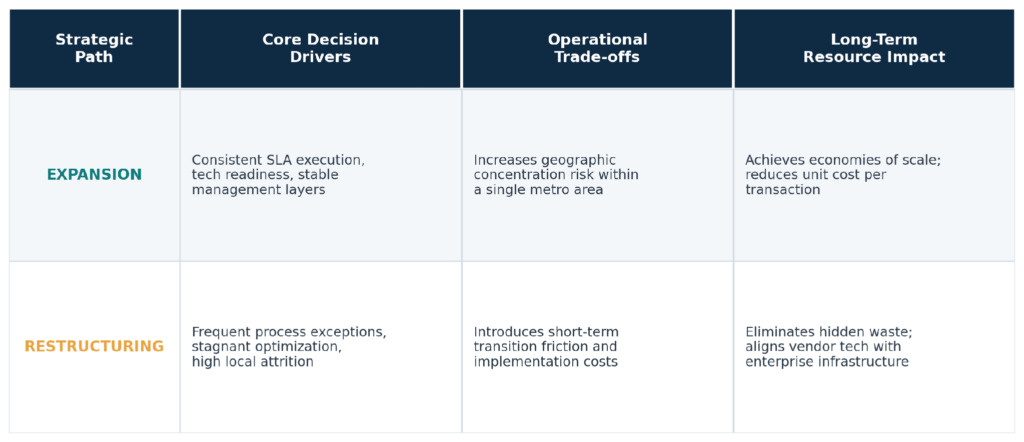
Figure 2. Decision drivers, trade-offs, and long-term resource impact for the two active strategic paths.
The paths carry different risk profiles. Expansion compounds what already works but concentrates geographic exposure if headcount simply stacks up in the same metro area — which is why mature expansions pair volume growth with tier-2 city diversification. Restructuring accepts short-term transition friction in exchange for eliminating hidden waste and realigning the vendor’s technology with enterprise infrastructure. Critically, before walking away from a provider entirely, enterprise leaders should evaluate whether shifting to a hybrid governance model can recover performance — full migration is the last resort, not the first response to a bottleneck. The decision tree below traces the full logic from problem discovery to strategic outcome:
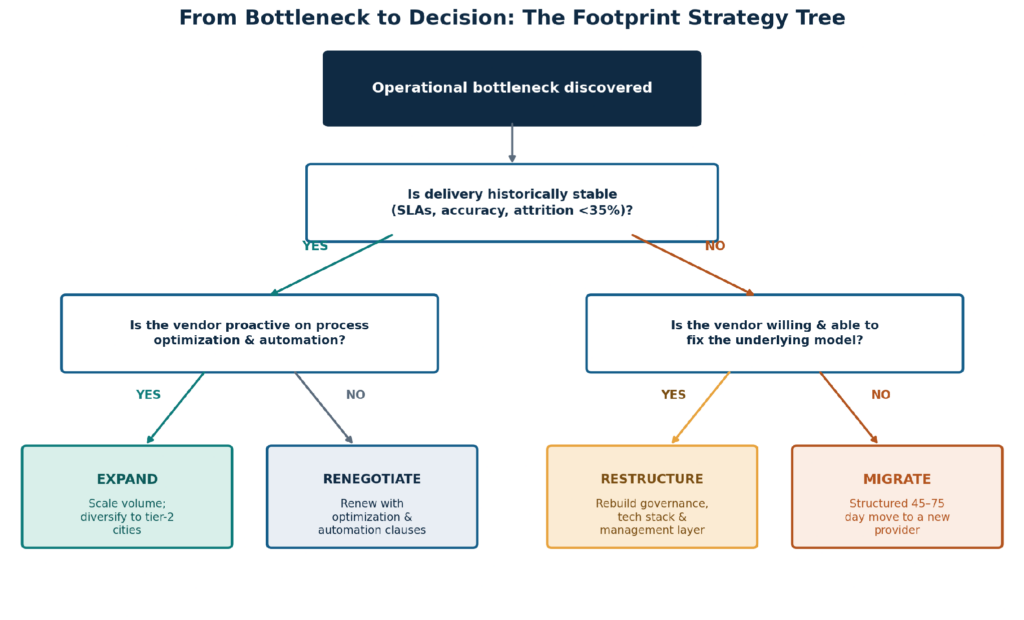
Figure 3. The footprint strategy tree: from operational bottleneck to expansion, renegotiation, restructuring, or full vendor migration.
How Does Automation Integration Shift the Lifecycle of an Offshore Operation?
Automation redefines vendor value: modern operations no longer rent headcount, they procure a digital-first delivery engine. The critical lifecycle question becomes how effectively the provider integrates automated tools with human work — and whether the commercial agreement rewards efficiency or quietly punishes it.
This is where legacy contract structures actively work against buyers. A provider billing purely by the hour profits from labor intensity, so every automation opportunity is a revenue threat to be deferred. Agreements structured around outcomes, transaction pricing, or gain-sharing invert the incentive: the provider now profits by pairing skilled Philippine professionals with intelligent tools that accelerate transaction speeds and absorb simple inquiries automatically. Automation competency should therefore be tested — not assumed — before any expansion or renewal: desktop environments, data architecture, and API compatibility either support modern automation pipelines or they cap the operation’s ceiling.
“A legacy provider focused solely on billing hours will naturally resist efficiencies that lower headcount requirements,” explains John Maczynski, CEO of PITON-Global. “Enterprise buyers must structure their agreements to reward providers who actively find ways to automate parts of their own workflows. The vendors driving the highest returns are those pairing skilled Philippine professionals with modern AI tools to accelerate transaction speeds.”
What Is the Operational Audit Lifecycle for Footprint Assessment?
The audit lifecycle runs in four phases: calculate the true total cost to serve, map attrition and knowledge leaks over 12 months, benchmark the partner’s automation competency, and match the audited data against long-term goals to finalize the strategy — renewal, tier-2 diversification, or full provider migration.
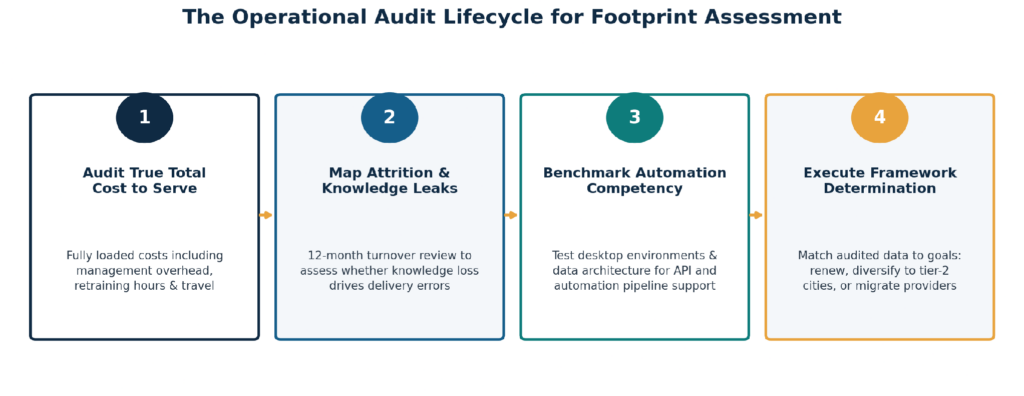
Figure 4. The four-phase operational audit lifecycle preceding any expand, renew, or restructure decision.
Phase one replaces the raw vendor hourly rate with fully loaded economics: internal management overhead, continuous retraining hours, and travel all belong in the cost base, and their inclusion frequently reverses which option looks cheapest. Phase two reviews localized turnover data over 12 months to assess whether persistent knowledge loss is causing down-funnel delivery errors. Phase three stress-tests the partner’s technical infrastructure — desktop environments, data architecture, endpoint security — for compatibility with modern enterprise APIs and secure automation pipelines. Phase four then matches the audited evidence against long-term business goals to finalize the framework determination. The sequence matters: deciding before auditing simply ratifies whichever narrative the incumbent vendor has supplied.
What Does a Footprint Restructuring Look Like in Practice?
In a representative engagement, a large telecommunications firm restructured a stagnant 150-FTE technical support operation rather than renewing its legacy Manila vendor. Migrating to an automation-ready boutique provider — with the footprint split between Manila and a tier-2 city — lifted first-contact resolution 22%, cut turnover from 42% to 14%, and reduced overhead 28%.
Client Challenge
The firm faced declining customer satisfaction and rising costs within a 150-FTE technical support team managed by a legacy offshore vendor in Manila — a classic renewal-risk profile: SLAs nominally met, improvement flat, attrition climbing.
Vendor Selection Process
The corporation turned to PITON-Global to move away from rigid, single-vendor frameworks. PITON-Global used its audited network of more than 100 specialized Philippine operators to identify a mid-market partner specializing in tech-enabled customer service.
Solution Implemented
- Guided a complete restructuring rather than a standard renewal, migrating the operation to a boutique provider that integrates frontline agents with real-time text analytics.
- Split the footprint between Manila and a lower-cost tier-2 city to manage geographic concentration risk.
- Restructured the commercial model around agent utilization and outcome metrics rather than billed hours.
Quantifiable Business Outcomes
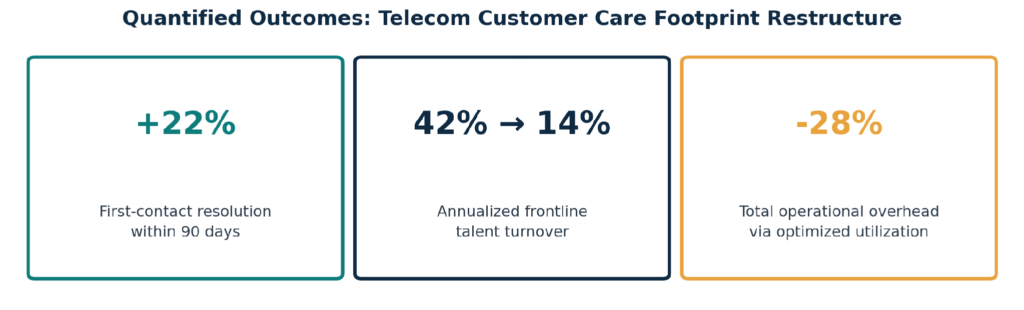
Figure 5. Measured results from the customer care footprint restructure.
Lessons Learned
Restructuring a stagnant team with an automation-ready partner delivers better long-term value than renewing a legacy contract that relies purely on low hourly rates. The cheapest bill rate and the lowest total cost to serve are rarely the same vendor.
What Is PITON-Global’s Role in the Outsourcing Ecosystem?
PITON-Global is an advisory-led outsourcing consultancy that removes the guesswork from expand, renew, and restructure decisions. Leveraging a vetted network of more than 100 premium Philippine operators, it matches enterprise buyers with partners aligned to their specific operational needs — backed by clear data and at no cost to the buyer.
Who Is PITON-Global?
PITON-Global is a Philippine-focused BPO advisory firm led by executives with decades of institutional outsourcing leadership. Within the Philippine market it acts as an independent guide for enterprise buyers navigating footprint transitions: auditing current operations, mapping the provider landscape, and steering expansion, renegotiation, or migration decisions. Its expertise spans provider technical maturity, pricing benchmarks, tier-2 market dynamics, and compliance frameworks.
How Does PITON-Global Differ from Traditional Outsourcing Brokers?
Traditional brokers are commission-driven: they profit from placements, which biases them toward migration even when renegotiation or restructuring would serve the client better. PITON-Global operates an advisory-led model built on independent provider evaluation — objectively assessing operational maturity, automation competency, management depth, and cultural fit. Recommendations rest solely on the client’s audited operational data and long-term goals, keeping the focus on client outcomes rather than provider promotion.
How Does PITON-Global’s Network of 100+ Vetted Philippine BPO Providers Benefit Organizations?
The Philippine landscape consists of hundreds of providers with varied levels of technical and operational maturity — and the boutique, automation-ready operators best suited to restructures rarely surface in generic directories. PITON-Global maintains a continuously audited ecosystem of more than 100 premium providers spanning customer care, technical support, back-office, and data operations across Manila, Cebu, and tier-2 cities. Because diligence on infrastructure, certifications, and track records has already been performed, buyers compress vendor discovery and qualification from months into weeks.
How Does PITON-Global’s Advisory-Led Vendor Matching Process Work?
Engagements follow a structured five-stage methodology. A footprint audit establishes the current operation’s true costs, attrition profile, and automation readiness. PITON-Global then filters its network to a shortlist with demonstrated strength in the relevant domain, scores each provider against the client’s technical, cultural, and scale criteria, and layers in risk-reduction measures — site diligence, security audits, and reference validation — before supporting evaluation, pricing benchmarking, and transition or migration planning.
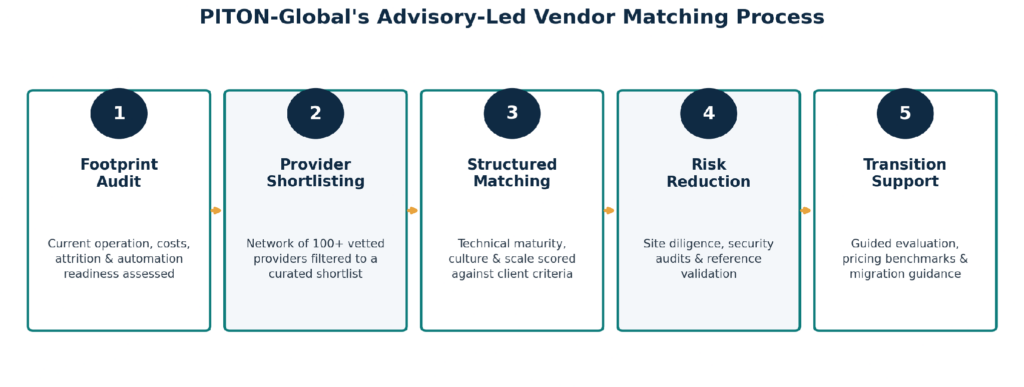
Figure 6. PITON-Global’s five-stage advisory-led vendor matching process, from footprint audit to transition support.
Why Do Organizations Use PITON-Global?
Enterprise buyers engage PITON-Global to de-risk footprint transitions, improve provider fit, and accelerate decisions. Whether the outcome is expanding an existing operation, renegotiating with the incumbent, or executing a full restructure, the advisory-led process grounds the choice in audited operational data and proven management capabilities — replacing incumbent-supplied narratives with independent evidence, at zero advisory cost.
What Are the Most Common Questions About BPO Footprint Decisions?
Buyers most often ask what attrition rate signals danger, how tier-2 cities compare to Manila, whether mid-term restructuring triggers penalties, how automation affects headcount plans, how long migrations take, and how to audit a vendor’s infrastructure. The answers below reflect established practice across mature Philippine engagements.
What attrition rate should be considered a warning sign during contract reviews?
Annualized frontline turnover exceeding 30–35% typically signals management or cultural issues within the local operation — and predicts hidden retraining costs and erratic delivery quality well before SLA metrics deteriorate.
How do tier-2 locations in the Philippines compare to Manila for expansion?
Tier-2 destinations offer 10–15% labor cost advantages and lower talent competition, making them excellent choices for scaling high-volume transactional work while maintaining stable, lower-attrition teams.
Can a corporate buyer restructure a contract mid-term without significant penalties?
Yes — provided the original agreement includes clear performance-based clauses, volume fluctuation provisions, and regular service-review milestones. Contracts lacking these levers should build them in at the next renewal.
How does tool integration impact headcount planning during an expansion?
Technologically mature providers deploy automated solutions that absorb simple inquiries, allowing buyers to scale transaction volumes without a linear increase in headcount — decoupling growth from cost for the first time.
What is the typical timeline for migrating an operation during a restructuring phase?
A structured migration — process mapping, secure technical integration, and parallel testing — generally takes 45 to 75 days to complete without disrupting live service.
How should organizations assess a vendor’s technical infrastructure prior to renewal?
Through independent IT architecture audits focusing on endpoint security tools, redundant network uplinks, power backup capacity, and native compatibility with client CRM systems — verified on site rather than accepted from sales documentation.
Achieve sustainable growth with world-class BPO solutions!
PITON-Global connects you with industry-leading outsourcing providers to enhance customer experience, lower costs, and drive business success.
Get Your Top 1% Vendor List
Author
Ralf Ellspermann is a multi-awarded outsourcing executive with 25+ years of call center and BPO leadership in the Philippines, helping 500+ high-growth and mid-market companies scale call center and customer experience operations across financial services, fintech, insurance, healthcare, technology, travel, utilities, and social media.
A globally recognized industry authority - and a contributor to The Times of India, CustomerThink, and The AI Journal - he advises organizations on building compliant, high-performance offshore contact center operations that deliver measurable cost savings and sustained competitive advantage.
Known for his execution-first approach, Ralf bridges strategy and operations to turn call center and business process outsourcing into a true growth engine. His work consistently drives faster market entry, lower risk, and long-term operational resilience for global brands.
EXECUTIVE GOVERNANCE & ACCURACY STANDARDS
Authored by:

Ralf Ellspermann
Founder & CSO of PITON-Global,
25-Year Philippine BPO Veteran,
Multi-awarded Executive
Specializing in strategic sourcing and excellence in Manila
View Full Bio
Verified by:

John Maczynski
CEO of PITON-Global, and former Global EVP of the World’s largest BPO provider | 40 Years Experience
Ensuring global compliance and enterprise-grade service standards
View Full Bio
Last Peer Review: July 10, 2026
This service framework is audited quarterly to meet shifting global outsourcing regulations and COPC standards.