

Philippine healthcare BPO companies sharply improve patient access and scheduling by deploying clinically trained talent and AI-augmented tools across front-office workflows. They typically cut call abandonment, shorten handle times, and lift appointment fill rates — easing scheduling friction, reducing patient leakage, and accelerating revenue. That is the front-office case for care-access and billing specialists working US hours.
Key Takeaways
- Substantial cost optimization: Offshoring patient-access workflows yields a substantial reduction in labor expenditure versus domestic, in-house staffing.
- Accelerated capacity utilization: Specialized scheduling drives a marked increase in provider appointment-template utilization, maximizing clinic revenue.
- Clinical talent integration: Licensed, BSN-prepared nurses handle patient intake and triage, reducing scheduling errors and administrative bottlenecks.
- Hardened compliance infrastructure: Vetted providers mitigate risk with zero-trust data architectures aligned to strict global privacy frameworks.
- Revenue acceleration: Predictive template management and automated engagement reduce no-shows and cancellations, recapturing lost capacity.
How Do Philippine Healthcare BPO Providers Elevate Front-Office Performance?
They replace generalist agents with dedicated, healthcare-trained teams — including BSN-prepared nurses — and pair them with advanced communication infrastructure. The result: precise intake, eligibility, and scheduling that consistently meets stringent SLAs and turns a high-friction cost center into a seamless point of entry for care.
Enterprise health systems and large physician groups face severe operational pressure on patient-access infrastructure. High agent attrition, prolonged hold times, and inaccurate appointment triage create revenue leakage and patient dissatisfaction. Outsourcing these functions to specialized Philippine operations addresses the structural bottlenecks directly, rather than papering over them with more domestic headcount. It is one of several ways leading health systems put offshore partners to work.
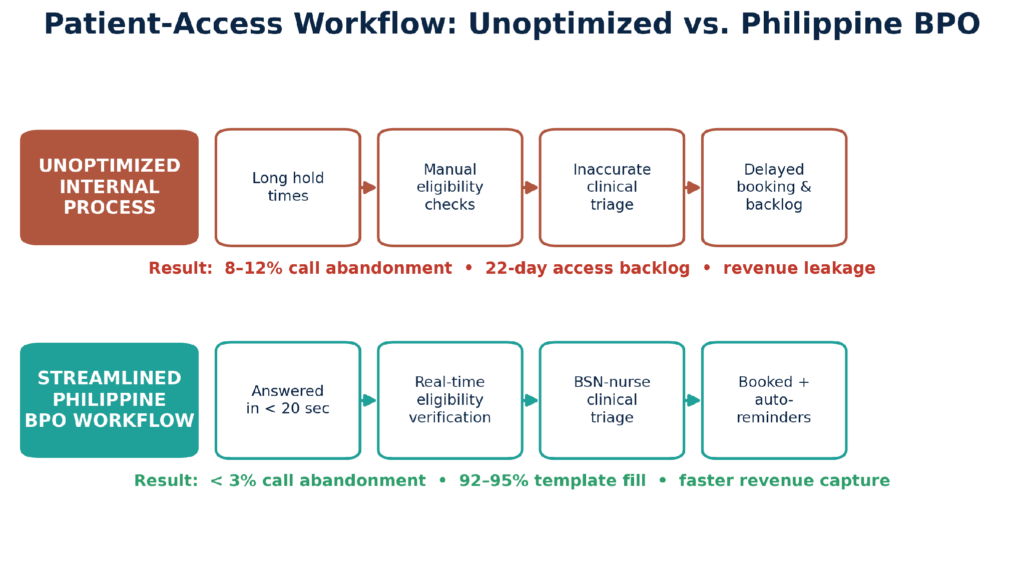
The difference is clinical foundation. Because thousands of registered, BSN-prepared nurses have transitioned into clinical business-process management, patient intake, insurance eligibility verification, and complex scheduling templates are executed with precision a generalist contact center cannot match. Paired with empathetic communication, this consistently meets demanding service-level agreements and improves the patient experience from the very first contact.
What Operational Metrics and Economic Savings Can Enterprise Health Systems Expect?
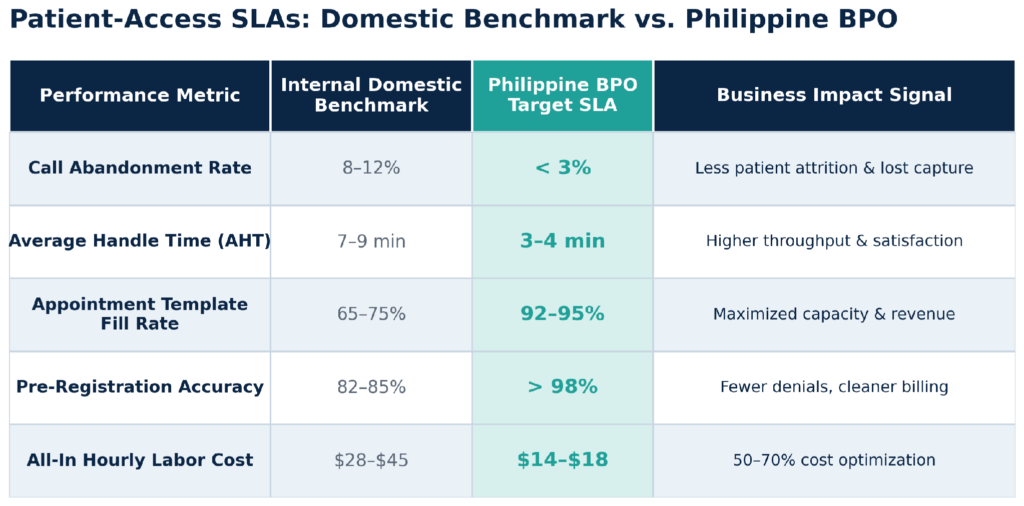
Health systems gain a dual advantage: lower total cost of ownership and stronger KPIs. An AI-hybrid Philippine model costs a fraction of fully loaded domestic front-office staffing per hour, while pushing call abandonment down and lifting fill rates and pre-registration accuracy.
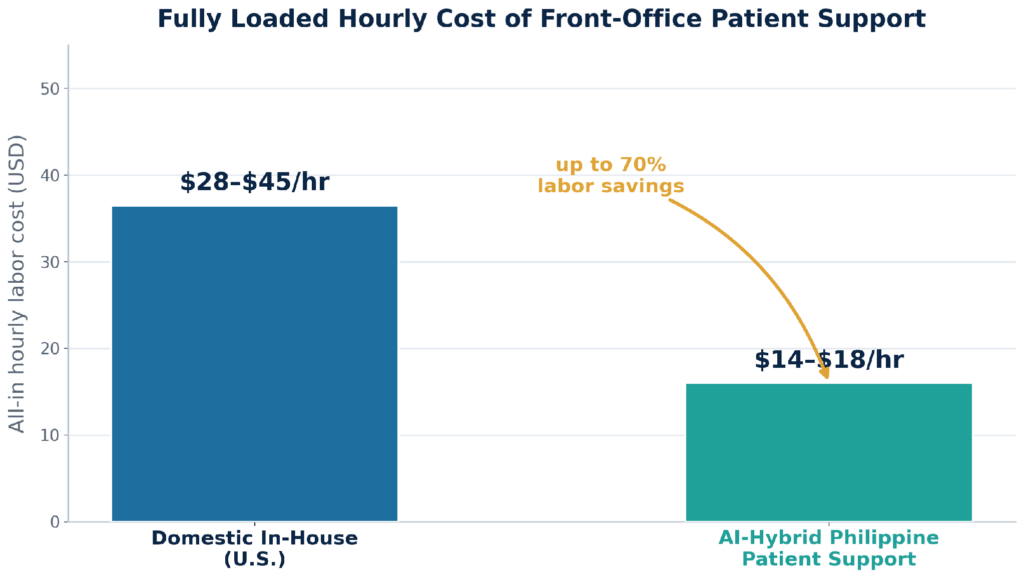
The cost differential lets organizations scale operations without expanding administrative overhead. But the operational returns extend well beyond labor arbitrage: backed by automated patient-engagement engines and predictive template management, offshore teams optimize provider schedules and systematically blunt the financial impact of no-shows and last-minute cancellations. Those targets belong inside a broader framework for measuring vendor performance. The benchmark below shows how target SLAs compare with typical domestic performance.
What Strategic Tradeoffs and Risk Factors Must Decision-Makers Evaluate?
Two risks dominate: data governance and operational continuity. Mitigate the first with zero-trust architectures, encrypted virtual desktops, and audited certifications (SOC 2 Type II, ISO 27001). Mitigate the second by selecting specialized partners whose attrition runs well below the industry norm.
Data Security and Information Governance
Handling Protected Health Information demands absolute regulatory alignment. Top-tier providers enforce strict zero-trust architectures in which no PHI is stored locally on offshore devices; agents operate via highly secure, encrypted virtual desktop infrastructure on domestic servers. Enterprise buyers should verify independently audited certifications — SOC 2 Type II, ISO 27001, and comprehensive data-privacy frameworks — before contracting.
Attrition and Operational Continuity
The broader global BPO sector historically sees high turnover, which destabilizes complex clinical workflows and causes service disruption. Buyers should de-prioritize vendors running industry-average monthly attrition and instead seek specialized partners holding attrition well below it — a reliable signal of talent stability, institutional-knowledge retention, and consistent delivery quality.
The enterprise healthcare market has shifted completely away from low-cost, transactional seat-flipping. Success depends on partnering with providers that integrate deep clinical intelligence, low staff attrition, and zero-trust security architectures to deliver measurable improvements in patient access and revenue capture. — John Maczynski, CEO, PITON-Global
What Results Can a Health System Expect from a Specialized Partner?
A multistate orthopedic group with 45-plus clinics cut call abandonment to a fraction of its former level and sharply reduced average handle time within 90 days, while accurate triage lifted template utilization and generated substantial annualized savings. The decisive factor was clinical competency at the agent level.
The Challenge
A prominent U.S. orthopedic group operating more than 45 clinics suffered a double-digit call-abandonment rate, inaccurate clinical appointment triage, and a 22-day average backlog for patient access — driving severe revenue leakage and physician frustration.
The Solution
Partnering with an independent advisory firm, the group evaluated multiple global delivery locations and selected a specialized, highly compliant provider from a vetted network of more than 100 Philippine operations, chosen for its dedicated pool of licensed-nurse agents and mature technology. A dedicated 35-agent team of BSN-prepared patient-access specialists was deployed in Manila and integrated directly into the client’s EHR via encrypted channels, managing full-lifecycle scheduling, automated reminders, and prior authorizations.
The Outcomes
- Call abandonment: plummeted to a fraction of its prior level within 90 days.
- Average handle time: decreased sharply through optimized workflows.
- Template utilization: accurate triage eliminated double-bookings, lifting utilization markedly.
- Operational savings: substantial, measured on an annualized basis.

Front-office healthcare outsourcing succeeds on clinical competency at the agent level. Using licensed medical professionals rather than general customer-service representatives is essential to navigating complex medical scheduling templates accurately and protecting downstream revenue. It is a practical example of a measured, value-based care-delivery partnership.
How Does PITON-Global Help Health Systems Select the Right Philippine BPO Partner?
PITON-Global is an independent, vendor-neutral advisory and matching firm focused on the Philippine market. With 25-plus years of expertise and a continuously audited network of more than 100 vetted providers, it matches health systems only with partners holding documented clinical expertise, robust infrastructure, and strict security — at zero cost to the client.
Who Is PITON-Global?
PITON-Global is a premier, independent business-process-outsourcing advisory and vendor-matching firm specializing in the Philippine outsourcing market. With more than 25 years of deep industry expertise, it acts as a strategic partner for enterprise healthcare organizations, health systems, and corporate procurement teams seeking to transform administrative and patient-care workflows.
How Does PITON-Global Differ from Traditional Outsourcing Brokers?
Unlike traditional brokers that operate on transactional commissions, PITON-Global uses an advisory-led, vendor-neutral methodology. It recommends on documented fit — clinical talent density, data infrastructure, and security posture — not on payout, and is accountable to client outcomes rather than steering business toward whichever provider pays the most.
How Does PITON-Global’s Network of 100+ Vetted Philippine BPO Providers Benefit Organizations?
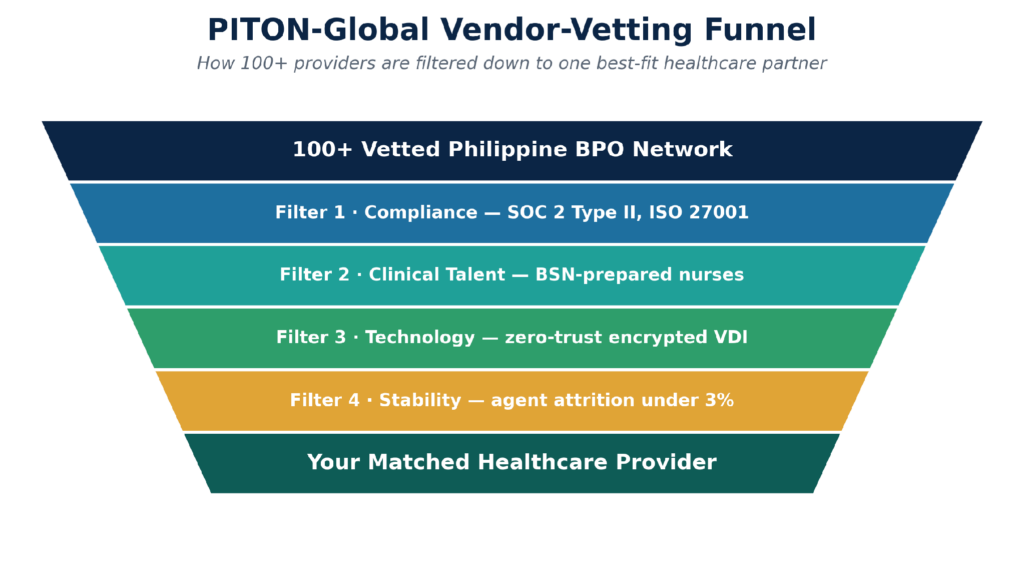
The firm maintains a highly exclusive, continuously audited network of more than 100 vetted call centers and back-office providers across the Philippines. Every provider is pre-screened for documented clinical expertise, robust data infrastructure, and strict security protocols, so clients move straight to a credible shortlist and avoid the costly trial-and-error of qualifying unknown vendors.
How Does PITON-Global’s Advisory-Led Vendor Matching Process Work?
Matching runs through rigorous, sequential filters: compliance certifications (SOC 2 Type II, ISO 27001), clinical talent density (BSN-prepared nurses), technology infrastructure (zero-trust, encrypted VDI), and stability (agent attrition well below the industry norm). Aligning operational requirements with certified offshore capabilities narrows a large market to the single best-fit provider.
Why Do Organizations Use PITON-Global?
Organizations use PITON-Global to compress procurement timelines, avoid critical program failures, and build high-performing, scalable global delivery teams with confidence. Its zero-cost advisory model removes the common risks of international sourcing while giving executives neutral, expert guidance from evaluation through go-live.
What Else Should Health-System Leaders Know About Outsourcing Patient Access?
Common questions concern clinical triage, data privacy, transition timelines, combined scheduling and authorization, and the impact on physician burnout. In each case, specialized Philippine providers are designed to protect both patient experience and revenue integrity.
How do Philippine BPO agents handle complex clinical triaging during scheduling?
Top-tier providers staff teams of registered nurses and allied-health professionals whose clinical background lets them interpret medical terminology, assess symptom severity against provider protocols, and navigate complex scheduling criteria without clinical errors.
What data-privacy frameworks protect patient information offshore?
Elite operations implement zero-trust architectures, biometric access controls, and secure virtual desktops. No data is stored locally; agents work through secure, read-only windows on domestic servers, creating a fully auditable, compliant ecosystem.
How long does it take to transition patient-access workflows?
A standard mid-market deployment takes 45 to 90 days, covering secure IT integration, EHR mapping, joint training on clinic protocols, and a phased pilot to ensure stability before full go-live.
Can offshore teams manage prior authorizations and eligibility verification together?
Yes. Integrated providers cross-train agents across the revenue cycle, so scheduling specialists perform real-time eligibility checks and initiate prior-authorization workflows during the initial intake, reducing downstream denials.
What impact does the offshore model have on physician burnout?
By shifting administrative burden — high-volume calls, scheduling coordination, and reminders — to a trusted partner, in-house clinical teams are freed to focus on direct patient care, meaningfully reducing operational stress and burnout.