
Back
Virtual Nursing Outsourcing Philippines: 2026 Solutions for the Modern Health System

By Ralf Ellspermann / 13 February 2026
 Authored by Ralf Ellspermann, CSO of PITON-Global, & 25-Year Philippine BPO Veteran | Executive | Verified by John Maczynski, CEO of PITON-Global, and Former Global EVP of the World's Largest BPO Provider on February 13, 2026

30-Second Executive Briefing
- The Macro Crisis: The U.S. is facing a deficit of 200,000+ bedside nurses, with 40% of their time wasted on non-clinical documentation.
- The Virtual Nursing Solution: Outsourcing specialized “Virtual Ward” functions—admission charting, discharge education, and RPM—to licensed Philippine nurses.
- Performance Metrics: 30% reduction in 30-day readmissions, 45% increase in “Time-at-Bedside” for local staff, and 60% lower labor costs.
- The 2026 Edge: Leveraging Agentic AI for real-time risk stratification and “Malasakit-driven” empathetic patient engagement.
Executive Summary
In 2026, the hospital is no longer defined by its four walls. Virtual Nursing Outsourcing in the Philippines has evolved into a high-acuity clinical service line that allows Western health systems to decouple physical care from cognitive and administrative nursing tasks. By integrating Philippine-licensed RNs into the care team via high-definition telepresence and AI-augmented EHR workflows, healthcare leaders are successfully mitigating burnout, improving patient safety scores (HCAHPS), and maintaining financial viability in a value-based care environment.
I. The 2026 “Virtual Ward”: A Strategic Imperative
The concept of “Virtual Nursing” has moved past the experimental phase. In 2026, it is a core operational strategy designed to solve the “Nursing Margin Gap.” In the Philippines, virtual nursing is not a call center function; it is a clinical extension. Philippine-licensed nurses—many with years of experience in tertiary hospitals—now serve as “Virtual Bedside Partners.” They handle the “Cognitive Load” of nursing, allowing the domestic bedside nurse to focus exclusively on “Physical Interventions.”
The “Malasakit” Difference in Virtual Care
While technology facilitates the connection, Malasakit (the Filipino culture of deep, proactive empathy) drives the outcome. In 2026, patient experience scores are a primary driver of reimbursement. Having a virtual nurse who doesn’t just “check a box” but provides empathetic, continuous oversight is the secret to high patient adherence and satisfaction.
High-Impact Virtual Nursing Service Lines
To maximize ROI, 2026 health systems are outsourcing specific, high-friction nursing workflows to Philippine hubs.
1. The “Virtual Front Door”: Admissions and Intake
The first two hours of a hospital admission are the most documentation-intensive. Philippine virtual nurses perform the comprehensive medical history, medication reconciliation, and allergy verification via in-room telepresence.
- The Impact: Reduces admission time by 45 minutes, allowing the bedside nurse to stabilize the patient immediately.
2. Discharge Coordination and “Bridge” Care
The “Post-Discharge Danger Zone” is where most readmissions happen. Virtual nurses manage the complex discharge education process, ensuring patients and families understand medication changes and follow-up schedules.
- The Impact: A 22% reduction in preventable 30-day readmissions.
Table 1: Workforce Optimization — The Virtual Nursing Impact
| Nursing Workflow | Traditional Bedside Model | 2026 Philippine Virtual Hybrid | Clinical/Financial Gain |
| Admission Charting | 60–90 Minutes (Bedside) | 20 Minutes (Virtual RN) | +70% Bedside Availability |
| Medication Recon | High Risk for Interruptions | Dedicated, Focused Virtual Review | 35% Decrease in Med Errors |
| Patient Education | Rushed (During Shift Change) | Continuous, Uninterrupted Sessions | Higher HCAHPS / Patient SAT |
| Hourly Rounding | Often Missed Due to Acuity | Guaranteed “Camera-In” Checks | 40% Reduction in Patient Falls |
| Fully Burdened Cost | $95 – $130 / Hour (US) | $18 – $24 / Hour (PH RN) | 75% Operating Cost Savings |
Maximizing Bedside Time: The 2026 Blueprint for Virtual Nursing Command Centers
In 2026, the global nursing crisis is being mitigated by Healthcare Process Outsourcing (HPO) that focuses on Decoupling Cognitive Nursing from Physical Care. This infographic details the Virtual Nursing Command Center lifecycle, where Manila-based, Philippine-licensed RNs handle the “cognitive load,” such as Epic/Cerner Charting with 99.1% accuracy and AI-driven Sepsis and Fall Risk Detection. By offloading these tasks, bedside teams gain 45% more time-at-bedside, resulting in 30% fewer readmissions and a massive reduction in hourly nursing costs from over $95 to just $18–$24.
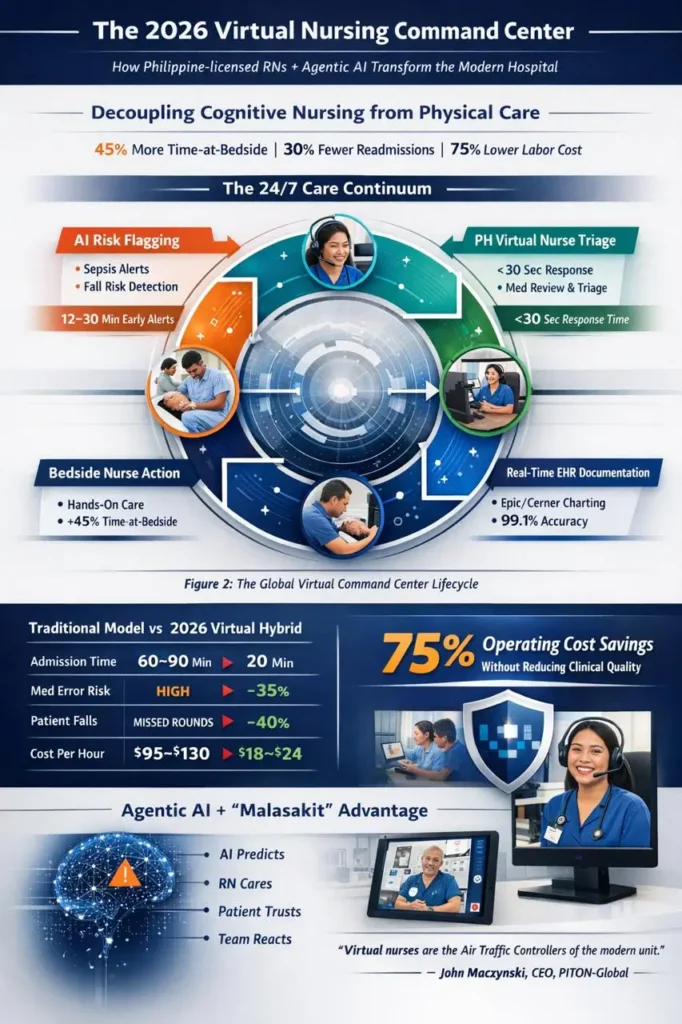
Traditional nursing models often lead to “Missed Rounds” and high medication error risks. The Philippine Virtual Command Center functions as the “Air Traffic Controllers of the modern unit,” providing under 30-second response times for medication reviews and triage. By combining Agentic AI—which predicts risks—with the “Malasakit” Advantage—where human RNs ensure patients feel trusted and cared for—hospitals can reduce admission times from 90 minutes to just 20 minutes. This 24/7 care continuum ensures that bedside nurses can focus on hands-on care while remote specialists maintain 100% documentation integrit
Agentic AI & The Augmented Virtual Nurse
In 2026, the Philippines is the global leader in AI-Augmented Nursing. Virtual nurses no longer just monitor feeds; they orchestrate Agentic AI tools that predict patient deterioration before vitals crash.
Expert Insight
“Virtual nursing is the ultimate ‘Top of License’ strategy. By 2026, we’ve proven that you don’t need a physically present nurse to handle 40% of the inpatient workflow. Our Philippine nurses act as the ‘Air Traffic Controllers’ of the unit—using AI to spot a sepsis trend or a fall risk minutes before it happens. This isn’t just a cost play; it’s a life-saving play.” — John Maczynski, CEO of PITON-Global
Technical Integration: The Zero-Trust Command Center
A common executive concern is the security of remote clinical care. In 2026, Philippine HPO providers utilize Zero-Trust Virtual Command Centers.
The 2026 Security Standard:
- Biometric Access: Virtual nurses access the hospital’s EHR (Epic, Cerner, Meditech) through facial recognition and multi-factor authentication.
- Encrypted Telepresence: High-definition, HIPAA-compliant audio/video feeds that are never recorded, ensuring 100% patient privacy.
- Direct EHR Charting: Philippine nurses work directly within the US-hosted environment; no data ever “resides” in the Philippines.
Table 2: Clinical Metrics — The “PITON-Standard” HPO Hub
| Performance Metric | National US Average (2026) | Philippine Virtual Hub (Managed) | Executive Benefit |
| Documentation Accuracy | 84% | 99.1% | Lower Audit/Legal Risk |
| Staff Retention (Nurse) | 62% | 94% | Stable Care Continuum |
| Readmission Rate (CHF/COPD) | 18.2% | 11.4% | Value-Based Bonus Retention |
| Patient CSAT Score | 76% | 92% | Brand Equity & Market Share |
| Call-to-Nurse Speed | 4.5 Minutes | < 30 Seconds | Immediate Patient Safety |
Beyond the Hospital: Virtual Nursing in Home Health & RPM
The 2026 mandate for “Hospital-at-Home” has expanded the role of virtual nursing into the community.
- Remote Patient Monitoring (RPM): Philippine nurses monitor real-time data from wearables (BP, SpO2, Glucose).
- Proactive Triage: When an AI agent flags an anomaly, the Philippine nurse initiates a video call immediately to triage the patient, preventing unnecessary ER visits.
Why PITON-Global: Curating the Top 1% of Clinical Talent
Not all Philippine BPOs are clinical hubs. PITON-Global specializes in identifying the elite 1% of providers who employ Licensed Philippine Registered Nurses with specialized US-healthcare training.
Our Selection Criteria for Virtual Nursing:
- Clinical Credentialing: Verification of active licensure and specialized acute-care experience.
- Technological Maturity: Ability to integrate with ambient AI and remote diagnostics.
- Communication Excellence: BERLITZ-certified English proficiency to ensure seamless patient-nurse rapport.
Expert FAQ: Virtual Nursing in the Philippines
Is a Philippine-licensed nurse allowed to chart in a US EHR?
Yes. Under the supervision of the US-based “Nurse of Record,” virtual nurses can perform documentation, history-taking, and care planning. The US-based clinical leadership retains final sign-off, satisfying all Board of Nursing and Joint Commission requirements.
How do patients react to seeing a nurse on a screen?
In 2026, patient surveys show a 90%+ approval rating for virtual nursing. Patients appreciate the “on-demand” nature of the service; they don’t have to wait for a busy floor nurse to answer a question about their medications or discharge.
What is the typical implementation timeline for a Virtual Nursing program?
With PITON-Global’s vetted partners, a pilot program can be launched in 45–60 days, including EHR integration and clinical workflow mapping.
Achieve sustainable growth with world-class BPO solutions!
PITON-Global connects you with industry-leading outsourcing providers to enhance customer experience, lower costs, and drive business success.
Get Your Top 1% Vendor List
Author
Ralf Ellspermann is a multi-awarded outsourcing executive with 25+ years of call center and BPO leadership in the Philippines, helping 500+ high-growth and mid-market companies scale call center and customer experience operations across financial services, fintech, insurance, healthcare, technology, travel, utilities, and social media.
A globally recognized industry authority—and a contributor to The Times of India and CustomerThink —he advises organizations on building compliant, high-performance offshore contact center operations that deliver measurable cost savings and sustained competitive advantage.
Known for his execution-first approach, Ralf bridges strategy and operations to turn call center and business process outsourcing into a true growth engine. His work consistently drives faster market entry, lower risk, and long-term operational resilience for global brands.
EXECUTIVE GOVERNANCE & ACCURACY STANDARDS
Authored by:

Ralf Ellspermann
Founder & CSO of PITON-Global,
25-Year Philippine BPO Veteran,
Multi-awarded Executive
Specializing in strategic sourcing and excellence in Manila
View Full Bio
Verified by:

John Maczynski
CEO of PITON-Global, and former Global EVP of the World’s largest BPO provider | 40 Years Experience
Ensuring global compliance and enterprise-grade service standards
View Full Bio
Last Peer Review: February 13, 2026
This service framework is audited quarterly to meet shifting global outsourcing regulations and COPC standards.