
Back
Retail Omnichannel Support Outsourcing Philippines: Synchronizing the 2026 Unified Commerce Journey

By Ralf Ellspermann / 12 February 2026
30-Second Executive Briefing
- The Conflict: In 2026, “multi-channel” is a legacy term representing fragmented data silos. Brands using disconnected support channels lose 12–18% of their margins to operational friction.
- The Transformation: Modern retail demands Unified Commerce Orchestration. This moves the “Single Source of Truth” from static software to human-in-the-loop specialists in the Philippines.
- The Advantage: Utilizing Agentic AI, Philippine hubs don’t just “talk” to customers—they execute cross-platform workflows (Shopify, NetSuite, TikTok Shop) in real-time.
- The ROI: Retailers realize a 35% increase in Cross-Channel Conversion and a 65% reduction in total cost of ownership compared to onshore operations.
Executive Summary
As we navigate 2026, the retail industry has moved beyond the simple “buy and ship” model into a complex, decentralized ecosystem of “everywhere commerce.” For the modern consumer, the brand is a single entity, whether they are interacting with an AI-driven TikTok ad, a Shopify storefront, or a physical retail kiosk. However, behind the scenes, most retailers struggle with the “Silo Tax”—the high cost of fragmented data and disconnected customer service.
The Philippines has emerged as the global epicenter for Retail Omnichannel Support Outsourcing, transitioning from a labor-cost play to a high-value “Intelligence Arbitrage” model. By centralizing operations in Manila, brands can bridge the gap between digital discovery and physical fulfillment. This article explores how Philippine-based unified hubs leverage Agentic AI and high-EQ talent to orchestrate seamless customer journeys that drive both immediate revenue and long-term brand equity.
Synchronizing the 2026 Unified Journey: The Philippine Model
In 2026, the “Silo Tax” is a margin-killer. This infographic details the Unified Commerce Nervous System, where Philippine hubs act as the strategic brain of retail. Moving beyond fragmented “multi-channel” support, Manila-based “Unified Commerce Pilots” manage a single source of truth across Shopify, TikTok Shop, and physical POS systems. By leveraging Agentic AI to execute cross-platform workflows—like instantly reflecting an Instagram return in the brand’s ERP—these hubs achieve a 94% cross-channel resolution rate. This model eliminates operational friction, reduces costs by 65%, and ensures a consistent, high-EQ “Malasakit” experience that turns every discovery into a lifelong advocate.
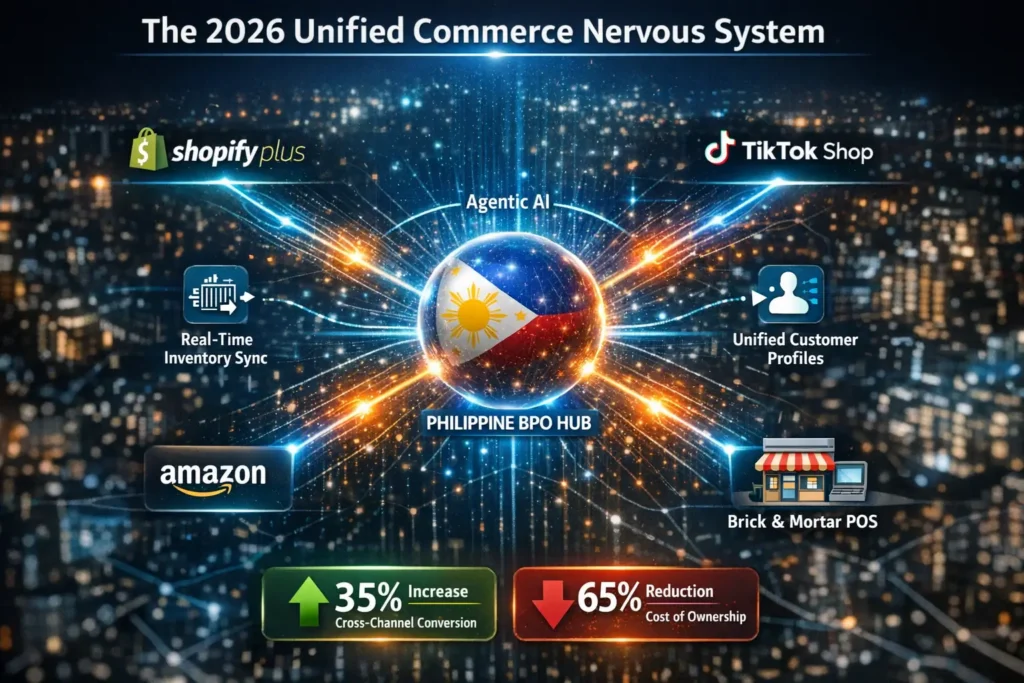
The 2026 Unified Commerce Nervous System”—illustrates how Philippine-based Omnichannel Command Centers eliminate the 12–18% “Silo Tax” caused by fragmented retail systems. At the core is a centralized Manila hub functioning as the brand’s operational brain, connected through Agentic AI orchestration to Shopify Plus, TikTok Shop, Amazon, and physical POS environments.
The infographic highlights the shift from disconnected multi-channel support to true Unified Commerce Orchestration—where real-time inventory synchronization, unified customer profiles, and cross-platform workflow execution operate as a continuous, intelligent loop. In this architecture, Agentic AI handles high-speed API integrations and automated marketplace actions, while high-EQ Filipino specialists serve as Human-in-the-Loop pilots, resolving complex edge cases, protecting seller ratings, and preventing cart abandonment.
I. Beyond Multi-Channel: The Rise of Unified Commerce
The retail landscape of 2026 has rendered traditional “multi-channel” support obsolete. In the legacy model, email, chat, and voice operated as separate tickets, often managed by different teams with different data. Today, the customer is the center of a “Nervous System” that includes social commerce, mobile apps, and physical pop-ups.
Retail Omnichannel Support Outsourcing in the Philippines has evolved into a strategic command center. It’s no longer about answering a phone; it’s about Data Orchestration. Filipino specialists are now trained as “Unified Commerce Pilots,” managing the customer’s “Digital Twin” across every touchpoint. This ensures that a return started on Instagram can be resolved seamlessly via a live chat on a Shopify Plus storefront, with the refund instantly reflected in the brand’s ERP.
II. Intelligence Arbitrage: The Expert Perspective
The move to the Philippines is no longer driven solely by labor arbitrage (saving on wages), but by Intelligence Arbitrage (gaining a superior operational engine). This shift is critical as AI begins to automate routine tasks, leaving the “complex middle” to human experts.
“In 2026, the brands that win are those that eliminate the friction between discovery and delivery,” notes John Maczynski, CEO of PITON-Global. “A Philippine omnichannel hub isn’t just a support center; it is the primary engine of global expansion. We aren’t just saving retailers money; we are embedding a high-EQ, AI-augmented operational moat into their brand that competitors simply cannot replicate at home. It’s about being faster, smarter, and more unified than the market.”
III. Strategic Comparison: Legacy vs. 2026 Unified Models
| Metric | Legacy Siloed Model | Philippine Unified Hub (2026) | Strategic Impact |
| Cross-Channel Resolution | 42% (Fragmented) | 94% (Synchronized) | 52% Higher Efficiency |
| Response Latency | 2-4 Hours | <15 Minutes (24/7) | Prevents Cart Abandonment |
| Tech Integration | Manual API sync | Agentic AI Orchestration | Reduces Manual Error by 88% |
| Fully Burdened Cost | $45 – $65/hr (Onshore) | **$14 – $22/hr** | 60-70% Margin Recovery |
IV. Technical Edge: Agentic AI & Marketplace Harmonization
In 2026, the complexity of managing global marketplaces—Amazon, Walmart, eBay, and regional players like Mercado Libre—is the number one cause of operational failure for mid-market brands. Philippine omnichannel hubs act as the Marketplace Harmonizer. By utilizing Agentic AI, these hubs monitor “Account Health” signals in real-time. If a logistics delay occurs in a US-based 3PL warehouse, the Manila-based specialist doesn’t just wait for a customer to complain. They execute a bulk-messaging protocol via the marketplace’s API to manage expectations, protecting the brand’s seller rating and preventing account suspensions that can cost millions in lost revenue.
Furthermore, these specialists are adept at Social Commerce Orchestration. In the era of TikTok Shop and Instagram Shopping, the line between social media moderation and sales is gone. Philippine teams manage high-velocity live-stream comments and DMs, using Predictive Intent Scoring to identify “High-Value Buyers” in the chat. By engaging these customers with high-EQ conversation while simultaneously checking real-time stock levels, they transform a social interaction into a confirmed transaction without the customer ever leaving their favorite app.
V. The “Malasakit” Factor in a Digital Age
While the technology stack of 2026 is formidable, the “secret sauce” of Philippine outsourcing remains the cultural concept of Malasakit—a deep, inherent sense of ownership and care. In an omnichannel environment, where a customer might interact with a brand five times before buying, this empathy is the difference between a one-time transaction and a lifelong advocate. Filipino agents don’t just close tickets; they manage relationships, ensuring that the brand’s voice is consistent whether the interaction is a technical support query or a VIP loyalty reward.
Expert FAQs: The 2026 Omnichannel Playbook
Q1: What is the primary difference between traditional BPO and a 2026 Philippine Unified Hub?
A: The difference is “Actionability.” Legacy BPOs followed rigid scripts. A 2026 Philippine hub uses Agentic AI to execute complex workflows. An agent in Manila can authenticate a user via behavioral biometrics, check real-time inventory in a local warehouse, and trigger a partial refund or re-route a shipment autonomously across multiple platforms like Shopify and NetSuite.
Q2: How does omnichannel outsourcing impact customer loyalty?
A: It creates Predictive Trust. When a customer doesn’t have to repeat their story or order number across different channels, their perceived value of the brand increases. By centralizing operations in the Philippines, brands can afford to provide 24/7 high-EQ support that feels “onshore” but operates with a level of global efficiency.
Q3: Can these hubs manage physical store data and B&M integration?
A: Absolutely. In the 2026 Unified Commerce model, Philippine teams manage the back-end synchronization between e-commerce platforms and physical POS (Point of Sale) systems. This enables high-value services like “Buy Online, Return In-Store” (BORIS) and “Ship from Store,” with Manila-based specialists handling the logistics exceptions.
Achieve sustainable growth with world-class BPO solutions!
PITON-Global connects you with industry-leading outsourcing providers to enhance customer experience, lower costs, and drive business success.
Get Your Top 1% Vendor List
Author
Ralf Ellspermann is a multi-awarded outsourcing executive with 25+ years of call center and BPO leadership in the Philippines, helping 500+ high-growth and mid-market companies scale call center and customer experience operations across financial services, fintech, insurance, healthcare, technology, travel, utilities, and social media.
A globally recognized industry authority—and a contributor to The Times of India and CustomerThink —he advises organizations on building compliant, high-performance offshore contact center operations that deliver measurable cost savings and sustained competitive advantage.
Known for his execution-first approach, Ralf bridges strategy and operations to turn call center and business process outsourcing into a true growth engine. His work consistently drives faster market entry, lower risk, and long-term operational resilience for global brands.