
Back
Retail Multilingual Support Outsourcing Philippines: Orchestrating a 2026 Global Polyglot Strategy
By Ralf Ellspermann / 12 February 2026
 Authored by Ralf Ellspermann, CSO of PITON-Global, & 25-Year Philippine BPO Veteran | Executive | Verified by John Maczynski, CEO of PITON-Global, and Former Global EVP of the World's Largest BPO Provider on February 12, 2026

30-Second Executive Briefing
- The Conflict: Legacy multilingual support requires fragmented teams across several time zones, leading to “Brand Drift” and inconsistent data.
- The Transformation: In 2026, the Philippines has emerged as the Single-Hub Global Engine, centralizing 50+ languages through a combination of native-level human polyglots and Agentic AI Translation Layers.
- The Advantage: Brands no longer need separate BPOs for EMEA, LATAM, and APAC. One Manila-based hub provides 24/7 Zero-Latency Support in Spanish, Mandarin, Japanese, and major European languages.
- The ROI: Centralization delivers a 45% reduction in management overhead and a 25% uplift in Global CSAT through unified brand voice and synchronized data.
Executive Summary
For global retailers in 2026, the primary barrier to expansion isn’t logistics—it’s the Language Gap. Modern consumers demand support in their native tongue, yet managing a patchwork of regional BPOs in Europe, Asia, and the Americas creates massive operational friction and “data silos.”
The Philippines has solved this through the Single-Hub Strategy. By leveraging its unique educational system and a growing pool of expatriate and heritage speakers, the country has become the premier destination for Retail Multilingual Support Outsourcing. This model allows brands to manage their entire global customer footprint from a single command center in Manila or Cebu. Supported by Agentic AI translation overlays, Philippine-based polyglot teams provide the high-EQ, native-feeling interactions that drive loyalty in diverse markets, from luxury fashion in Milan to consumer electronics in Tokyo.
Orchestrating the 2026 Global Polyglot Strategy: The Philippine Model
In 2026, fragmented regional BPOs are a liability. This infographic details the Single-Hub Global Command Center, where the Philippines centralizes 50+ languages from a single location. By utilizing Agentic AI Translation Layers on top of high-IQ polyglot talent, Manila-based hubs eliminate “Brand Drift” and data silos. These “Super-Agents” use sentiment-aware AI to provide cultural overlays in real-time, ensuring that a luxury customer in Milan or a tech buyer in Tokyo receives a native-feeling experience. This model delivers a 45% reduction in management friction and provides a “Global Source of Truth” that allows for instant strategic pivoting across all territories.
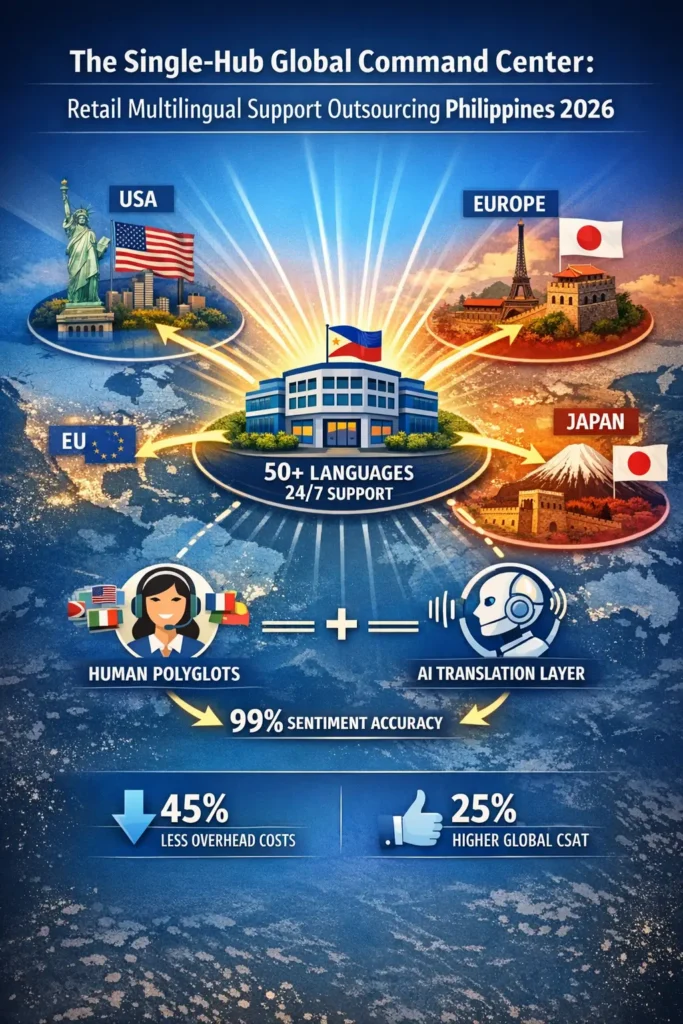
This visual guide presents the Single-Hub Global Command Center model, showing how a centralized Philippine multilingual hub supports 50+ languages across the US, Europe, China, and Japan from one synchronized 24/7 operation. It illustrates the shift from fragmented regional BPO structures to a unified 2026 architecture powered by Human Polyglots + Agentic AI Translation Overlays—delivering 99% sentiment accuracy with zero-latency response.
The infographic highlights how consolidating global support into one Manila-based engine eliminates data silos, creates a unified global CRM dashboard, and ensures consistent brand voice across markets. AI provides real-time cultural and linguistic augmentation, while high-EQ Filipino specialists deliver empathy-driven engagement that machines alone cannot replicate.
I. The 2026 Single-Hub Strategy: Centralizing the World
The most significant trend in 2026 is the Consolidation of Complexity. Retailers are moving away from the “One Region, One BPO” model, which often resulted in customer data being trapped in local languages.
Retail Multilingual Support in the Philippines allows for a unified data stream. Whether a customer emails in German or chats in Japanese, the data is captured in a centralized CRM (like Salesforce or Zendesk) and translated into a single “Brand Language” for the executive team. This provides a “Global Source of Truth,” allowing HQ to see emerging product defects or market trends in real-time across all territories simultaneously.
II. Agentic AI & The Polyglot “Super-Agent”
The breakthrough of 2026 isn’t just better translation; it’s Agentic AI Integration. Traditional “translation bots” often missed cultural nuances, leading to brand damage. Today, Philippine hubs utilize an AI-Human Hybrid model:
- Sentiment-Aware Translation: AI provides a real-time “Cultural Overlay,” suggesting idioms and local etiquette to the agent.
- Multilingual Workflow Execution: Agents use “Agentic” tools to process refunds and tracking in foreign-language backend systems without needing to be fluent in the UI’s base language.
- The Polyglot Tier: For high-value VIP segments, the Philippines offers “Super-Agents”—professionals fluent in 3+ languages who switch seamlessly between markets as demand shifts, ensuring 100% occupancy and maximum cost efficiency.
III. Strategic Capability Comparison: 2026 Global Support
| Feature | Legacy Regional BPO Model | Philippine Single-Hub (2026) | Strategic Impact |
| Language Coverage | 1–2 per hub | 50+ via Single Hub | 65% Less Management Friction |
| Cultural Empathy | Variable | High (Malasakit DNA) | 18% Higher Global NPS |
| Translation Tech | Static/Manual | Agentic AI Overlay | Zero-Latency Response |
| Data Visibility | Fragmented/Siloed | Unified Global Dashboard | Faster Strategic Pivoting |
IV. Vertical Excellence: Luxury, Tech, and Social Commerce
In 2026, the Philippines isn’t just a generalist hub; it offers Niche Multilingual Expertise.
- Luxury Fashion: Agents in Manila provide concierge-level support for European fashion houses, blending Italian or French fluency with the high-touch “Malasakit” service culture.
- Cross-Border Tech: For consumer electronics, Philippine teams provide technical troubleshooting in Mandarin and Japanese, utilizing Visual AI to see what the customer sees and providing instructions in the customer’s native dialect.
- Global Social Commerce: As TikTok Shop expands globally, Philippine hubs manage social moderation and live-stream sales in 10+ languages simultaneously, ensuring a “Follower-to-Buyer” conversion rate that is 3x higher than automated-only solutions.
V. The Empathy Moat: Why Machines Aren’t Enough
While AI translation has reached 95% accuracy in 2026, it still lacks the Empathy Moat. A Japanese customer experiencing a delivery failure doesn’t just want a translated apology; they want the subtle “Omotenashi” (hospitality) that acknowledges their frustration. Filipino agents are uniquely trained in these cultural “micro-cues,” ensuring that the brand’s global reputation remains untarnished even during logistics crises.
Expert FAQs: Global Multilingual Operations
Q1: Which languages are most commonly supported from the Philippines?
A: Beyond English, the Philippines is a hub for Spanish (LATAM/US), Mandarin, Japanese, Korean, and major European languages including French, German, and Italian.
Q2: How does the Philippines handle “Language Peaks” in different time zones?
A: The Single-Hub model utilizes “Follow-the-Sun” scheduling. As the Spanish market goes to sleep, the Manila team shifts focus to the US-Hispanic or Asian markets, maintaining high agent utilization and reducing costs.
Q3: Is the data secure when handling multilingual PII?
A: Yes. 2026-tier BPOs in the Philippines utilize Zero-Trust Edge Computing. Personal Identifiable Information (PII) remains within its country of origin (e.g., GDPR data stays in the EU), while only the “interaction layer” is processed in Manila via encrypted, VDI-only access.
Achieve sustainable growth with world-class BPO solutions!
PITON-Global connects you with industry-leading outsourcing providers to enhance customer experience, lower costs, and drive business success.
Get Your Top 1% Vendor List
Author
Ralf Ellspermann is a multi-awarded outsourcing executive with 25+ years of call center and BPO leadership in the Philippines, helping 500+ high-growth and mid-market companies scale call center and customer experience operations across financial services, fintech, insurance, healthcare, technology, travel, utilities, and social media.
A globally recognized industry authority - and a contributor to The Times of India, CustomerThink, and The AI Journal - he advises organizations on building compliant, high-performance offshore contact center operations that deliver measurable cost savings and sustained competitive advantage.
Known for his execution-first approach, Ralf bridges strategy and operations to turn call center and business process outsourcing into a true growth engine. His work consistently drives faster market entry, lower risk, and long-term operational resilience for global brands.
EXECUTIVE GOVERNANCE & ACCURACY STANDARDS
Authored by:
Ralf Ellspermann
Founder & CSO of PITON-Global,
25-Year Philippine BPO Veteran,
Multi-awarded Executive
Specializing in strategic sourcing and excellence in Manila
View Full Bio
Verified by:
John Maczynski
CEO of PITON-Global, and former Global EVP of the World’s largest BPO provider | 40 Years Experience
Ensuring global compliance and enterprise-grade service standards
View Full Bio
Last Peer Review: February 12, 2026
This service framework is audited quarterly to meet shifting global outsourcing regulations and COPC standards.