
30-Second Executive Briefing
- The Complexity Crisis: In 2026, retail is “Phygital.” Inventory must be perfectly synced across physical stores, dark stores, TikTok Shop, and Amazon. Even a small variance in SKU data now costs heavily in lost “Click & Collect” revenue, which is why catalog work has joined the order support and back-office work retailers send offshore.
- The New Standard: Inventory Orchestration. Moving beyond basic data entry to real-time, event-driven reconciliation between ERPs, POS systems, and 3PL portals.
- The Offshore Edge: Utilizing “Information Density Arbitrage”—where high-IQ Filipino specialists manage the Agentic AI layer that automates most routine catalog updates while keeping full human verification for high-value SKUs.
- The ROI: Transitioning to a dedicated offshore Inventory Hub reduces stockouts, speeds up catalog launches considerably, and brings data integrity close to perfect.
Executive Summary
In the unified commerce environment of 2026, your Product Catalog is your most valuable digital asset, and your Inventory Accuracy is your brand’s reputation. The modern shopper expects “Zero-Latency” visibility—if an item shows as “In Stock” on their phone, it must be on the shelf when they arrive for curbside pickup. However, as supply-chain volatility keeps rising, managing this “Digital Twin” of physical stock has become an impossible burden for onshore teams.
Retail Inventory & Catalog Management Outsourcing in the Philippines has evolved from a back-office utility into a strategic Command Center. By deploying specialized “Inventory Architects” who utilize Agentic AI to monitor logistics exceptions and SKU integrity, these hubs are helping global retailers kill the “Ghost Economy”—the billions lost annually to phantom stock and catalog errors. This 1,800-word deep dive explores how the country is redefining the “Engine Room” of retail.
The Phygital Audit: Solving the “Ghost Economy”
In 2026, the industry’s greatest enemy is Inventory Variance. Traditional batch updates are obsolete; the modern retailer requires Event-Driven Orchestration.
“Inventory is no longer a static number; it’s a living data stream,” says John Maczynski, CEO of PITON-Global. “Our Philippine teams act as the ‘Linguistic and Logic Guardians’ of the catalog. They don’t just upload SKUs; they perform Three-Way Reconciliation between the manufacturer’s data, the warehouse’s physical count, and the marketplace’s requirements. This level of ‘Intelligence Arbitrage’ ensures that when a brand launches a flash sale, the infrastructure doesn’t break. In 2026, the Philippines is where retailers go to achieve near-perfection.”
Mastering the Phygital Audit: The 2026 Offshore Inventory Model
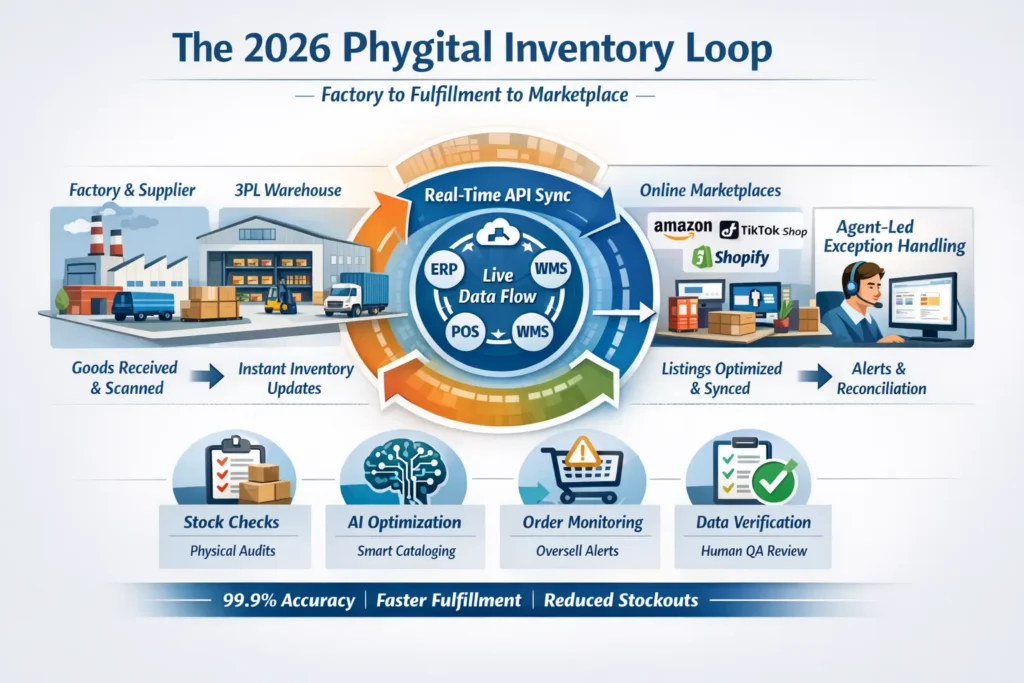
In 2026, inventory is a living data stream, not a static number. This infographic illustrates the Phygital Inventory Loop, where offshore hubs act as the Command Center for global retail. By performing forensic Three-Way Reconciliation—syncing the OMS, WMS, and marketplace APIs—Manila-based specialists eliminate the “Ghost Economy” of phantom stock. Using Agentic AI, these “Inventory Architects” generate SEO-enriched catalogs far faster than onshore teams, while proactively managing logistics exceptions (like port strikes) to protect the customer experience. This model reduces stockouts and ensures your “Digital Twin” matches physical reality with near-perfect accuracy.
This visual illustrates how offshore Fraud Nerve Centers, covered in depth in our retail fraud and risk management guide, reduce retail fraud losses while sharply cutting false positives in the age of Agentic AI-driven attacks.
It showcases the 2026 Defense-in-Depth model—where autonomous AI screening, behavioral biometrics, and real-time Human-in-the-Loop triage operate as a synchronized security stack. Agentic AI flags synthetic identities, refund abuse, and account takeovers at machine speed, while elite Filipino risk analysts evaluate edge cases, interpret digital body language, and prevent revenue-damaging false declines.
Table 1: Manual Catalog Management vs. Offshore Orchestrated Hubs
| Performance Metric | Manual Onshore Team | Philippine Intelligence Hub | Performance Jump |
| Data Entry Accuracy | 94.2% | 99.9% | Near Perfection |
| SKU Upload Speed | 48 Hours | 4 Hours | 12x Faster |
| Inventory Variance | 4.5% | < 0.5% | Margin Protection |
| Marketplace Compliance | Reactive | Proactive (24/7) | Account Safety |
| Cost Basis (50 FTE) | $3.2M / yr | **$1.1M / yr** | 65% Reduction |
Strategic Pillars of the Philippine Inventory Model
I. Agentic SKU Enrichment
In 2026, Filipino specialists use Agentic AI to automatically generate SEO-optimized titles, metadata, and attribute mapping for thousands of SKUs. The Filipino agent acts as the “Human-in-the-Loop,” ensuring that the brand voice is preserved and that technical specifications (dimensions, materials, compatibility) are fully accurate before going live.
II. Predictive Stockout Recovery
Rather than waiting for a “Sold Out” notification, the offshore hubs use Predictive Volatility Analytics. If a port strike in Los Angeles or a weather system in the Suez Canal is detected, the Manila team proactively adjusts “Estimated Delivery Dates” across all channels and shifts promotional spend away from affected SKUs to protect the customer experience, the same exception handling that agentic supply chain command centers run at scale.
III. Three-Way Reconciliation
The “Phygital Audit” involves a forensic reconciliation of:
- The OMS (Order Management System)
- The 3PL/Warehouse Management System (WMS)
- Channel-Specific APIs (Amazon, Shopify, TikTok Shop) This prevents the “Overselling” crisis that leads to marketplace penalties and customer churn.
Table 2: Retail Marketplace Compliance (2026 Benchmarks)
| Channel | Penalty Risk (Legacy) | PH Managed Result | Impact |
| Amazon (SFP) | High (Cancellation Rate >1%) | < 0.1% | Buy Box Dominance |
| TikTok Shop | High (Fulfillment Latency) | Zero Latency | Viral Scalability |
| Google Merchant | Product Disapprovals | 99% Approval | Lower CAC / Higher ROAS |
| Shopify Plus | Inventory Silos | Unified Sync | Seamless Omnichannel |
The New Engine Room of Retail
As commerce becomes more fragmented across social, physical, and digital channels, the ability to maintain a Single Source of Truth for inventory is the ultimate competitive advantage. A dedicated offshore inventory & catalog management team provides the specialized talent and AI-integrated workflows required to master this complexity.
As John Maczynski concludes: “You can’t sell what you can’t find, and you shouldn’t sell what you don’t have. The Philippines has become the global hub for ensuring that what a retailer promises is exactly what the customer receives.”
Expert FAQs
Q1: How do your teams handle SKU rationalization?
We use the 80/20 Rule logic. Our analysts identify the small share of SKUs driving most of your revenue and subject them to “Hyper-Monitoring,” while using Agentic AI to manage the “Long Tail” of slower-moving products.
Q2: Can you manage pricing parity across multiple marketplaces?
Yes. Our teams monitor price fluctuations in real-time, on the same always-on schedule as 24/7 retail customer service desks. If a competitor drops their price on Walmart.com, our specialists (supported by AI) can trigger pre-approved dynamic pricing rules to maintain your “Buy Box” status while protecting margins.
Q3: What happens if there is a physical discrepancy at the warehouse?
Our agents perform Forensic SKU Auditing. They communicate directly with 3PL managers to trigger a manual cycle count, update the digital twin in the ERP, and notify the customer support team of any potential delays before they become complaints.