
30-Second Executive Briefing
- The 2026 Paradigm: The back-office has evolved from a “hidden cost” to a Revenue Recovery Unit. In the era of autonomous commerce, the Philippines provides the critical Human-in-the-Loop (HITL) layer for AI integrity, extending the back-office work for retailers and brands into data governance.
- The Core Strategy: Moving beyond simple task-based BPO to Information Density Arbitrage, where Manila-based specialists manage the “digital twin” of global retail supply chains.
- The Manila Advantage: A specialized workforce fluent in high-complexity technical stacks (ERPs, PIMs, and WMS) that ensures near-perfect data accuracy across fragmented global marketplaces.
- The ROI: Retailers typically see much lower administrative overhead and far fewer false-positive fraud declines, directly boosting Lifetime Value (LTV).
Executive Summary
In the hyper-accelerated retail world of 2026, the “Front-End” is only as strong as the “Back-End” allows it to be. As global brands navigate the complexities of unified commerce—managing thousands of SKUs across TikTok Shop, Amazon, and direct-to-consumer (DTC) sites—the administrative burden has become the primary bottleneck for growth. Retail Back-Office Outsourcing in the Philippines has emerged as the strategic solution to this “Operational Congestion.”
The country has transitioned from basic data processing into a global hub for Retail Intelligence Operations. By delegating high-volume, high-precision tasks to Manila-based specialists, global brands ensure that their digital shelves are always optimized, their inventory is perfectly synchronized, and their margins are protected from “Operational Leakage.” This deep dive explores the tactical and technical framework of the modern offshore back-office and why it is the “Secret Weapon” for the world’s most profitable retailers.
The 2026 Engine Room: From “Support” to “Intelligence”
For decades, back-office outsourcing was seen as a way to “clear the clutter.” In 2026, it is seen as a way to Weaponize Data. The modern retail back-office specialist in Manila isn’t just entering data; they are auditing the logic of autonomous systems.
“In 2026, we aren’t just managing tasks; we are managing the ‘Digital Twin’ of the retail empire,” says John Maczynski, CEO of PITON-Global. “If your PIM or ERP data is ‘dirty,’ your AI agents will hallucinate, inventory will desync, and your margins will bleed. The Philippines provides the Intelligence Arbitrage to keep the circulatory system of retail running with clinical precision. We are the guardians of the digital shelf.”
Orchestrating the Digital Engine Room: Inside the Manila Hubs
In 2026, the back-office is no longer a cost center; it is a Revenue Recovery Unit. This infographic outlines the Intelligence Flow of the modern offshore “Engine Room.” By moving from manual data entry to Information Density Arbitrage, Manila-based specialists manage the Digital Twin of a global retail empire. They utilize Agentic AI to harmonize catalog data and monitor Behavioral Biometrics to keep fraud loss to a minimum. With near-perfect catalog accuracy and sharply lower overhead, these hubs ensure that your “Digital Shelf” is always optimized and your inventory is perfectly synchronized across the global unified commerce stack.
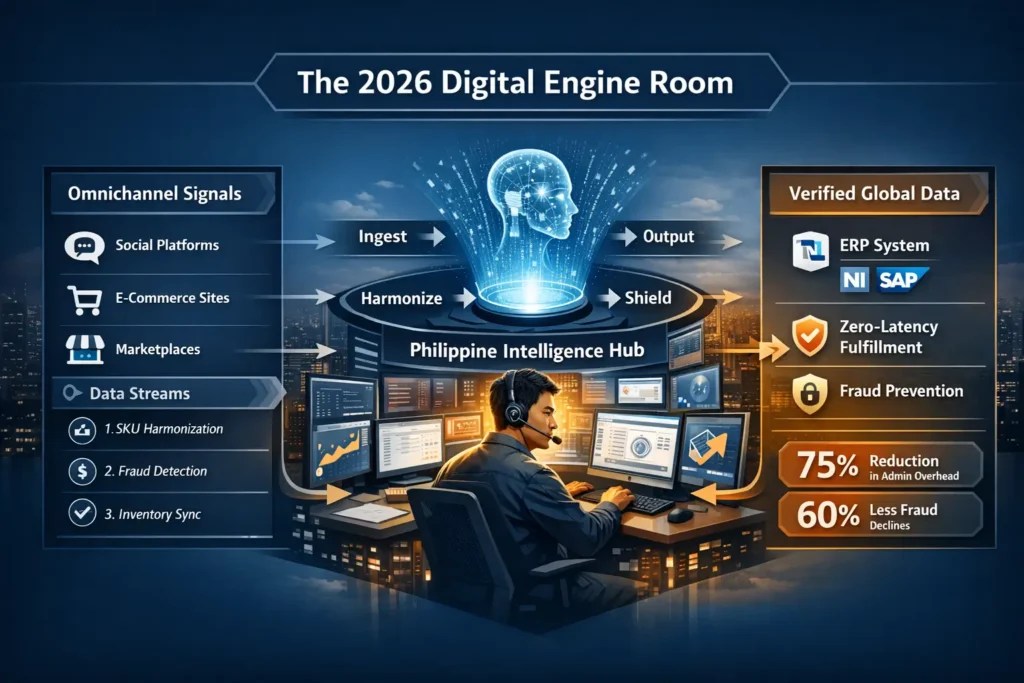
This visual guide showcases the transition from legacy “Reactive Tracking” to 2026 Predictive Latency Management, where certified administrators in Manila govern the APIs of NetSuite, SAP, and Salsify to ensure zero-latency fulfillment and maximum operational velocity.
Table 1: The Shift to Agentic Operations
| Functional Area | Legacy Model (2020) | 2026 Intelligence Model |
| Catalog Management | Manual Copy/Paste | Agentic Content Harmonization |
| Inventory Logic | Batch Updates (Daily) | Real-Time Global Sync (Event-Driven) |
| Fraud Prevention | Static Rule-Based Filters | Behavioral Biometrics & AI-Sentry |
| Supply Chain | Reactive Tracking | Predictive Latency Management |
| Marketplace Sync | Manual CSV Uploads | Automated API Governance |
| Primary Goal | Cost Reduction | Operational Velocity & Profitability |
Strategic Pillars of Philippine Retail Back-Office
I. Catalog & Digital Shelf Excellence
Your product listing is your salesperson. In 2026, the digital shelf is dynamic. Offshore teams manage:
- Dynamic Attribute Mapping: Ensuring SKUs are optimized for the specific “Search & Discovery” algorithms of diverse marketplaces (e.g., mapping different category requirements for Amazon vs. Walmart).
- Content Localization: Adapting imagery and descriptions for cultural nuances in global markets, ensuring brand voice remains consistent but relevant.
- PIM-to-Marketplace Sync: Maintaining a “Single Source of Truth” (SSOT) to prevent pricing errors that trigger account suspensions.
II. Unified Inventory & Supply Chain Orchestration
In a world of “Same-Day Shipping,” even a small error in inventory data leads to a wave of canceled orders. Manila back-office hubs specialize in Logistics Exception Management (LEM)—identifying stalled containers or carrier latencies in real-time before they impact the customer, the upstream half of last-mile WISMO support. This “proactive back-office” notifies the support team to manage customer expectations before a complaint is even filed.
III. High-Velocity Fraud & Risk Management
In 2026, retail fraud is an AI-driven industry. These specialists are the “Cyber-Sentries” who monitor behavioral biometrics. They identify “Friendly Fraud” and account takeovers by analyzing how a user interacts with the checkout page—identifying bot-driven behavior that traditional rule-based filters often miss.
The Financial Impact: Eliminating “Operational Leakage”
“Operational Leakage”—the small, hidden costs of data errors, over-stocking, and false-positive fraud declines—can quietly erode a meaningful share of a retailer’s EBITDA. An offshore-managed back-office eliminates this leakage through superior Information Density, working hand in hand with retail administration and reconciliation teams.
Table 2: Comparative Operational ROI (2026)
| Metric | Onshore (US/UK/EU) | Philippine Back-Office Hub |
| Catalog Accuracy | 94.2% | 99.9% |
| Time-to-Market (New SKUs) | 5–7 Days | <12 Hours |
| Fraud Loss Rate | 0.8% | 0.15% |
| FTE Scalability | Slow (3-Month Lead) | Instant (On-Demand Bursting) |
| Fully Burdened Cost | $45–$60/hr | $12–$16/hr |
Technical Integration: Managing the 2026 Stack
The local IT-BPM sector has matured into a technical powerhouse. Specialists in Manila are no longer just “users” of software; they are certified administrators for the retail tech stacks of 2026, including:
- ERPs: NetSuite, SAP S/4HANA, Microsoft Dynamics 365.
- PIMs: Akeneo, Salsify, Riversand.
- Marketplace Tools: ChannelAdvisor, Helium 10, CommerceHub.
The Foundation of Scale
As we move through 2026, the winners in retail will not necessarily be the ones with the best products, but those with the most disciplined operations. A dedicated offshore retail back-office provides that discipline. It allows brand owners to stop worrying about the “Digital Engine Room” and start focusing on the next horizon of brand growth.
Expert FAQs
Q1: How does an offshore team improve “Time-to-Market” for new SKUs?
By using Agentic AI Workflows where specialists act as “Orchestrators”—quickly validating AI-generated content and mapping it across hundreds of marketplaces in hours rather than weeks.
Q2: Is back-office data secure in the Philippines?
Top-tier Manila providers utilize Zero-Trust Edge Computing and Sovereign Data Perimeters. This ensures that PII (Personally Identifiable Information) remains within the retailer’s home borders while the “analysis” and “management” happen securely in Manila.
Q3: Can your offshore teams manage reverse logistics (Returns)?
Yes. Reverse logistics is a back-office priority in 2026. The hubs manage the return authorization, credit reconciliation, and inventory restock logic, ensuring that returned goods move back into “sellable” status with zero friction while the retail phone support team keeps the customer informed.