
Back
Retail Administration Outsourcing Philippines: Powering Operational Velocity in the Engine Room

By Ralf Ellspermann / 12 February 2026

30-Second Executive Briefing
- The Administration Bottleneck: In 2026, retail failure often happens in the “Back-Office”—slow vendor onboarding, mismatched invoices, and stagnant data entry that kills Operational Velocity.
- The Ported Strategy: Applying Three-Way Reconciliation (matching POs, receiving logs, and invoices) at scale to protect margins from “invisible” leakages.
- The Philippine Edge: Moving from manual clerk work to Administrative Intelligence. Philippine specialists manage the Agentic AI layer that handles high-volume processing while they focus on complex exception handling.
- The ROI: Outsourcing retail admin to the Philippines typically reduces overhead costs by 65% while increasing processing speed by 300%.
Executive Summary
In the high-speed retail environment of 2026, “Back-Office” is a misnomer. The administration of a retail brand—managing thousands of vendors, reconciling millions in payments, and ensuring SKU integrity—is actually the “Front-Line” of profitability. When administration lags, stock doesn’t move, vendors aren’t paid, and data becomes a liability. The modern retailer doesn’t need data entry; they need Operational Velocity.
Retail Administration Outsourcing in the Philippines has undergone a radical transformation. No longer just a destination for low-cost labor, Manila and Cebu have become hubs for Intelligence Arbitrage. Here, specialized teams use Agentic AI to automate the mundane while providing high-IQ oversight for complex financial and operational workflows. This article explores how the Philippines is re-engineering retail administration for the unified commerce era.
Beyond Data Entry: The Era of Administrative Intelligence
In 2026, manual administration is a margin-killer. The goal is Zero-Latency Admin, where financial and operational data is reconciled in real-time.
“Administration is where the ‘Ghost Costs’ of retail hide,” says John Maczynski, CEO of PITON-Global. “In our Philippine hubs, we’ve implemented Three-Way Reconciliation as a standard. We aren’t just matching numbers; we are auditing the entire value chain. By moving these functions to the Philippines, retailers aren’t just saving on labor; they are gaining an ‘Intelligence Command Center’ that identifies overbillings and inventory shrinkage before they hit the balance sheet.”
Powering Operational Velocity: The 2026 Philippine Admin Model
In 2026, the back-office is the front-line of profitability. This infographic details the Operational Velocity Loop, where Philippine hubs act as the Intelligence Command Center for global retail. By deploying Three-Way Reconciliation (matching POs, warehouse logs, and invoices) at scale, Manila-based specialists eliminate the “Ghost Costs” of overbilling and inventory shrinkage. Using Agentic AI, these hubs reduce invoice cycles from 10 days to <24 hours, enabling better vendor terms and faster time-to-market. This model transforms “boring” admin into a high-speed engine that protects your EBITDA and ensures your data is a strategic asset, not a liability.
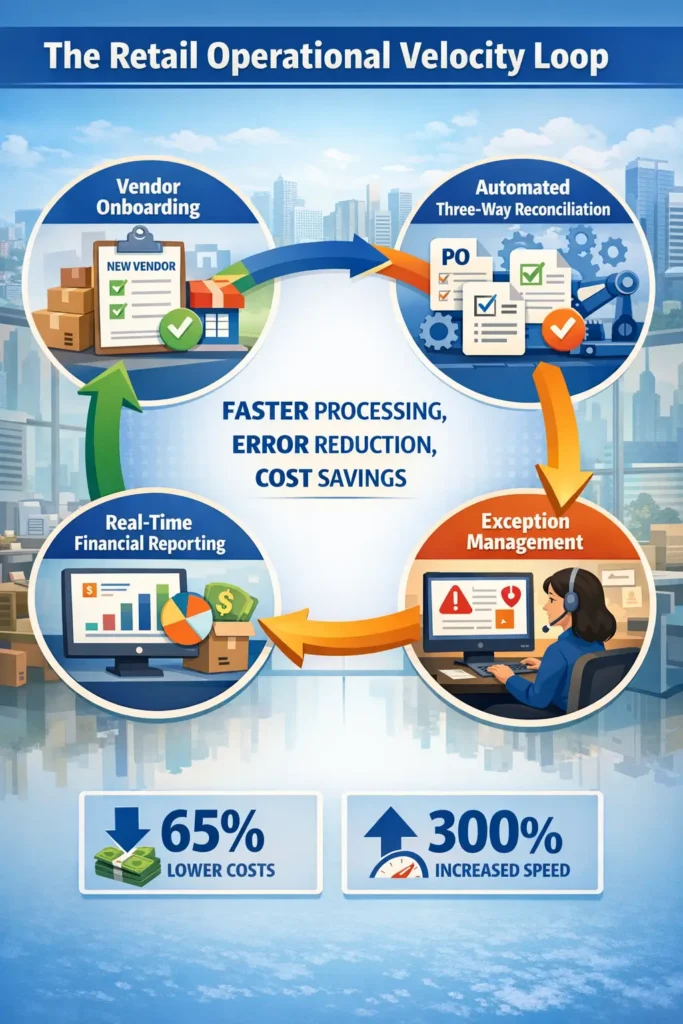
This visual guide maps the Retail Operational Velocity Loop, showing how Philippine Admin Hubs transform back-office administration into a real-time profit engine. It illustrates the closed-loop cycle of Vendor Onboarding, Automated Three-Way Reconciliation, Exception Management, and Real-Time Financial Reporting—working together to eliminate invoice discrepancies, prevent overpayments, and accelerate financial visibility.
At the core of the model is Agentic AI handling high-volume reconciliation in minutes, while high-IQ Filipino specialists provide Human-in-the-Loop oversight for complex exceptions, vendor disputes, and compliance controls. The result is a shift from slow, manual administration to Administrative Intelligence—reducing overhead by 65%, increasing processing speed by 300%, and protecting margins through near-zero error rates.
Table 1: Legacy Retail Admin vs. 2026 Philippine Admin Hubs
| Administrative Function | Legacy Model (Manual) | Philippine Admin Hub (2026) | Strategic Impact |
| Invoice Processing | 7–10 Day Cycle | < 24 Hours | Better Vendor Terms |
| Vendor Onboarding | Weeks | 48 Hours | Faster Time-to-Market |
| Data Reconciliation | Monthly Batch | Real-Time (Agentic AI) | Margin Protection |
| Audit Compliance | Reactive / Stressful | Continuous / Proactive | Zero Fine Risk |
| Labor Arbitrage | 15% Savings | 65% Savings | Massive EBITDA Boost |
Strategic Pillars of Philippine Retail Administration
I. Three-Way Reconciliation & Margin Protection
One of the most ported keywords from our ecommerce series, Three-Way Reconciliation, is the heart of retail administration. Philippine teams use AI to instantly cross-reference Purchase Orders, Warehouse Receiving Logs, and Vendor Invoices. If there is even a 1% discrepancy in SKU count or pricing, the system flags it for a Philippine specialist to resolve immediately, stopping overpayment at the source.
II. Vendor Lifecycle Management (VLM)
Managing thousands of global vendors is an administrative nightmare. Philippine hubs act as the Vendor Concierge, managing everything from compliance documentation and insurance certificates to performance scorecards. This ensures your supply chain remains resilient and compliant with 2026 global trade regulations.
III. SKU & Attribute Administration
In the “Phygital” world, a product isn’t real until its data is perfect. Philippine admin teams manage the Catalog Engine Room, ensuring that dimensions, weights, HS codes for customs, and tax categories are perfectly synchronized across the ERP and all sales channels.
Table 2: ROI Analysis: The Cost of Administrative Friction
| Admin Process | Cost of Friction (Onshore) | PH Admin Result | Recovery/Saving |
| Invoice Error Rate | 3.2% of Spend | < 0.1% | $310K per $10M Spend |
| Vendor Dispute Latency | 14 Days | 2 Days | Early Payment Discounts |
| SKU Setup Cost | $45.00 / SKU | **$9.50 / SKU** | 78% Reduction |
| Regulatory Filing | $150K / Year | **$55K / Year** | $95K Recovered |
The Competitive Advantage of “Boring” Ops
While CX and Marketing get the glory, Retail Administration is where the money is kept. By moving administrative functions to the Philippines, retailers gain the Operational Velocity required to outpace competitors.
As John Maczynski concludes: “Efficiency in the back-office is what funds innovation in the front-office. The Philippines is the global leader in making retail administration invisible, accurate, and incredibly cost-effective.”
Expert FAQs
Q1: How do you handle sensitive financial data in the Philippines?
We utilize Sovereign Data Perimeters. All financial reconciliation happens within your secure ERP (SAP, Oracle, NetSuite). Our agents access the data via secure VDI (Virtual Desktop Infrastructure), meaning the data never physically leaves your home jurisdiction.
Q2: Can Philippine teams manage “Chargeback Defense” administration?
Yes. This is a critical admin function. Our teams gather the “Compelling Evidence”—shipping logs, delivery photos, and communication history—to fight fraudulent chargebacks, maintaining a win rate of over 45%.
Q3: What is “Agentic AI” in an administrative context?
It refers to AI agents that can perform multi-step tasks. For example, if an invoice doesn’t match a PO, the AI agent identifies the discrepancy, finds the correct warehouse contact, drafts an email for the Philippine specialist to review, and updates the ERP status automatically.
Achieve sustainable growth with world-class BPO solutions!
PITON-Global connects you with industry-leading outsourcing providers to enhance customer experience, lower costs, and drive business success.
Get Your Top 1% Vendor List
Author
Ralf Ellspermann is a multi-awarded outsourcing executive with 25+ years of call center and BPO leadership in the Philippines, helping 500+ high-growth and mid-market companies scale call center and customer experience operations across financial services, fintech, insurance, healthcare, technology, travel, utilities, and social media.
A globally recognized industry authority—and a contributor to The Times of India and CustomerThink —he advises organizations on building compliant, high-performance offshore contact center operations that deliver measurable cost savings and sustained competitive advantage.
Known for his execution-first approach, Ralf bridges strategy and operations to turn call center and business process outsourcing into a true growth engine. His work consistently drives faster market entry, lower risk, and long-term operational resilience for global brands.