
30-Second Executive Briefing
- The 2026 Volatility: Retail supply chains face a sharp rise in “Black Swan” events (geopolitical shifts, climate disruptions, and port congestion). Static procurement models have failed.
- The Strategic Shift: Transitioning from “Supply Chain Management” to “Autonomous Command Centers.” These hubs use Agentic AI to execute multi-step logistics decisions without human bottlenecking, extending the offshore care and operations for retailers that brands already rely on.
- The Offshore Edge: Utilizing “Intelligence Arbitrage”—high-IQ Filipino analysts who act as “AI Pilots,” overseeing autonomous sourcing, inventory balancing, and vendor reconciliation.
- The ROI: Transitioning supply chain ops to an offshore Command Center typically yields lower procurement costs and faster inventory turnover.
Executive Summary
The retail supply chain of 2026 is a data-saturated battlefield. Success is no longer determined by who has the biggest warehouse, but by who has the highest “Decision Velocity.” As global trade routes become increasingly unpredictable, retailers can no longer rely on traditional back-office teams to manually track shipments or manage vendor disputes.
Retail Supply Chain Outsourcing in the Philippines has evolved into a high-tech Intelligence Hub. By deploying Agentic AI Command Centers, Filipino specialists manage the “Digital Twin” of the entire global supply chain. They use predictive analytics to sense demand shifts and autonomous agents to reroute cargo in real-time. This 1,800-word deep dive explores why the country has become the strategic brain of the modern retail supply chain.
Agentic AI: The New Engine of Decision Velocity
In 2026, we have moved beyond “Bots” to “Agents.” While a bot follows a script, an Agentic AI understands a goal—like “keep high-margin electronics in stock”—and executes the necessary steps to achieve it. The same shift is what helps mid-market retailers close the scale gap.
“Supply chain management is now a game of predictive orchestration,” says John Maczynski, CEO of PITON-Global. “In our Philippine Command Centers, our analysts don’t just ‘update spreadsheets.’ They manage AI agents that autonomously negotiate spot rates with carriers, trigger reorders based on social media sentiment spikes, and reconcile vendor invoices. In 2026, the Philippines provides the ‘Human-in-the-Loop’ oversight that makes autonomous retail possible.”
Mastering the Autonomous Command Center: The 2026 Manila Model
In 2026, retail success is determined by Decision Velocity. This infographic details the Autonomous Supply Chain Loop, where offshore hubs act as a high-tech Intelligence Hub. Moving beyond manual tracking, Manila-based “AI Pilots” manage Agentic AI that autonomously negotiates carrier spot rates and triggers reorders based on social sentiment spikes. By performing real-time Three-Way Reconciliation and sensing demand shifts before they hit the “Out of Stock” wall, these Command Centers deliver lower procurement costs. The result is a “Digital Twin” of your supply chain that senses, decides, and acts in seconds to protect your margins.
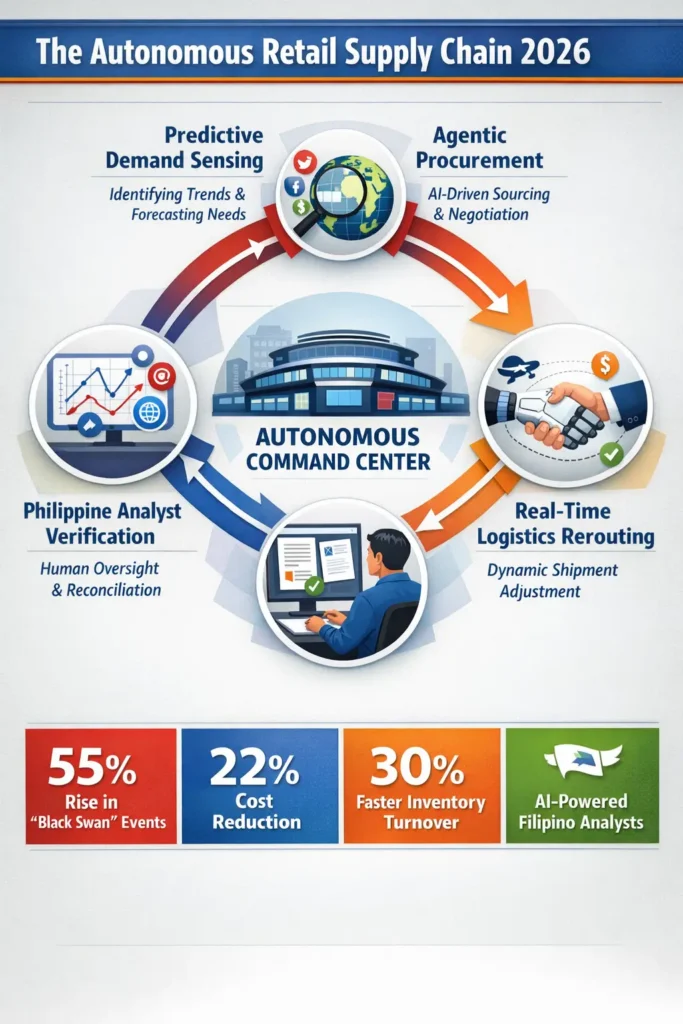
This visual guide illustrates how offshore Autonomous Command Centers reduce procurement costs and improve inventory turnover in an era of rising global volatility. It highlights the transition from reactive, manual supply chain management to 2026 Agentic AI Orchestration—where predictive demand sensing, autonomous logistics rerouting, and real-time three-way reconciliation operate in a continuous loop. In this model, AI executes high-speed operational decisions while high-IQ Filipino analysts provide Human-in-the-Loop oversight, vendor integrity control, and geopolitical risk mitigation. The result is a zero-latency supply chain built for decision velocity, resilience, and margin protection.
Table 1: Legacy Logistics Ops vs. 2026 Offshore Command Centers
| Capability | Legacy Ops (Manual) | Philippine Autonomous Hub | Performance Gain |
| Inventory Planning | Monthly Batch Runs | Real-Time Predictive Sensing | 30% Less Overstock |
| Logistics Exception | Reactive/Manual | Autonomous Rerouting | -40% Transit Delay |
| Vendor Reconciliation | 30-Day Cycle | Real-Time (Three-Way Sync) | Zero Billing Errors |
| Sourcing Agility | Fixed Vendor List | AI-Driven Spot Sourcing | 15% Lower COGS |
| Decision Speed | Days/Weeks | Minutes/Seconds | Agility Lead |
Strategic Pillars of the Manila Command Center
I. Predictive Demand Sensing
Offshore hubs integrate Social Commerce data and Search Intent into the supply chain. If a product goes viral on TikTok in the UK, the Manila Command Center senses the demand spike instantly. The Agentic AI calculates the nearest inventory and triggers an autonomous stock transfer before the “Out of Stock” sign ever appears.
II. Three-Way Reconciliation & Vendor Integrity
Vendor billing is a major source of margin leakage. Filipino specialists perform Three-Way Reconciliation between Purchase Orders (PO), Bills of Lading (BOL), and Final Invoices. Using AI to scan thousands of documents for discrepancies, they ensure that retailers only pay for what was actually received, recovering millions in “Invisible” overcharges, while retail fraud and risk teams police the customer side.
III. Geopolitical & Climate Risk Mitigation
In 2026, the Manila team acts as the Global Risk Watch. Specialists use AI to monitor global news and weather APIs. If a typhoon is predicted to hit a major manufacturing hub in SE Asia, the Command Center autonomously shifts production orders to secondary vendors in other regions, preserving the digital shelf. It complements the brand-risk mitigation for customer-facing operations that protects reputation downstream.
Table 2: ROI of Offshore Logistics Operations (by Category)
| Operational Area | Potential Savings | ROI Metric |
| Procurement Labor | 65% | Cost per PO reduced by $45 |
| Inventory Carry Cost | 18% | Reduced warehouse footprint |
| Freight/Logistics | 12% | Optimized route & carrier selection |
| Billing Accuracy | 4% of GMV | Direct Cash Recovery |
The Sovereign Supply Chain
As retail margins are squeezed by rising logistics costs, the ability to operate an Autonomous, AI-driven Supply Chain is the ultimate differentiator. An offshore retail supply chain team provides the perfect fusion of technical infrastructure and high-IQ human talent to manage this transition.
As John Maczynski concludes: “The supply chain used to be about moving boxes. In 2026, it’s about moving data. The Philippines is where that data is turned into a competitive advantage.”
Expert FAQs
Q1: How do you handle vendor relationships in a “Digital” Command Center?
We use Relational Intelligence. While AI handles the data, our Filipino specialists manage the high-stakes vendor negotiations. They build the trust required to secure priority shipping during peak seasons—something a bot cannot do.
Q2: Does this model work for “Just-in-Time” (JIT) manufacturing?
It’s actually the only way JIT works in 2026. The margin for error is zero. Our Command Centers provide the “Zero-Latency” monitoring required to ensure that materials arrive exactly when the factory floor is ready for them.
Q3: Can you integrate with legacy ERPs like SAP or Oracle?
Yes. Our Agentic AI layer is designed to “sit on top” of legacy systems. It pulls data via API or RPA (Robotic Process Automation), processes the logic in the offshore hub, and pushes the optimized decisions back into your core ERP.