
Back
Polygon Annotation Outsourcing Philippines: Defining Irregular Boundaries for Advanced Machine Learning

By Ralf Ellspermann / 11 March 2026
 Authored by Ralf Ellspermann, CSO of PITON-Global, & 25-Year Philippine BPO Veteran | Executive | Verified by John Maczynski, CEO of PITON-Global, and Former Global EVP of the World's Largest BPO Provider on March 11, 2026

TL;DR: The Key Takeaway
This specialized work is the process of creating highly precise, vertex-by-vertex outlines of irregular objects in images, a critical need for advanced AI. The Philippines has become the premier destination for this BPO service, offering expert human cognition to train computer vision models that require a deep understanding of real-world complexity.
As artificial intelligence transitions from identifying basic shapes to comprehending the intricate irregularities of the physical world, the demand for high-fidelity data has reached a fever pitch. Polygon annotation outsourcing in the Philippines has emerged as a mission-critical service for training models that require more than just a square box. By meticulously tracing objects vertex-by-vertex, the Philippine workforce provides the “boundary integrity” necessary for surgical robotics, autonomous navigation, and advanced agricultural tech to function with human-level discernment.
Executive Briefing
- The Precision Surge: AI models are moving beyond simple detection toward complex scene parsing, requiring exact outlines of cellular structures, diseased foliage, or mechanical components.
- Human Dexterity: Despite advances in auto-labeling, the human hand and eye remains the gold standard for defining vertices on objects with soft, overlapping, or occluded edges.
- Cognitive Advantage: The Philippines provides a talent pool characterized by high focus and the spatial reasoning needed to interpret visual ambiguity.
- Impact on Reliability: Industry leaders now view boundary precision as a primary predictor of a model’s learning rate and real-world safety.
- Vetted Connectivity: PITON-Global streamlines the path to high-fidelity data by linking tech innovators with the archipelago’s most elite polygon annotation laboratories.
Executive Summary
For artificial intelligence to navigate the “irregular glory” of our world, it requires training data that mirrors that very complexity. This is the strategic essence of polygon annotation outsourcing in the Philippines—a discipline now vital for the most sophisticated computer vision applications. This process involves the painstaking creation of multi-vertex outlines for objects that defy simple geometric categories. Because this task demands a high degree of cognitive judgment to navigate obscured parts and intricate details, it cannot be left to brute-force automation. The Philippines has solidified its role as a global authority in this niche, providing the human oversight that guarantees pixel-perfect accuracy for the next generation of visual AI.
“We have seen a decisive shift in requirements from ‘draw a box’ to ‘trace the exact cellular membrane.’ This is the frontier of computer vision. Polygon annotation is a fundamentally different cognitive task requiring immense focus. Our partners in the Philippines excel at this, providing the granular data that allows an AI to distinguish between a healthy plant and one with a subtle fungal infection.” — John Maczynski, CEO of PITON-Global
Moving Beyond the Box: The Boundary Integrity Imperative
The first wave of computer vision relied on bounding boxes to identify cars or pedestrians. However, as AI enters high-stakes environments, generalization is no longer an option. A self-driving vehicle must understand the exact volume a pedestrian occupies—including limbs and accessories—to predict movement. Similarly, a medical AI cannot rely on a vague rectangle to identify a tumor; it must map the precise, irregular border of malignant tissue to guide a surgeon’s scalpel.
This is why polygon annotation is mission-critical. By using connected vertices to trace the exact perimeter of an object, specialists capture the true form of items that a simple box would misrepresent. This work is inherently more labor-intensive, often requiring hundreds of precise clicks for a single mask. This human-led precision forms the bedrock of high-performing models in satellite imagery, autonomous navigation, and diagnostic medicine.
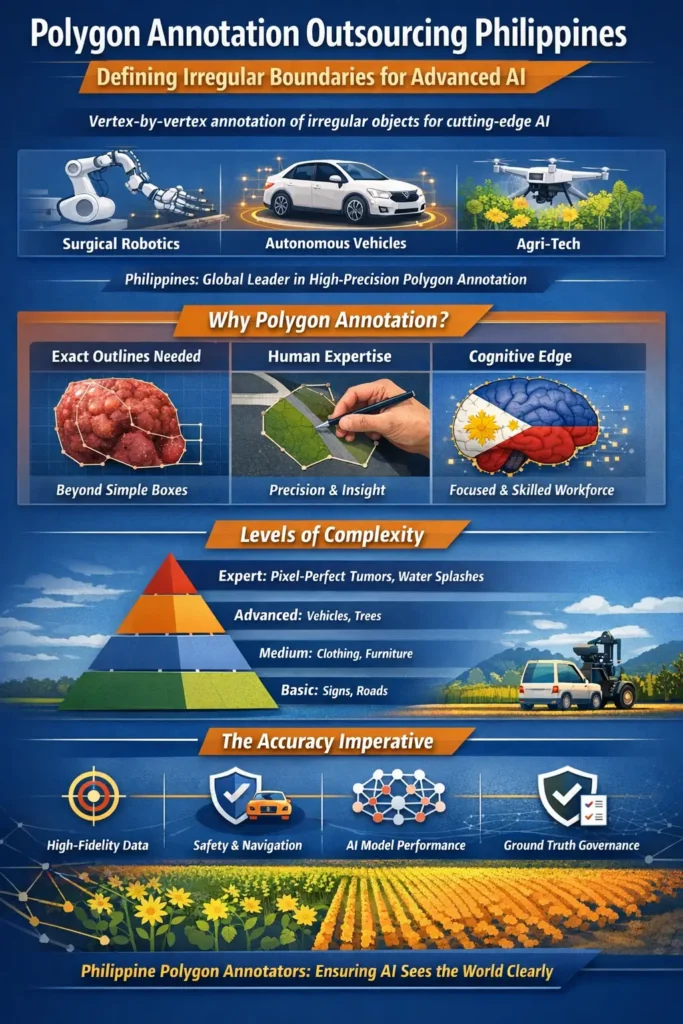
The Polygon Annotation Maturity Curve
The complexity of this work scales with the needs of the model. Premier BPO providers in the Philippines are uniquely equipped to handle every stage of this progression.
| Maturity Level | Annotation Style | Primary Application | Key Skill Required |
| Level 1: Foundational | Coarse Polygons | General segmentation (sky, road) | Speed & Tool Proficiency |
| Level 2: Intermediate | Detailed Polygons | Object recognition (cars, trees) | Precision & Patience |
| Level 3: Advanced | Nested/Overlapping | Scene-level depth (engine parts) | Spatial Reasoning |
| Level 4: Expert | Semantic / Pixel-Perfect | Expert analysis (tumors, crop damage) | Domain Knowledge |
Intelligence Arbitrage: Investing in Model Performance
In 2026, the concept of “Intelligence Arbitrage” has redefined outsourcing. It is no longer about finding the lowest hourly rate; it is about securing the highest cognitive output. When an AI firm engages a Philippine team for polygon annotation, they are insourcing an intellectual process that directly dictates the model’s success.
This shift moves the key performance indicator (KPI) away from quantity and toward the quality of insights. A masterfully annotated dataset accelerates training, eliminates the need for expensive rework, and provides a significant market edge. The expert annotators in the Philippines serve as the human engine of this value creation, providing the nuance that software alone cannot replicate.
The Complexity Spectrum of Polygon Data
Not all shapes are equally difficult to map. Understanding this spectrum is essential for project scoping and partner selection:
- Low Tier: Solid, regular shapes like road signs or simple logos. Requires high speed.
- Medium Tier: Irregular but clear boundaries, such as furniture or clothing. Requires high dexterity.
- High Tier: Fine details and partial occlusion, like tree branches or hair. Requires exceptional focus.
- Extreme Tier: Amorphous or transparent objects like smoke, water splashes, or cellular imagery. Requires deep domain expertise and cognitive interpretation.
Agentic Governance: Defining the Ground Truth
As AI agents become more autonomous, the integrity of their training data becomes a matter of public safety. An imprecise polygon that misrepresents a boundary can cause catastrophic system failure. This is where “Agentic Governance” comes into play—the human-led process of ensuring that data represents “ground truth” with total fidelity.
Elite teams in the Philippines act as the guardians of this truth. They provide the vertex-by-vertex delineation that serves as the gold standard for machine perception. This is not mere data entry; it is the act of teaching a machine to see with human nuance. By providing this layer of expert oversight, the Philippine BPO industry ensures that the autonomous systems of the future are built on a foundation of absolute accuracy.
Expert FAQs
Why can’t AI just label these polygons automatically?
While auto-labeling exists, it frequently fails in “edge cases”—where objects are partially hidden (occluded), have soft edges (like smoke), or blend into the background. Human cognition remains the only way to resolve these ambiguities for high-stakes AI.
What is the difference between semantic segmentation and polygon annotation?
Semantic segmentation is the goal (classifying every pixel), while polygon annotation is the tool used to reach it. By drawing precise polygonal masks, annotators define the exact pixel-level boundaries the AI needs to learn.
How does PITON-Global verify quality?
We use a multi-stage vetting process that looks beyond technical skills. We evaluate a partner’s quality assurance (QA) methods, their domain-specific experience (e.g., medical or agritech), and their data security protocols to ensure a measurable “model lift.”
Does polygon annotation help with Large Language Models (LLMs)?
While LLMs are text-based, the rise of “Multimodal AI” (which understands both text and images) makes high-quality polygon data essential. It teaches these advanced models to understand the physical world in a holistic, human-like way.
Achieve sustainable growth with world-class BPO solutions!
PITON-Global connects you with industry-leading outsourcing providers to enhance customer experience, lower costs, and drive business success.
Get Your Top 1% Vendor List
Author
Ralf Ellspermann is a multi-awarded outsourcing executive with 25+ years of call center and BPO leadership in the Philippines, helping 500+ high-growth and mid-market companies scale call center and customer experience operations across financial services, fintech, insurance, healthcare, technology, travel, utilities, and social media.
A globally recognized industry authority—and a contributor to The Times of India and CustomerThink —he advises organizations on building compliant, high-performance offshore contact center operations that deliver measurable cost savings and sustained competitive advantage.
Known for his execution-first approach, Ralf bridges strategy and operations to turn call center and business process outsourcing into a true growth engine. His work consistently drives faster market entry, lower risk, and long-term operational resilience for global brands.
EXECUTIVE GOVERNANCE & ACCURACY STANDARDS
Authored by:

Ralf Ellspermann
Founder & CSO of PITON-Global,
25-Year Philippine BPO Veteran,
Multi-awarded Executive
Specializing in strategic sourcing and excellence in Manila
View Full Bio
Verified by:

John Maczynski
CEO of PITON-Global, and former Global EVP of the World’s largest BPO provider | 40 Years Experience
Ensuring global compliance and enterprise-grade service standards
View Full Bio
Last Peer Review: March 11, 2026
This service framework is audited quarterly to meet shifting global outsourcing regulations and COPC standards.