

TL;DR: The Key Takeaway
AI model training outsourcing in the Philippines provides the essential human-in-the-loop expertise to bridge the gap between promising AI prototypes and scalable, production-grade systems. It is the data-side discipline behind the hybrid human-and-AI delivery model, and the nation offers a strategic advantage in generating high-quality training data, which is crucial for achieving model accuracy and reliability.
Outsourced model training closes the critical gap between experimental prototypes and commercial-grade deployments. By leveraging a high-aptitude workforce for complex data refinement, reinforcement learning (RLHF), and bias mitigation, innovators can overcome the “data bottleneck.” This strategic collaboration ensures the high-fidelity supervision necessary to transform raw algorithms into reliable, production-ready AI assets at market-leading speeds.
Executive Briefing
- Production Readiness: Overcome the last-mile accuracy hurdle that often stalls AI projects in “sandbox” environments through expert human supervision.
- Time-to-Market Velocity: Dramatically reduce deployment timelines by integrating pre-trained, specialized Filipino teams into the development cycle.
- Cognitive Depth: Access a talent pool capable of nuanced reasoning, move beyond simple labeling to complex scenario simulation and red teaming.
- Seamless Scalability: Rapidly expand training capacity to handle massive datasets without the overhead of internal recruitment or infrastructure.
- Strategic Governance: Ensure ethical alignment and model reliability through rigorous human-in-the-loop validation frameworks.
From Sandbox to Scale: The Production Imperative
While many artificial intelligence ventures show immense promise within controlled “sandbox” settings, the transition to real-world application is frequently where momentum dies. A prototype may exhibit brilliance on curated, sterile data, yet its actual viability in a production environment hinges entirely on the diversity and integrity of its training foundations. The chasm between a visionary concept and a scalable, market-ready system is almost always a data problem. Automated labeling tools reach a point of diminishing returns; achieving the precision required for mission-critical deployment demands the sophisticated cognitive input of human specialists.
This operational reality highlights the strategic importance of the Philippine outsourcing sector. The nation’s workforce has pivoted from basic annotation to providing high-level, context-aware data refinement. These experts don’t just tag images; they diagnose subtle algorithmic errors, adjudicate ambiguous edge cases, and provide the qualitative feedback loops necessary to prepare models for the chaos of real-world variables. This human-centric approach serves as the catalyst for the “Intelligence Gain” required to push a model past experimental thresholds into robust, industrial-grade performance.
“Our partners are evolving beyond the search for mere data processors. They are hunting for strategic collaborators who can compress the AI development lifecycle. We meet innovators at the prototype phase and provide the Filipino expertise needed to achieve production-level scale. This isn’t just a cost-saving measure—it’s a pursuit of critical market velocity.” — John Maczynski, CEO, PITON-Global
This fundamental shift from prioritizing low-cost labor to prioritizing speed and high-fidelity output has redefined the global outsourcing map. Today’s most successful AI firms recognize that investing in elite training data early in the cycle is the most direct route to securing a dominant market position. That pivot from labor arbitrage to intelligence arbitrage is also the thread running through the sector’s five-year outlook to 2031.
The Philippine Advantage: A Hub of AI-Ready Talent
The Philippines has engineered a sophisticated ecosystem that positions it as the premier destination for AI model training. The local Business Process Outsourcing (BPO) industry has undergone a radical transformation, moving far beyond legacy customer support into a high-tier technical powerhouse, a shift laid out in our guide to the 2026 service mix and AI-hybrid support. The workforce offers a rare combination of technical literacy, sharp analytical skills, and a high degree of linguistic proficiency that aligns perfectly with Western enterprise requirements.
This specific skill set is indispensable for the high-level reasoning required in modern AI training. Filipino specialists are uniquely equipped to navigate the subtleties of cultural nuance, linguistic intent, and social context—elements that automated systems frequently overlook. They provide the essential feedback that ensures models are not only functionally accurate but also ethically grounded and free from systemic bias. The result is a workforce that does not merely follow instructions but actively improves the intelligence of the systems they touch.
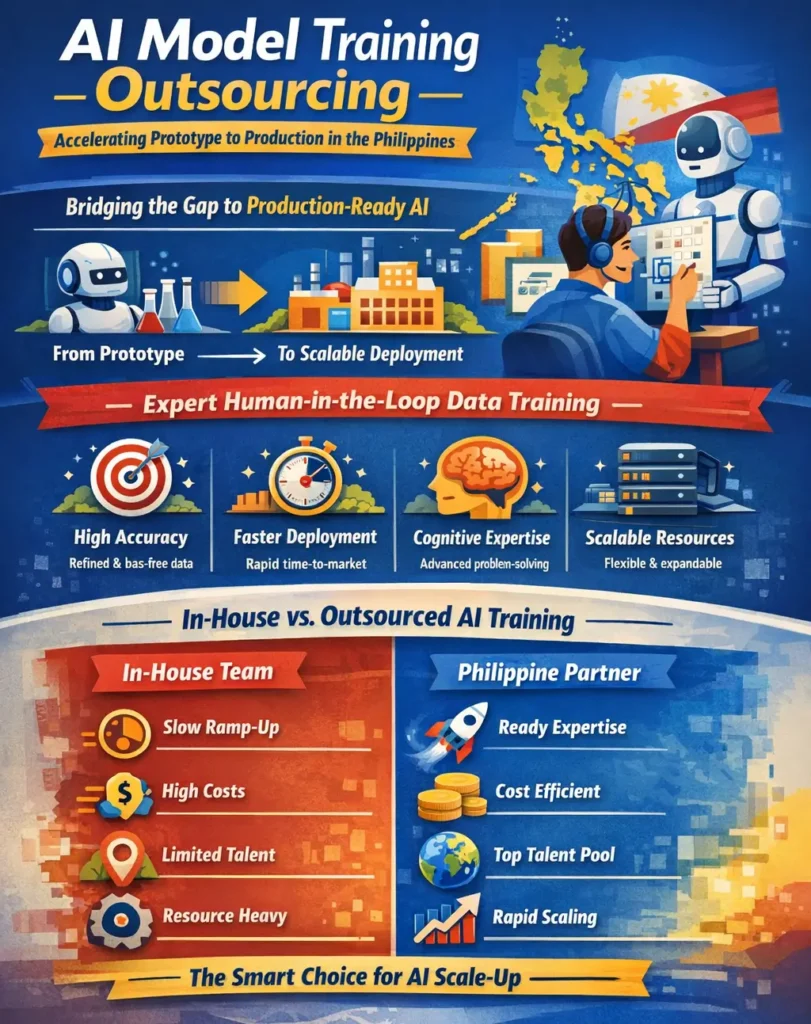
In-House vs. Outsourced AI Model Training: A Comparative Analysis
Determining whether to build an internal data training department or to partner with an offshore specialist is a defining moment for any AI-led organization. The following table illustrates the operational trade-offs:
| Factor | In-House Internal Team | Outsourced Partner (Philippines) |
| Time to Competency | High (Often 6-12 months for hiring/onboarding). | Low (Immediate deployment of veteran teams). |
| Scalability | Low (Internal growth is slow and capital-intensive). | High (Elastic staffing that adapts to project flow). |
| Cost Structure | High (Fixed salaries, benefits, and local overhead). | Moderate (Flexible, project-based OpEx model). |
| Talent Access | Restricted by local geographic competition. | Global (Direct access to a specialized talent hub). |
| Core Focus | Resources are split between R&D and data ops. | Singular focus on delivering premium training data. |
| Strategic Impact | Total control over micro-processes. | Maximum speed and specialized intelligence gain. |
Intelligence Arbitrage: Human Cognition as the Edge
The era of simple cost-cutting is over; we have entered the age of “Intelligence Arbitrage.” This concept describes the competitive advantage gained by utilizing high-level human cognition to enhance AI performance. In the Philippines, this isn’t merely a play on wage differences—it’s about tapping into a culture of meticulousness and a deep pool of talent that offers a level of insight unavailable in other regions.
This cognitive contribution is what allows an AI model to move past basic pattern matching toward a profound understanding of complex systems. By collaborating with elite local providers, companies can access this “intelligence well,” gaining a massive edge in model reliability. This is the new frontier of AI development, where the goal is to create systems that are more intuitive, more reliable, and more closely aligned with human logic.
Service Tiers by Task Complexity
The AI training service landscape is categorized by complexity, allowing firms to choose the tier that matches their strategic goals:
| Service Tier | Task Examples | Cognitive Intensity | Strategic Value |
| Tier 1: Foundational | Image classification, basic text tagging. | Low | Building raw datasets for simple ML. |
| Tier 2: Intermediate | Semantic segmentation, entity extraction. | Medium | Enhancing core model accuracy. |
| Tier 3: Advanced | Scenario simulation, RLHF, dialogue auditing. | High | Training for complex, high-stakes tasks. |
| Tier 4: Expert | Red teaming, bias detection, ethical validation. | Very High | Ensuring safety, trust, and AI alignment. |
Agentic Governance: Ensuring AI Reliability
As autonomous AI agents become more prevalent, the demand for rigorous oversight has never been higher. “Agentic Governance” refers to the frameworks used to ensure these systems act safely and ethically. This requires a constant human presence to monitor behaviors and provide the corrective feedback needed to keep models within their intended parameters, much as hybrid content moderation routes ambiguous cases to human reviewers.
The Philippines is establishing itself as a leader in this critical oversight niche. The local talent pool possesses the maturity and technical background required for high-level Agentic Governance, offering a safeguard against the unintended consequences of autonomous software. By partnering with a vetted provider, organizations can ensure their AI assets remain trustworthy and aligned with societal expectations.
Expert FAQs
Why is the Philippines considered superior for high-level AI training?
The combination of high English proficiency, cultural alignment with Western markets, and a massive, tech-savvy urban population creates an ideal environment. Unlike other regions, the Philippines offers a workforce that can engage with the conceptual and ethical nuances of data, not just the mechanical labeling.
How does AI training differ from traditional BPO work?
Traditional BPO often centers on repetitive tasks or basic customer interaction. In contrast, AI training requires active reasoning, the ability to identify complex edge cases, and the technical aptitude to provide feedback that directly alters a neural network’s behavior.
What is the strategic role of PITON-Global?
PITON-Global serves as the bridge between cutting-edge AI firms and a rigorously vetted tier of service providers in the Philippines. We handle the vetting and governance, ensuring that innovators are paired with partners who meet the highest standards of data security and qualitative accuracy.
Is the industry moving toward full automation?
On the contrary, as AI becomes more complex, the need for “Human-in-the-Loop” validation is actually increasing. The industry is moving toward higher-value human tasks like ethical auditing and red teaming, ensuring that machines remain safe and effective for human use.