
TL;DR: The Key Takeaway
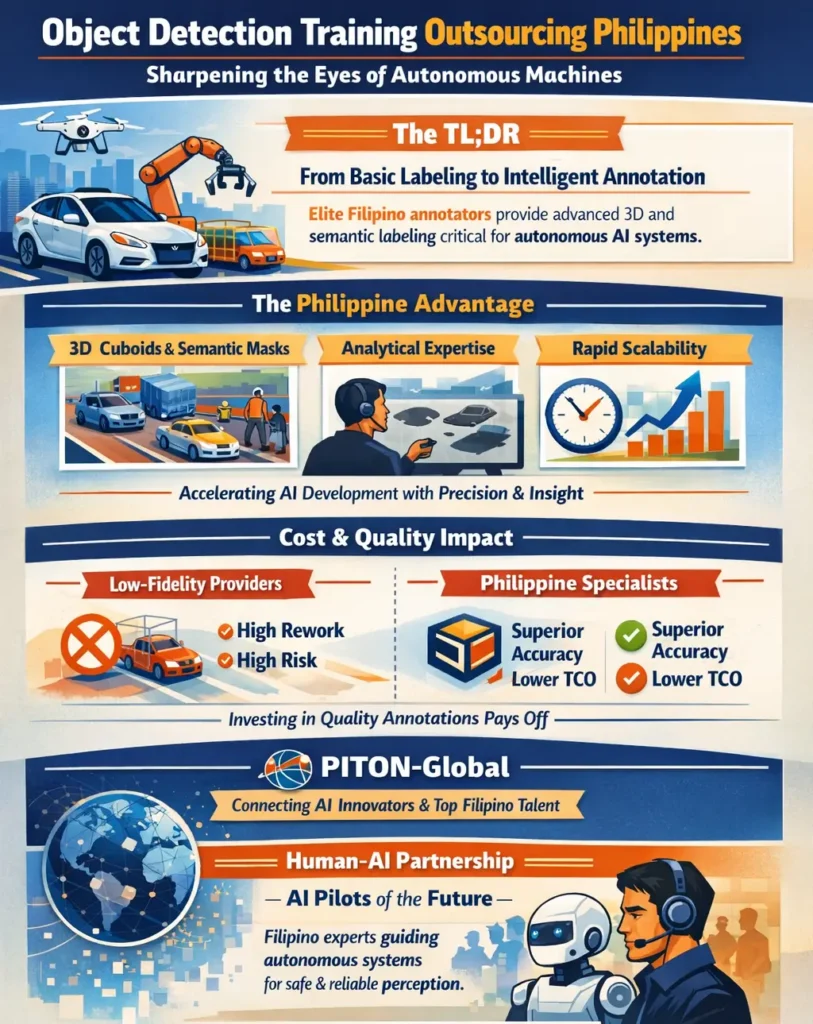
Object detection training outsourcing in the Philippines has transcended simple image labeling, evolving into a sophisticated service where expert human annotators provide the critical contextual understanding and edge-case analysis that autonomous machine perception systems require. This strategic outsourcing unlocks a higher caliber of AI performance, moving beyond basic recognition to genuine environmental comprehension, the standard now set for training-data teams behind autonomous-vehicle perception.
High-precision machine vision requires more than raw pixels; it demands expert-led “Intelligence Arbitrage.” In the Philippines, object detection training has evolved into a sophisticated cognitive discipline. By utilizing elite specialists for semantic segmentation and 3D point cloud annotation, global AI firms can significantly accelerate development timelines while ensuring the safety and reliability of autonomous systems.
Executive Briefing
- Beyond Basic Labeling: Modern perception models have outgrown simple bounding boxes, requiring complex 3D cuboids, semantic masks and per-pixel depth estimation labeling to navigate real-world chaos.
- The Philippine Cognitive Edge: The nation’s workforce provides the analytical reasoning necessary to distinguish subtle environmental cues, such as the difference between a pothole and a shadow.
- Strategic Time-to-Market: Outsourcing to specialized Filipino teams allows technology pioneers to scale rapidly without sacrificing the data fidelity required for edge-case safety.
- Total Cost of Ownership: Investing in high-fidelity offshore annotation reduces expensive model rework and mitigates the catastrophic risks of perception failure.
- Elite Connectivity via PITON-Global: As a strategic architect, PITON-Global bridges the gap between AI innovators and the most qualified Southeast Asian annotation experts.
Beyond the Bounding Box: The Cognitive Demands of Modern Object Detection
The early era of machine learning was defined by volume—drawing simple 2D rectangles around common street objects in static images. While those initial efforts laid the groundwork, they have become a bottleneck for the sophisticated, high-stakes applications of 2026. Today’s autonomous systems, from surgical robots to self-driving freight, require a profound spatial and contextual understanding of their surroundings. They must perceive orientation, predicted trajectory, and the complex interplay between overlapping objects.
This shift from clerical labeling to expert interpretation represents a fundamental transformation of the industry. Annotators in the Philippines are no longer just clicking points; they are actively reasoning through ambiguous visual scenarios and identifying subtle cues that automated systems miss. This transition from a labor-intensive to a knowledge-intensive model has established the archipelago as the primary global hub for high-fidelity machine vision training, from general object detection to autonomous vehicle data labeling.
“Our clients are no longer asking for teams that can simply label images. They are asking for partners who can help them solve their most complex perception challenges. This is the new frontier of object detection, and it’s a frontier defined by the exceptional cognitive talent of the Filipino workforce.” — John Maczynski, CEO, PITON-Global
The Perception Stack: From Raw Pixels to Actionable Intelligence
Transforming chaotic sensor data into reliable machine intelligence requires a multi-layered pipeline known as the perception stack. Human experts are the “ground truth” anchors at every level of this process.
The Human Role in the Perception Stack
| Stage | Description | Expert Human Contribution |
| 1. Sensor Fusion | Merging LiDAR, radar, and camera feeds. | Verifying spatial alignment and correcting temporal errors. |
| 2. Classification | Identifying object types (cyclist vs. pedestrian). | Precise semantic segmentation and 3D cuboid placement. |
| 3. State Estimation | Tracking velocity and acceleration. | Annotating movement trajectories across video frames. |
| 4. Scene Prediction | Anticipating future object behavior. | Labeling complex interactions and social cues (e.g., hand signals). |
The Economic Imperative of High-Fidelity Annotation
Choosing a training data partner is as much a financial decision as a technical one, which is why AV delivery programs use a safety-first scorecard for choosing a support partner. While “low-cost” providers may seem attractive initially, the hidden costs of poor data—model drift, safety failures, and months of rework—can be ruinous. Among specialized providers, the focus is on “Intelligence Arbitrage,” where the value is found in the drastic reduction of the Total Cost of Ownership (TCO).
Comparative Analysis of Annotation Strategy
| Cost Factor | Low-Fidelity (Commoditized) | High-Fidelity (Philippine Elite) |
| Initial Outlay | Lower | Competitive/Mid-tier |
| Rework & Correction | High | Minimal |
| Model Accuracy | Stagnant | Superior |
| Time to Market | Delayed by errors | Accelerated |
| Reputational Risk | Critical | Mitigated |
| Total Cost (TCO) | Higher | Lower |
The Future of Perception: A Collaborative Human-AI Ecosystem
We are entering an era where AI doesn’t replace human sight but relies on it for guidance. In the Philippines, a new generation of “AI Pilots” has emerged. These specialists act as the human co-pilots for autonomous machines, providing the critical oversight and ethical judgment needed to navigate the complexities of the physical world. This symbiotic relationship ensures that as machines become more autonomous, they remain firmly rooted in safe, human-verified reality.
Expert FAQs
Q: What skills distinguish an elite Filipino annotator from a basic one? Elite annotators possess high spatial reasoning and domain-specific knowledge. For example, in medical AI, they must recognize rare anomalies in imaging; in autonomous driving, they must interpret the intent behind a pedestrian’s body language.
Q: How does the Philippine BPO infrastructure support these high-tech needs? The nation offers a mature ecosystem with redundant high-speed connectivity and military-grade data security. This infrastructure is purpose-built to handle the massive data throughput required for 3D point cloud and high-resolution video annotation.
Q: Can synthetic data replace the need for human annotators? Synthetic data is a powerful supplement for rare “edge cases,” but it requires human validation to ensure it doesn’t lead to “model collapse.” Human-annotated real-world data remains the indispensable gold standard for safety-critical systems.
Q: What is the role of PITON-Global in this process? PITON-Global serves as the strategic link. We vet specialized annotation firms to match AI companies with teams that possess the exact technical and cognitive profile required for their specific perception stack.