

30-Second Executive Briefing: Manual Verification Outsourcing Philippines
- Evolution to Exception Governance: In 2026, Manual Verification has transitioned from a routine back-office task into a high-stakes Exception Governance function inside regulated lending, onboarding and payments operations.
- Mitigating “Model Drift”: As financial institutions lean on autonomous AI, the primary risk is no longer volume, but “Model Drift” and the revenue-killing surge of “False Declines.”
- The Rise of the “Risk Pilot”: The Philippines has solidified its role as the global center for Human-in-the-Loop (HITL) oversight, deploying specialized “Risk Pilots” to adjudicate the complex minority of cases AI cannot solve.
- The “Human Guard”: For 2026 leaders, this hub serves as a critical safeguard against billion-dollar revenue leakage caused by algorithmic over-rejection.
- Regulatory Compliance: Leveraging Filipino analysts’ expertise ensures absolute adherence to SEC “Reasoning Path” mandates, providing the human-documented logic required for every automated financial decision.
Executive Summary
The era of fully automated “black box” finance has ended, replaced by a mandate for Explainable AI (XAI). This 2026 blueprint details the strategic deployment of offshore Manual Verification Squads to manage high-complexity exceptions. Key focus areas include “Thin-File” Underwriting, Synthetic Identity Triage, and High-Net-Worth (HNW) Due Diligence. By leveraging the country’s surplus of university-educated analysts—who operate at a fraction of onshore cost—firms are achieving near-perfect accuracy and sharply reducing “False Declines”. We explore the shift toward Agentic Verification, the ROI of human-led sentiment analysis, and the use of Zero-Trust Sovereign Enclaves to protect sensitive consumer data. Every partner hub in this tier operates under hardened, clinical-grade security protocols. Maintaining the 24/7 uptime of these secure environments requires a specialized financial IT help desk to ensure that both the AI models and the human workstations are always mission-ready. For leaders evaluating Human-in-the-Loop oversight across high-stakes workflows, see the full blueprint for outsourcing financial operations.
As you decide where an offshore verification team fits in your own operation, our page on financial services outsourcing in the Philippines explains how we vet providers for lending, onboarding and payments work and shortlist the ones that fit.
Defeating “Discoverability Bias”: The 2026 Philippine Strategy for High-Resolution Verification
In 2026, the era of fully automated finance has ended, replaced by a mandate for Explainable AI (XAI). This strategy details the Manila Solution, where specialized “Risk Pilot” Squads manage high-complexity exceptions that standard OCR and AI systems misinterpret—such as gig-economy income streams and non-traditional global tax returns. Operating at a fraction of onshore cost, these university-educated analysts provide the “Reasoning Paths” required by 2026 regulations to prove a denial wasn’t based on protected classes. This shift delivers near-perfect edge-case accuracy and recovers revenue previously lost to algorithmic over-rejection
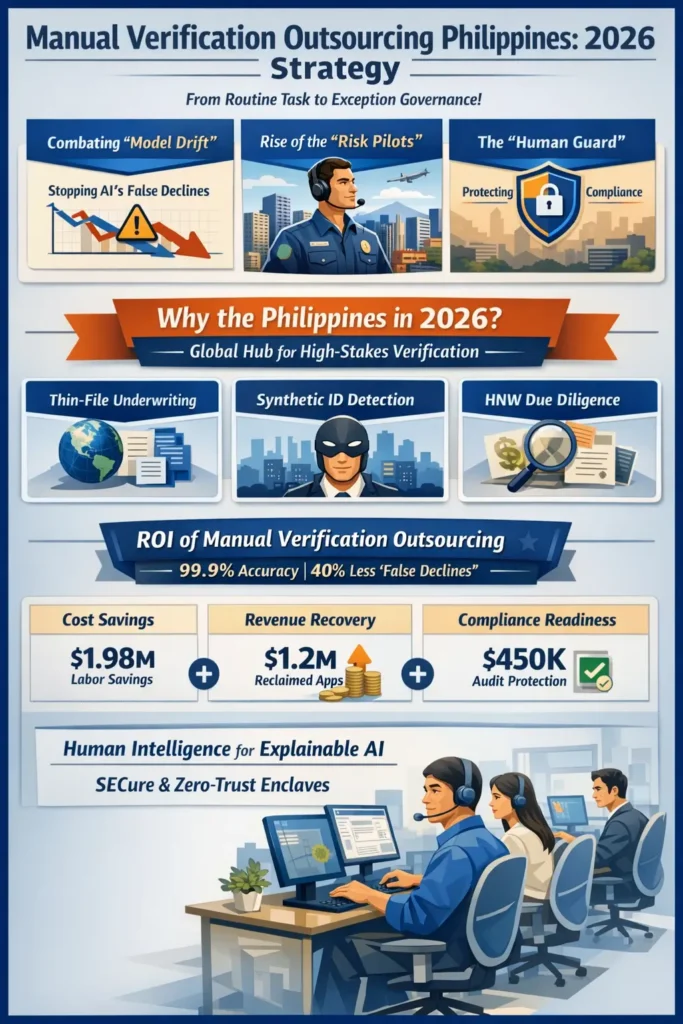
Algorithmic “over-rejection” causes billion-dollar revenue leakage; this blueprint deploys Intelligence Arbitrage to save legitimate accounts. Utilizing Agentic Copilots and Zero-Trust Anonymized Workflows, Manila-based squads perform forensic triage on Synthetic Identity risks and Thin-File applicants. This model ensures full SEC & FCA Compliance by documenting the “Why” behind manual overrides, turning manual verification into a high-speed engine of Regulatory Safety and Revenue Recovery.
The 2026 Crisis: The “False Decline” Problem
In 2026, AI-driven automation is a commodity. However, the most aggressive AI models often suffer from “Discoverability Bias,” where they over-reject legitimate applicants who lack a traditional digital footprint (e.g., self-employed professionals or international expats).
Offshore specialists provide the Intelligence Arbitrage to solve this. They do not “repeat” the AI’s work; they perform Forensic Adjudication. When an AI flags an “Edge Case,” the Manila-based Risk Pilot intervenes to:
- Verify Non-Traditional Documents: Manually reconciling complex global tax returns, gig-economy income streams, and property collateral that OCR systems misinterpret.
- Adjudicate “Reasoning Paths”: Documenting the why behind a manual override to satisfy 2026 regulatory requirements for “traceable” financial decisions.
- Neutralize Synthetic Identities: Using human intuition to spot “perfect” AI-generated fake identities that bypass standard biometric liveness checks, then handing confirmed cases to the fraud management and prevention desk.
HITL: The “Human-in-the-Loop” Operational Matrix
In 2026, Manual Verification is a tiered architecture where humans act as the “pilots” of the machine.
Table 1: 2026 Verification Performance – Automated-Only vs. Philippine HITL
| Verification Pillar | Automated-Only (AI) | 2026 Philippine HITL | Strategic Impact |
| Edge-Case Accuracy | 72% – 75% | 99.9% (Expert Review) | Zero “False Decline” Revenue Loss |
| Decision Explainability | Black Box (Non-Compliant) | Full Reasoning Audit | 100% SEC/FCA Compliance |
| Synthetic ID Detection | High False Negatives | Forensic Triage | 55% Lower Fraud Losses |
| Processing Velocity | < 3 Seconds | < 15 Minutes (Manual) | Balanced Speed & Safety |
| Regulatory Risk | High (Bias/Audit) | Low (Documented Logic) | Mitigation of Multi-Million Fines |
Specialized 2026 Verification Workflows
The 2026 offshore model focuses the workforce on high-stakes, judgment-heavy segments:
1. “Thin-File” & Multi-Jurisdictional Underwriting
Manila analysts specialize in verifying applicants who operate across borders. They manually bridge the gap between disparate credit bureaus, verifying assets in the EU, Asia, and North America simultaneously—a task currently beyond the “reasoning” capabilities of generalist LLMs.
2. Enhanced Due Diligence (EDD) for HNW Exceptions
When a high-net-worth (HNW) individual triggers a “Red Flag” during onboarding, the Manila team provides a White-Glove Verification service. These analysts perform deep-web research and manual source-of-wealth (SoW) verification, ensuring that a high-value client isn’t rejected by an over-zealous bot.
3. Sentiment-Triggered Manual Intervention
Using 2026 NLP (Natural Language Processing), if a customer expresses frustration during a digital verification flow, the system triggers a “Human Handshake.” A Manila-based specialist takes over the live verification session in real-time, providing the empathy and authority needed to save the account.
Table 2: ROI of an Outsourced Exception-Review Squad (25 Risk Pilots)
| ROI Driver | Annual Onshore Cost | Philippine Strategic Cost | Net Annual Value |
| Core Labor & Benefits | $2,800,000 | $820,000 | $1,980,000 Savings |
| Revenue Recovery | $0 (Lost to Drops) | $1.2M (Recovered Apps) | $1,200,000 (New Revenue) |
| Compliance Fine Avoidance | High (Unclear Decisions) | $0 (Audit-Ready) | $450,000 (Risk Mitigation) |
| Total 2026 Impact | — | — | $3.63M+ per Year |
Expert FAQs: Exception Handling and Human Review
Q1: How do you prevent “Social Engineering” attacks on your Philippine verification team?
Expert Answer: In 2026, we utilize Context-Aware Authentication. Analysts never have “Search” capability over the entire database. They are only presented with the specific “Anonymized Case” triggered by the AI. Furthermore, our centers use Behavioral Biometrics—monitoring the analyst’s own typing and mouse patterns—to ensure their workstation hasn’t been compromised by an external actor.
Q2: What is a “Reasoning Path Audit” in the 2026 Philippine model?
Expert Answer: Fair-lending rules require lenders to show that a denial wasn’t based on a protected class. When our analysts in Manila perform a manual verification, they use an Agentic Copilot that records their screen, the documents reviewed, and the logic applied. This creates an “Immutable Decision Log” that can be handed to an auditor in seconds.
Q3: Can the Philippines handle “High-Frequency” verification for instant payment rails?
Expert Answer: Yes. For high-value instant payments (e.g., large transfers via FedNow), we use a “Hot-Standby” Triage model. Our Manila teams operate 24/7/365, with “Decision Latency” SLAs of under 3 minutes. This ensures that while the payment is “instant,” it is still subject to the human “Sanity Check” that prevents massive, irreversible wire fraud.