
Back
Financial Services Technical Support Outsourcing Philippines: 2026 Strategy

By Ralf Ellspermann / 13 February 2026
 Authored by Ralf Ellspermann, CSO of PITON-Global, & 25-Year Philippine BPO Veteran | Executive | Verified by John Maczynski, CEO of PITON-Global, and Former Global EVP of the World's Largest BPO Provider on February 13, 2026

30-Second Executive Briefing: Financial IT Help Desk Outsourcing Philippines
- From Support to “Ecosystem Resilience”: In 2026, the IT Help Desk has transitioned from basic troubleshooting to a Strategic Resilience Engine, responsible for the uptime of complex API integrations and real-time payment rails.
- The API “Partner Trap” Resolution: As financial institutions integrate hundreds of third-party APIs, Philippine-based “Technical Architects” now manage the “translation layer,” resolving 24/7 integration friction that previously required high-cost onshore engineering.
- Agentic AI-Human Hybrid: Outsourcing in 2026 utilizes Agentic AI to resolve 60–75% of routine tickets (password resets, MFA issues) autonomously, while Filipino specialists focus on high-stakes Tier 2/3 escalations and root-cause analysis.
- Hardened Financial Security: Leading Philippine hubs employ Zero-Trust Biometric VDI and are fully aligned with PCI-DSS 4.0 and SOC2, ensuring that technical support occurs within a secure, “Clean Room” environment.
- 60% Cost Arbitrage: By leveraging university-educated IT professionals at a $14–$22/hour fully loaded benchmark, firms are bypassing the $55+/hour onshore cost for specialized financial technical support.
Executive Summary
In the 2026 “Instant Finance” era, a technical glitch is no longer just an inconvenience—it is a regulatory and reputational emergency. This blueprint details the strategic deployment of Philippine-based Financial IT Help Desks to manage the complexity of modern fintech and banking stacks. Key innovations include Predictive Bug Analytics, Automated Ticket Orchestration, and 24/7 DevOps-linked support. By shifting from a reactive “break-fix” model to a proactive “Model Audit” posture, firms are reducing Mean Time to Resolution (MTTR) by 40% and transforming the IT Help Desk into a primary driver of customer trust and platform stability. By shifting from a reactive “break-fix” model to a proactive “Model Audit” posture, firms are reducing Mean Time to Resolution (MTTR) by 40% and transforming the IT Help Desk into a primary driver of customer trust and platform stability. This technical resilience ensures that transaction flows remain uninterrupted, preventing the financial friction that often necessitates late-stage Debt Collection Outsourcing Philippines: 2026 Strategic Blueprint. For institutions architecting full-stack operational resilience, explore the complete Financial Services Outsourcing Philippines (2026): A Strategic Blueprint.
The “Partner Layer”: The 2026 Philippine Strategy for Ecosystem Resilience
By 2026, 70% of transaction failures occur in the interoperability layer between third-party APIs (BaaS, biometric ID, and payment rails), not in the core code itself. This strategy details the Manila Solution, where university-educated “Technical Architects” manage this “Partner Layer” around the clock. Operating at a $14–$22/hour benchmark, these hubs utilize Agentic AI to resolve routine MFA and authentication tickets while human experts perform ephemeral sandbox debugging. This model delivers 60% cost arbitrage and a 40–60% reduction in MTTR, transforming support into a high-speed engine of Platform Uptime and client trust.
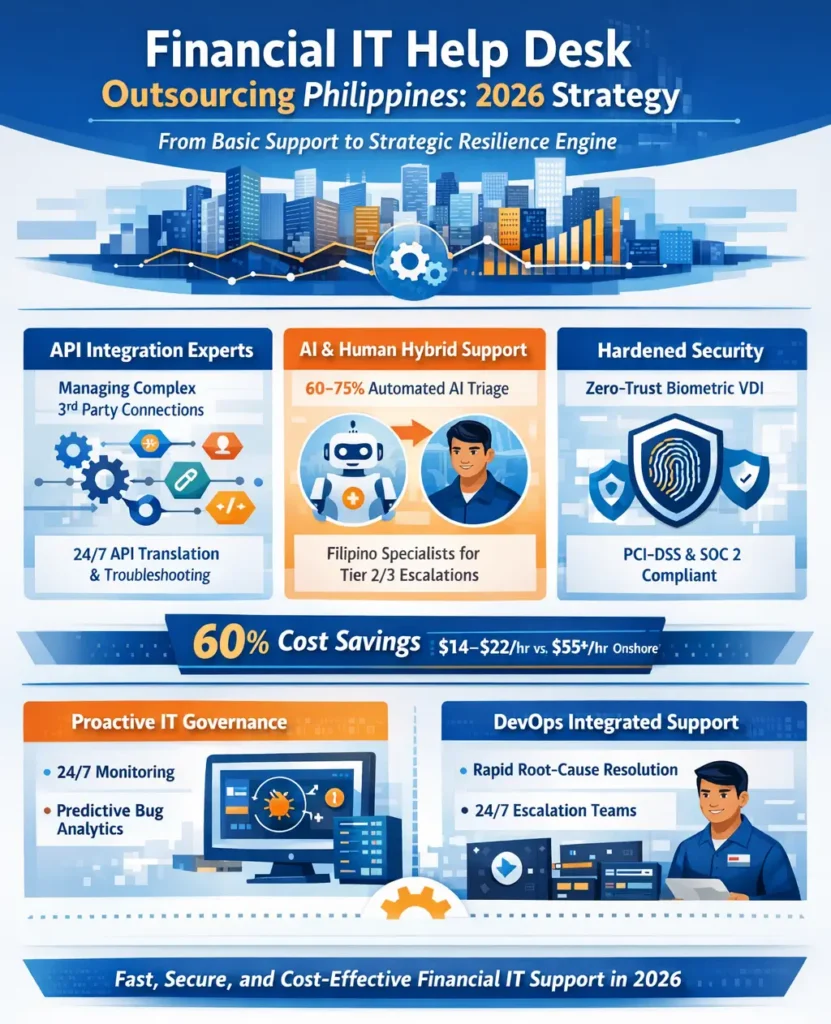
Standard “Break-Fix” models fail the 2026 “Zero-Latency” mandate; this blueprint deploys Intelligence Arbitrage to secure the technical stack. Utilizing Agentic AI-Human Hybrids, Manila hubs automate 60–75% of routine triage, allowing specialists to focus on Root-Cause Analysis (RCA) and real-time ISO-compliant message mapping. This model ensures SEC-mandated incident disclosure within 36 hours and adheres to PCI-DSS 4.0 through Zero-Trust “Clean Rooms,” turning technical support into a high-speed engine of Global Scalability and Regulatory Safety.
The 2026 Shift: The End of Reactive Support
By 2026, the traditional IT help desk model—waiting for a user to report a bug—is dead. Financial platforms now operate on “Zero-Latency” expectations. The Philippines has emerged as the global leader for Proactive IT Governance, where help desk teams monitor live telemetry and “self-healing” workflows to kill bugs before they impact the end-user.
Intelligence Arbitrage: The “Risk Pilot” IT Model
The 2026 Philippine workforce consists of Technical Architects—professionals who aren’t just reading scripts, but are managing the interplay between Cloud Infrastructure (AWS/Azure) and Financial Transaction Rails.
Table 1: 2026 Financial IT Help Desk Benchmarks – Onshore vs. Philippine Hub
| Performance Metric | Legacy Onshore (US/UK) | 2026 Philippine Help Desk | Strategic Impact |
| Tier 1 Automation | 40% (Chatbots) | 75% (Agentic AI) | Near-Instant Triage |
| First-Contact Resolution | 65% – 70% | 94% (AI-Augmented) | Drastic CX Improvement |
| Compliance Alignment | Periodic Audits | Real-Time / SOC2 Native | Zero Regulatory Lag |
| Follow-the-Sun Coverage | High Premium | Native 24/7/365 | Continuous Global Uptime |
| Fully Loaded Cost (p/hr) | $55 – $85 | $14 – $22 | 65%+ OpEx Reduction |
Specialized 2026 IT Help Desk Workflows
Our Philippine strategic hubs are hardened for three specific “modern finance” technical challenges:
1. API & Integration Support (The “Partner Layer”)
Modern banks are modular. A single “login” might touch identity providers, credit bureaus, and payment processors. Philippine specialists act as the Technical Integration Desk, managing the manual mapping of ISO-compliant messages and resolving API “handshake” rejections in real-time.
2. Security & MFA Orchestration
With the 2026 surge in sophisticated social engineering, the IT Help Desk is the first line of defense. Philippine teams utilize Behavioral Biometrics to verify users during password resets or MFA recovery, ensuring that “Account Takeover” (ATO) attempts are neutralized at the service level.
3. Tier 3 DevOps Escalation
In 2026, the help desk is no longer siloed from engineering. Philippine Tier 3 teams are integrated into DevOps pipelines, providing “Root Cause Analysis” (RCA) directly into GitHub or Jira. This allows a $18/hour specialist in Manila to identify a code-level bug that previously required a $150k/year onshore developer to diagnose.
Table 2: ROI of Financial IT Help Desk Outsourcing (30-Specialist Squad)
| ROI Driver | Annual Onshore Cost | Philippine Strategic Cost | Net Annual Gain |
| Core Labor & Benefits | $3,600,000 | $1,100,000 | $2,500,000 Savings |
| Efficiency (AI Hybrid) | 1.0x Productivity | 2.5x Productivity | $650,000 (Value Lift) |
| Loss Avoidance (Uptime) | Variable Risk | 99.99% Reliability | $400,000 (Risk Mit.) |
| Total 2026 Impact | — | — | $3.55M per Year |
Expert FAQs: Financial IT Help Desk & Technical Support
Q1: How does the Philippines handle the 2026 “SEC Cyber Resilience” incident disclosure rules?
Expert Answer: Under 2026 mandates, material incidents must be disclosed within 36–72 hours. Philippine hubs operate Zero-Trust SOC-integrated desks. When a technical failure occurs, the help desk team immediately triggers a “Materiality Scan.” If a breach is detected, the Manila team generates the “Decision Log” required for regulatory disclosure simultaneously with the technical fix, ensuring you meet the 36-hour window with verified data.
Q2: Can Philippine IT teams handle “White-Glove” VIP support for Wealth Management?
Expert Answer: Yes. We use a Tiered Concierge Model. While Agentic AI handles the general population, we deploy “High-EQ Technical Agents” in Manila specifically for HNW (High-Net-Worth) clients. These agents are trained not just in the software, but in the specific privacy and “empathy protocols” required for private banking, ensuring $10M+ clients never feel they are being “outsourced.”
Q3: What is “Agentic Engineering Assist” in the 2026 model?
Expert Answer: This is where our Philippine agents use AI to “read” your codebase. When a ticket comes in, the AI scans your GitHub/Confluence and provides the agent with a “Predicted Patch” or a specific line-item diagnosis. This allows an IT specialist in Manila to solve complex environment issues that previously required a senior developer, effectively “scaling” your engineering team at help-desk prices.
Achieve sustainable growth with world-class BPO solutions!
PITON-Global connects you with industry-leading outsourcing providers to enhance customer experience, lower costs, and drive business success.
Get Your Top 1% Vendor List
Author
Ralf Ellspermann is a multi-awarded outsourcing executive with 25+ years of call center and BPO leadership in the Philippines, helping 500+ high-growth and mid-market companies scale call center and customer experience operations across financial services, fintech, insurance, healthcare, technology, travel, utilities, and social media.
A globally recognized industry authority - and a contributor to The Times of India, CustomerThink, and The AI Journal - he advises organizations on building compliant, high-performance offshore contact center operations that deliver measurable cost savings and sustained competitive advantage.
Known for his execution-first approach, Ralf bridges strategy and operations to turn call center and business process outsourcing into a true growth engine. His work consistently drives faster market entry, lower risk, and long-term operational resilience for global brands.
EXECUTIVE GOVERNANCE & ACCURACY STANDARDS
Authored by:
Ralf Ellspermann
Founder & CSO of PITON-Global,
25-Year Philippine BPO Veteran,
Multi-awarded Executive
Specializing in strategic sourcing and excellence in Manila
View Full Bio
Verified by:
John Maczynski
CEO of PITON-Global, and former Global EVP of the World’s largest BPO provider | 40 Years Experience
Ensuring global compliance and enterprise-grade service standards
View Full Bio
Last Peer Review: February 13, 2026
This service framework is audited quarterly to meet shifting global outsourcing regulations and COPC standards.