
Back
LiDAR 3D Point Cloud Annotation Outsourcing Philippines: Building the Spatial Brain of Autonomous Systems

By Ralf Ellspermann / 16 March 2026
 Authored by Ralf Ellspermann, CSO of PITON-Global, & 25-Year Philippine BPO Veteran | Executive | Verified by John Maczynski, CEO of PITON-Global, and Former Global EVP of the World's Largest BPO Provider on March 16, 2026

TL;DR: The Key Takeaway
The outsourcing of LiDAR 3D point cloud annotation in Manila has transcended simple data entry, evolving into a sophisticated discipline that builds the very spatial intelligence of autonomous systems. This Southeast Asian powerhouse is now the strategic hub for AI leaders seeking to translate raw sensor data into high-fidelity, three-dimensional worlds. PITON-Global orchestrates this ecosystem, connecting innovators with elite Filipino teams who provide the expert-level judgment and logical verification required to ensure the safety and performance of next-generation AI, making the archipelago indispensable for the future of mobility and robotics.
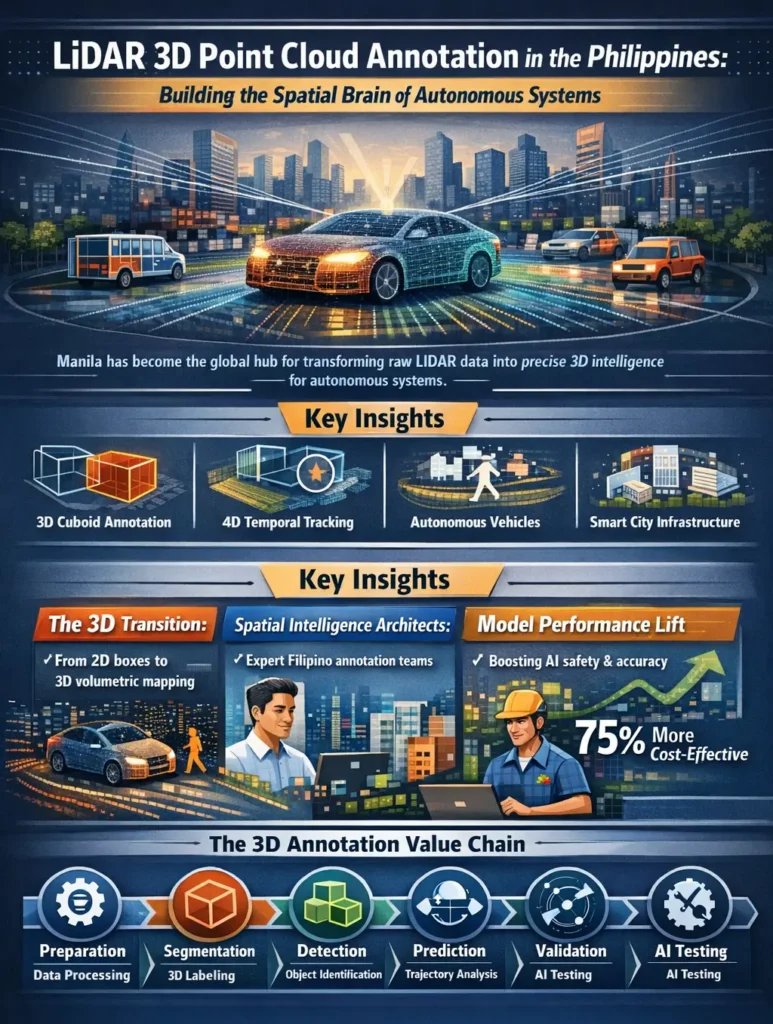
LiDAR 3D point cloud annotation in the Philippines is the specialized process of transforming millions of raw laser pulses into a semantically labeled, 3D digital reality. In 2026, Manila has solidified its position as the global hub for Spatial Intelligence Architecture, where Filipino experts move beyond 2D boxes to “sculpt” 3D cuboids and perform 4D temporal tracking. This work provides the foundational “spatial brain” for autonomous vehicles, industrial robotics, and smart city infrastructure, delivering a quantifiable “Model Performance Lift” that is critical for real-world safety.
Executive Briefing
- The 3D Transition: Shifting from flat pixel labeling to complex volumetric segmentation in dense point clouds, enabling AI to perceive depth, distance, and velocity.
- Spatial Intelligence Architects: Filipino annotators have evolved into “Architects” who resolve sensor-fusion ambiguities—such as distinguishing a pedestrian from a high-fidelity billboard—where automated tools fail.
- Intelligence Arbitrage: Leveraging the Philippines’ $42 billion BPO ecosystem to provide specialized cognitive feedback that reduces “disengagement events” in Level 4 autonomous systems.
- Economic Velocity: Utilizing the 2026 CREATE MORE Act to claim 100% deductions on power and training costs, keeping the Philippines 60–75% more cost-effective than onshore alternatives.
- Sovereign Data Hub: Manila provides a “secure sandbox” environment for sensitive geospatial data, ensuring compliance with global standards like UL 4600 and the EU Data Act.
The Third Dimension: Why LiDAR is the Bedrock of Autonomy
In 2026, the world of AI perception has moved from “What is it?” to “Where is it exactly, and where is it going?” While 2D images provide color and texture, LiDAR (Light Detection and Ranging) provides the skeletal truth of the environment.
A raw point cloud is a chaotic “dust” of millions of points. Filipino annotation experts transform this dust into a logical framework. They perform Semantic Segmentation—classifying every point (road, building, vegetation)—and Object Detection, ensuring that an autonomous system understands the precise volume and trajectory of every actor in its path.
The Manila Advantage: From Task-Based Labor to Cognitive Partnership
The Philippine workforce’s transition to Spatial Intelligence Architecture is driven by a unique combination of high technical literacy and an intuitive grasp of spatial reasoning.
| Aspect | The Old Model (2D Annotation) | The New Model (3D LiDAR Annotation) |
| Core Task | Drawing 2D boxes on flat images. | Segmenting & classifying 3D cuboids. |
| Required Skill | Basic visual recognition. | Spatial reasoning & physics awareness. |
| Value Metric | Cost per image. | Model Accuracy & Disengagement Reduction. |
| Workforce Role | Data Labeler. | Spatial Intelligence Architect. |
The 3D Annotation Value Chain
PITON-Global aligns global technology firms with the specific tiers of talent required to build a robust 3D perception model:
| Stage | Description | Required Expertise | Value Proposition |
| 1. Preparation | Cleaning/formatting raw LiDAR data. | Technical Proficiency. | Scalability & Data Hygiene. |
| 2. Segmentation | Classifying every point in the cloud. | Foundational Skill. | Creating the “Base Map.” |
| 3. Detection | Identifying 3D volumes (cars, people). | Intermediate Skill. | Populating the “Actor” layer. |
| 4. Prediction | Annotating 4D trajectory/intent. | Advanced Analytical. | Proactive safety/decision-making. |
| 5. Validation | Edge-case & “AI Pilot” testing. | Elite / AI Pilot. | Reliability in “Black Swan” events. |
Expert FAQs
Why is 3D annotation significantly more expensive than 2D?
It is a “Cognitive Step Up.” A 3D cuboid requires 8 points of reference and orientation in a 360-degree space, compared to 2 points for a 2D box. In 2026, Filipino architects also handle Temporal Consistency, ensuring an object is tracked accurately across a 4D sequence (time), which increases the complexity and the “Intelligence Arbitrage” value.
How does the 2026 CREATE MORE Act (RA 12066) specifically help LiDAR projects?
LiDAR processing is power-intensive and requires massive upskilling. The act allows BPOs to deduct 100% of their power expenses and 100% of their training costs from their taxable income. This allows Manila-based firms to invest in the latest GPU-accelerated annotation platforms while maintaining a lower price point for clients.
Can these teams handle “Sensor Fusion” (LiDAR + Camera + Radar)?
Yes. In 2026, the Philippines is the leader in Multi-Modal Synchronization. Filipino specialists ensure that the cuboid in the LiDAR cloud matches the pixel coordinates in the 2D video feed, providing the redundant verification needed for high-stakes safety models.
What is the “Model Performance Lift” for 2026?
It is the measurable improvement in an AI’s real-world behavior. Firms using Manila-based 3D architects report up to a 30% reduction in “Phantom Braking” and a 25% improvement in object detection at long ranges (100m+) compared to automated-only or generalist labeling teams.
Achieve sustainable growth with world-class BPO solutions!
PITON-Global connects you with industry-leading outsourcing providers to enhance customer experience, lower costs, and drive business success.
Get Your Top 1% Vendor List
Author
Ralf Ellspermann is a multi-awarded outsourcing executive with 25+ years of call center and BPO leadership in the Philippines, helping 500+ high-growth and mid-market companies scale call center and customer experience operations across financial services, fintech, insurance, healthcare, technology, travel, utilities, and social media.
A globally recognized industry authority—and a contributor to The Times of India and CustomerThink —he advises organizations on building compliant, high-performance offshore contact center operations that deliver measurable cost savings and sustained competitive advantage.
Known for his execution-first approach, Ralf bridges strategy and operations to turn call center and business process outsourcing into a true growth engine. His work consistently drives faster market entry, lower risk, and long-term operational resilience for global brands.
EXECUTIVE GOVERNANCE & ACCURACY STANDARDS
Authored by:

Ralf Ellspermann
Founder & CSO of PITON-Global,
25-Year Philippine BPO Veteran,
Multi-awarded Executive
Specializing in strategic sourcing and excellence in Manila
View Full Bio
Verified by:

John Maczynski
CEO of PITON-Global, and former Global EVP of the World’s largest BPO provider | 40 Years Experience
Ensuring global compliance and enterprise-grade service standards
View Full Bio
Last Peer Review: March 16, 2026
This service framework is audited quarterly to meet shifting global outsourcing regulations and COPC standards.