

30-Second Executive Briefing: KYC & AML Outsourcing Philippines
- From “Check-the-Box” to Effectiveness: In 2026, the global financial sector has moved beyond static compliance toward a standard of Demonstrable Effectiveness, where regulators demand proof of active risk mitigation.
- Perpetual KYC (pKYC) Integration: Traditional periodic reviews are being replaced by Perpetual KYC (pKYC) and Agentic AI Orchestration, enabling real-time, event-driven identity monitoring across financial crime and operations desks run from Manila.
- The Intelligence Arbitrage Play: The Philippines has emerged as the definitive global hub for this shift, providing “Intelligence Arbitrage”—high-IQ, AML-certified specialists who govern and audit autonomous compliance systems.
- Combating Modern Fraud: This strategic hub is critical for combating the 2026 surge in synthetic identity fraud and deepfake-driven money laundering through advanced human-AI forensic validation.
- Regulatory Resilience Strategy: For C-suite leaders, outsourcing these functions to Manila is no longer a cost-play; it is a Regulatory Resilience strategy designed to protect institutional integrity in a hyper-volatile threat landscape.
Executive Summary
As the regulatory landscape tightens under 2026 mandates like the AMLA effectiveness guidelines and the GENIUS Act, financial institutions face a “compliance gap” where legacy manual processes cannot keep pace with real-time payment rails. This blueprint examines the strategic integration of Manila-based compliance hubs to solve this crisis. By leveraging a Human-in-the-Loop (HITL) model, firms can achieve a 99.9% verification accuracy rate while reducing operational costs by over 65%. We explore the move toward Zero-Trust Data Enclaves, the role of Filipino “AI Orchestrators” in managing complex entity resolution, and the ROI of shifting from reactive to pre-emptive financial crime prevention. To see how perpetual KYC and regulatory resilience integrate across the financial ecosystem, review the full Financial Services Outsourcing Philippines 2026 strategic framework.
From Static Reviews to “Event-Driven” Integrity: The 2026 Philippine Blueprint for Compliance
In 2026, money moves in milliseconds, making the traditional 3-to-5-year “Periodic Review” model obsolete. This strategy details the Manila Solution, where specialized “Risk Pilots” utilize Perpetual KYC (pKYC) to turn compliance into a “Live State” document. By leveraging a Human-in-the-Loop (HITL) model, offshore hubs resolve complex Ultimate Beneficial Ownership (UBO) mapping and detect AI-generated deepfakes that standard bots miss. This model delivers 99.9% verification accuracy and reduces onboarding friction by 55%, while slashing operational costs by over 65% compared to domestic US or EU compliance teams.
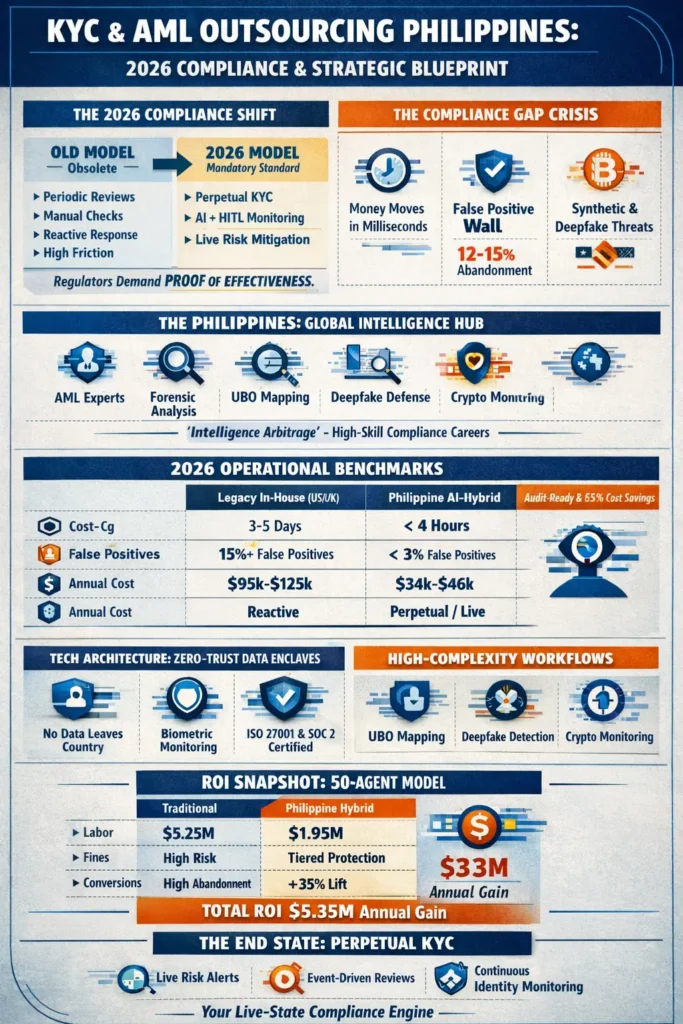
Static checklists fail the 2026 “Effectiveness” standard; this blueprint deploys Continuous Identity Orchestration to close the “Compliance Gap”. Utilizing Zero-Trust VDI Architecture, Manila-based analysts access encrypted “view-only” data streams, ensuring Sovereign Data Residency where PII never leaves your domestic servers. This model features Agentic AI to automate Level-1 alerts, while high-EQ specialists perform forensic audits on Crypto-Adjacent and Synthetic Identity risks. It transforms KYC into a high-speed engine of Global Regulatory Resilience and investor trust.
The 2026 Compliance Crisis: Beyond the Static Checklist
For decades, the banking industry relied on “Periodic Reviews”—refreshing customer files every three to five years based on risk level. In 2026, this model is officially obsolete. Regulators now demand Continuous Identity Orchestration.
The challenge is twofold:
- The Speed of Fraud: Money moves in milliseconds, but traditional KYC takes days.
- The “False Positive” Wall: Over-reliance on basic AI has led to high friction for legitimate customers, with abandonment rates spiking during onboarding.
The Philippines’ BPO sector has solved this by evolving into a Global Intelligence Hub. Instead of basic data entry, Filipino teams now provide Forensic Pattern Recognition, identifying synthetic identities and sophisticated “shell-in-shell” laundering clusters before they penetrate the ecosystem.
Intelligence Arbitrage: The New Philippine Value Proposition
In 2026, the term “Labor Arbitrage” is a relic. We now speak of Intelligence Arbitrage. In the United States or United Kingdom, a mid-level AML analyst often carries a fully loaded cost exceeding $110,000, yet high churn rates lead to “institutional memory loss.”
In Manila, compliance is a high-status, long-term career path. Firms gain access to CPA-qualified and ACAMS-certified specialists at a fraction of the cost, ensuring that the “Human-in-the-Loop” is actually an expert, not a transient worker.
Table 1: 2026 Operational Benchmarks – US vs. Philippines
| Performance Metric | Legacy In-House (US/UK) | 2026 Philippine AI-Hybrid | Strategic Impact |
| Onboarding Velocity | 3–5 Business Days | < 4 Hours | 55% Reduction in Abandonment |
| False Positive Rate | 12–15% | < 3% | Lower Friction, Higher RevOps |
| Verification Accuracy | 94–96% | 99.9% | Reduced “Buyback” & Fine Risk |
| FTE Loaded Cost (Annual) | $95k – $125k | $34k – $46k | 65%+ OpEx Savings |
| Compliance Posture | Reactive/Periodic | Proactive/Perpetual | Audit-Ready “Live State” |
Technical Architecture: Sovereign Data Zones & Zero-Trust
One of the primary concerns for 2026 boardrooms is Data Sovereignty. Our blueprint utilizes a Zero-Trust VDI (Virtual Desktop Infrastructure).
- No Local Data Residency: Customer PII (Personally Identifiable Information) never leaves your domestic servers. Offshore analysts utilize encrypted, “view-only” streams.
- Biometric Desktop Monitoring: Security is enforced at the individual agent level using liveness detection to ensure that only the assigned analyst can view the screen.
- ISO 27001 & SOC2 Type II: Every partner hub in this tier operates under hardened, clinical-grade security protocols.
Specialized Workflows: High-Complexity Vetting
The 2026 Manila compliance model is built for the most difficult segments of the fintech and banking ecosystem:
1. UBO Mapping & Entity Resolution
Mapping Ultimate Beneficial Ownership (UBO) in 2026 requires navigating global corporate registries that are often opaque. Filipino specialists use OSINT (Open-Source Intelligence) tools to map “shell-in-shell” structures across multiple jurisdictions in real-time.
2. Deepfake & Synthetic Identity Defense
As AI-generated fraud surges, simple document uploads are no longer sufficient. Manila hubs provide the Human-in-the-Loop validation required to catch subtle “glitches” in biometric liveness checks that automated systems might overlook. This forensic precision is the core of our specialized Financial Services Manual Verification Outsourcing Philippines: 2026 Strategy, which provides the final layer of human certainty in an increasingly automated fraud landscape.
3. Crypto-Adjacent & Stablecoin Monitoring
With the rise of stablecoins in global trade, Filipino teams are trained in On-Chain Analytics, monitoring transaction velocity and “Travel Rule” compliance for digital asset flows, work that draws on outsourced financial data analytics and management.
Table 2: Service Level ROI (50-Agent Operation Example)
| Factor | Traditional Annual Cost | Philippine Hybrid Cost | Annual Net Gain |
| Labor & Benefits | $5,250,000 | $1,950,000 | $3,300,000 |
| Regulatory Fine Mitigation | Variable (High Risk) | Tiered Protection | $1.2M (Estimated) |
| Onboarding Efficiency | High Abandonment | 35% Lift in Conversion | $850,000 (Revenue) |
| Total ROI Contribution | — | — | $5.35M per Year |
Moving Toward Perpetual KYC (pKYC)
The ultimate goal of the 2026 blueprint is the transition to pKYC. Instead of a calendar-based refresh, the offshore hub acts as an “Events Engine.”
If a customer has a sudden spike in transaction volume, a change in corporate directors, or appears in negative media, the system triggers an immediate, agent-led review. This ensures that your risk profile is a “Live State” document, significantly reducing the “Compliance Drift” that leads to massive regulatory fines.
Expert FAQs: Offshore Compliance Operations
Q1: How do Manila teams manage the “Explainability” requirement in 2026 AI mandates?
Expert Answer: Regulators now require that every AI-driven rejection or “frozen account” decision be auditable and free from bias. Our Manila teams serve as “Audit Trail Guardians.” They don’t just use AI; they provide the human narrative and “reason codes” for every automated decision, ensuring that if a regulator asks “Why was this customer flagged?”, you have a documented, expert-reviewed answer ready in seconds.
Q2: Can offshore teams handle specialized US-specific regulations like the Corporate Transparency Act (CTA)?
Expert Answer: Yes. In fact, many Filipino specialists are more familiar with the nuances of FinCEN’s BOI (Beneficial Ownership Information) database than domestic generalists. Because these teams are focused entirely on compliance, they undergo continuous training on US, UK, and EU regulatory updates as part of their core KPI structure.
Q3: What happens if there is a connectivity or geopolitical disruption?
Expert Answer: 2026 strategic blueprints require Operational Resilience (DORA compliance). Top-tier Manila hubs utilize Triple-Redundant Infrastructure: multiple ISP fiber loops, satellite (Starlink) backups, and onsite power generation. Furthermore, the “Zero-Trust VDI” model allows for immediate failover; if one facility is compromised, the “Intelligence” can be shifted to a secondary secure site without the data ever being at risk.