

Outsourcing robotic vehicle delivery operations to the Philippines means running the back-end of a last-mile rover fleet: automated dispatch coordination, sidewalk-navigation exceptions, and the mid-trip exception process that decides whether a stuck rover is recovered remotely or by a local field technician. The model is “offshore coordinates, local hands execute,” and mean-time-to-resolution is the metric that protects idle-fleet economics and customer experience. It is one strand of the remote assistance and incident triage for driverless fleets.
Key Takeaways
- Coordinate offshore, execute locally. Dispatch and exception triage run remotely; physical recovery stays local.
- Mid-trip exceptions are the core. Sidewalk blocks, faults, and access failures decide whether MTTR stays low.
- MTTR is money. A stuck rover is idle revenue and a CX hit; resolution speed is a direct cost lever.
- Field dispatch needs a clean trigger. When remote help can’t resolve, the path to a local technician must be instant and documented.
What in Robotic Delivery Operations Can Be Outsourced?
Direct answer: The coordination back-end: automated fleet dispatch, sidewalk-navigation exception handling, mid-trip triage, and merchant-to-customer escalation — while local technicians perform the physical recovery a stuck rover needs.
A last-mile rover fleet generates two kinds of work: information work and physical work. The information work — coordinating dispatch, handling sidewalk-navigation exceptions, triaging mid-trip problems, and managing merchant and customer escalations — runs well from an offshore center wired into the fleet systems. The physical work — retrieving a tipped or disabled rover, clearing a jam — stays local. The discipline is keeping the line clear: offshore coordinates and resolves whatever it can remotely; local hands execute only when a physical touch is genuinely required. That split keeps the expensive local footprint lean, and it mirrors the division used in driverless long-haul logistics support.
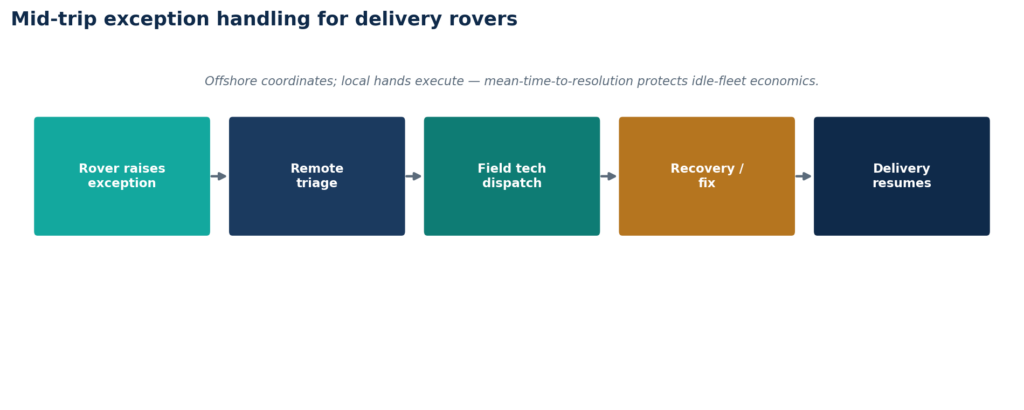
Figure 1 — Offshore coordinates; local hands execute — mean-time-to-resolution protects idle-fleet economics.
According to John Maczynski, CEO, PITON-Global, “In rover delivery the killer cost is the unit sitting motionless on a sidewalk while someone figures out what to do. The whole game is resolving the exception remotely in seconds, and only rolling a truck when you truly must. That triage discipline is what a good offshore operation sells you.”
How Does the Mid-Trip Exception Process Work?
Direct answer: A rover raises an exception, a remote operator triages it against a playbook, resolves it remotely where possible, and dispatches a local field technician only when a physical touch is required — closing the loop when the rover resumes.
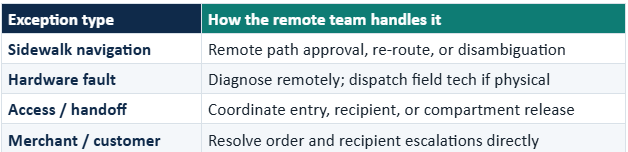
The mid-trip exception is the heartbeat of the operation. A rover encounters a blocked path, a hardware fault, a locked compartment, or a recipient problem and raises an exception. The remote team triages against documented playbooks, resolves remotely where it can — re-routing, re-planning, coordinating with the merchant or customer — and, where the issue is physical, dispatches the nearest qualified local technician with full context. The loop closes when the rover is back in service and the event is logged, the same record that governing liability in the remote-intervention hand-off depends on. Tight coupling between remote triage and field dispatch is the difference between a rover down for two minutes and one down for two hours.

Figure 2 — Each exception type needs a documented playbook and a clean path to field dispatch.
“The number we hold partners to is mean-time-to-resolution by exception type, because that single metric ties straight to fleet utilization and customer satisfaction. A team that drives MTTR down is quietly improving your unit economics every single day,” said Ralf Ellspermann, CSO, PITON-Global.
Why Does Offshore Coordination Improve the Economics?
Direct answer: Because efficient remote triage resolves most exceptions without rolling a truck, and one offshore team can coordinate fleets across many markets — keeping the costly local field footprint lean and mean-time-to-resolution low.
Local field time is the expensive resource, and it is governed by how well exceptions are triaged before a technician is dispatched. A strong remote operation resolves the majority of exceptions without a physical touch, batches and routes the ones that need one, and does it consistently across many markets from a single center — without standing up a coordination office in every city. The physical footprint stays lean and variable; the intelligence that drives its efficiency is centralized and low-cost, which is exactly what modeling the unit economics of AV delivery support makes visible. That is the core of why robotic delivery back-ends outsource well to the Philippines.
“Measure mean-time-to-resolution by exception type and put it where everyone can see it. The moment that number is visible, the whole operation starts optimizing toward it,” noted John Maczynski, CEO, PITON-Global.
Frequently Asked Questions
Can Robotic Delivery Operations Really Be Outsourced if They’re Physical?
The physical recovery stays local, but the coordination back-end — dispatch, sidewalk-navigation exceptions, mid-trip triage, and escalations — runs offshore. The model is “offshore coordinates, local hands execute.”
What Is the Key Metric for the Operation?
Mean-time-to-resolution by exception type. A stuck rover is idle revenue and a customer-experience hit, so resolution speed ties directly to fleet utilization and unit economics.
How Does Remote Triage Lower Field Cost?
By resolving most exceptions without dispatching a technician, and by coordinating many markets from one center. Local field time is the expensive resource, so triage that avoids unnecessary truck-rolls keeps the footprint lean.
About PITON-Global
PITON-Global helps last-mile robotic-delivery operators source the coordination back-end — dispatch, exception triage, and field-tech orchestration — from a network of 100-plus leading Philippine BPOs, 20 of them AI-first front-runners, shortlisted on mean-time-to-resolution. Our leadership carries 6+ decades of combined global outsourcing experience and 25+ years in the Philippines; sourcing is free and carries no obligation.