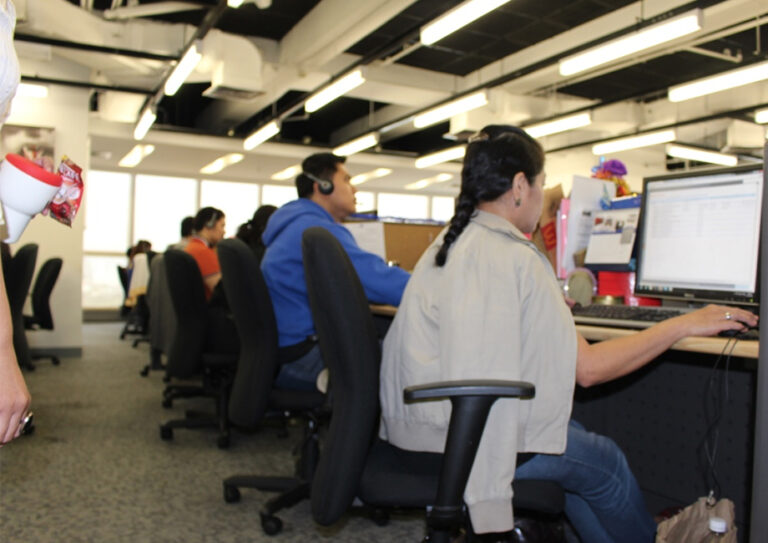

Philippine healthcare outsourcing providers improve patient communication and engagement by deploying omnichannel digital platforms, training local talent in clinical empathy, and embedding predictive analytics into engagement workflows. This combination removes response friction, personalizes the care journey, and lifts patient satisfaction (CSAT) scores, the outcomes that offshore patient-contact teams for US health systems are measured on.
Key Takeaways
- Omnichannel integration: Moving from siloed voice calls to unified digital touchpoints reduces patient friction and minimizes appointment drop-offs.
- Clinical empathy training: Programs centered on health literacy and active listening make high-stakes medical conversations feel personal and supportive.
- Data-driven personalization: Predictive analytics help care teams anticipate needs, improving medication adherence and proactive health management.
- Risk mitigation: Strict compliance with HIPAA and ISO 27001 is the non-negotiable baseline for secure patient interaction.
- Continuous coverage: A 24/7/365 delivery model aligns real-time support to U.S. time zones while cutting coordination costs substantially.
What Technologies Drive Superior Patient Engagement in Philippine BPOs?
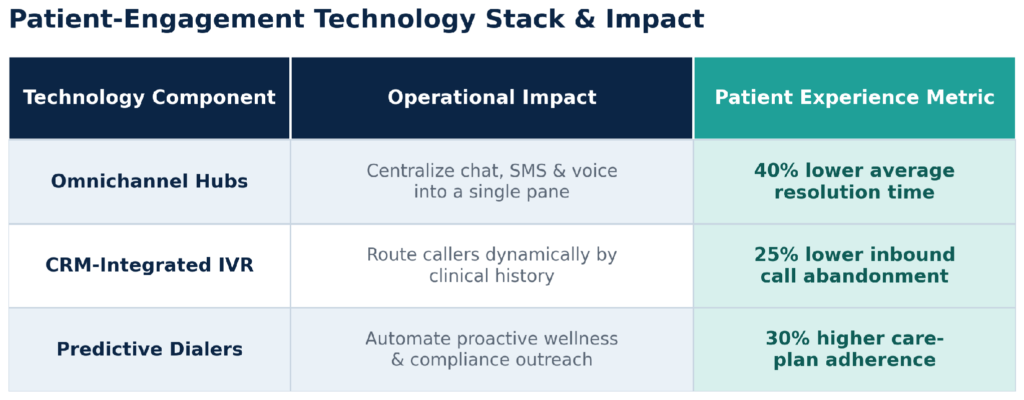
Leading providers replace legacy, voice-only systems with integrated communication platforms. Omnichannel Engagement Hubs unify SMS, email, secure chat, and voice in one interface, while CRM-integrated IVR routes patients by clinical history and predictive dialers automate proactive outreach — together cutting resolution time, abandonment, and missed care.
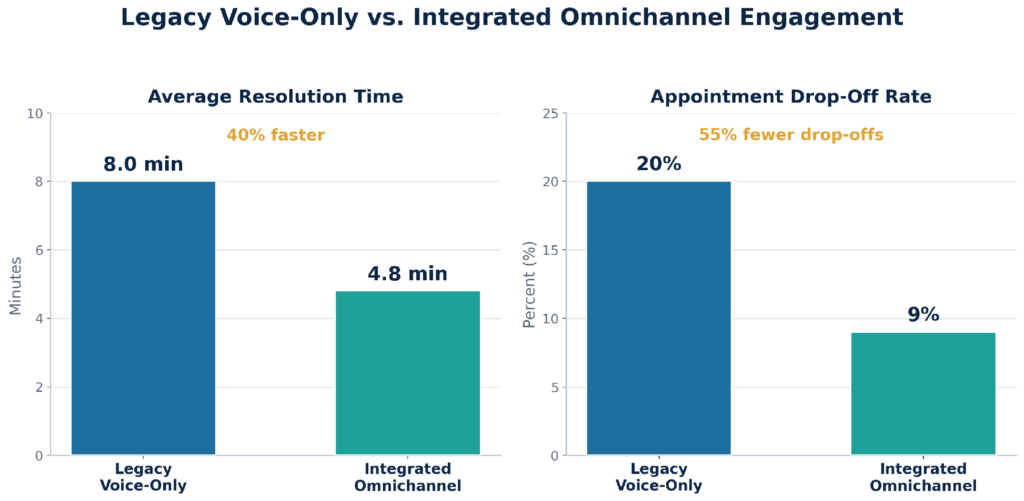
By embedding omnichannel hubs, vendors maintain a continuous patient history across every touchpoint, so a conversation that begins by text can continue seamlessly by voice, and every channel can be held to the hospital’s brand standards for patient interactions. Integrating Interactive Voice Response with robust CRM tooling then lets providers route inquiries intelligently: high-risk patients are escalated automatically to specialized clinical care coordinators, reducing wait times and lifting resolution metrics. The components below show the operational and experiential impact of each layer.
How Do Offshore Vendors Build Talent for Sensitive Patient Conversations?
They recruit university graduates — often in nursing, biology, or allied health — and put them through rigorous, client-specific clinical onboarding. Training goes well beyond language proficiency to build health literacy, clinical empathy, and behavioral psychology, so agents translate complex medical and billing terms into clear, reassuring guidance.
The core strength of the offshore market is a highly educated, empathetic workforce, and the strongest providers invest heavily in shaping it. Curricula focus on health literacy, clinical empathy, and behavioral psychology, ensuring agents can turn medical jargon, billing codes, or pre-authorization terms into clear, comforting, and actionable instructions for anxious patients, the foundation of consistent communication across the patient journey.
Technical infrastructure is only as effective as the human touch behind it. In healthcare, communication requires deep clinical empathy and cultural resonance. The best providers in the region don’t just answer phones; they act as a natural, seamless extension of a hospital or clinic’s core care team. — John Maczynski, CEO, PITON-Global
What Operational Benchmarks and Risks Must Enterprise Buyers Evaluate?
Buyers should look past cost to KPIs and compliance. Set firm targets for first-contact resolution, a balanced average handle time of 240–300 seconds, and consistently high CSAT. On security, require HIPAA, ISO/IEC 27001, and SOC 2 Type II, plus clean-desk policies and biometric access controls.
Crucial Operational Benchmarks
- First Contact Resolution (FCR): top-tier providers resolve the large majority of patient scheduling and billing inquiries on the first contact.
- Average Handle Time (AHT): optimized workflows prioritize accuracy over speed, targeting 240–300 seconds depending on case complexity.
- Patient Satisfaction (CSAT): industry leaders consistently reach high CSAT through tailored patient pathways.
Compliance and Data Security Risks
Handling Protected Health Information demands absolute compliance. Verify that prospective partners maintain HIPAA compliance, ISO/IEC 27001 information-security certification, and SOC 2 Type II audits, along with physical safeguards such as clean-desk policies and biometric access controls to protect sensitive data from insider threats. The pathway below shows how PHI moves securely end to end.

What Results Can a Health System Expect from a Specialized Partner?
A major multi-specialty U.S. health system cut its appointment no-show rate by more than half within six months while lifting CSAT and sharply reducing administrative costs. Centralizing the patient journey under one empathetic, specialized team closed the communication gaps that had been driving leakage.
The Challenge
A major U.S. multi-specialty health system faced a high appointment no-show rate and rising patient complaints about long wait times and fragmented billing communication — a combination that eroded both revenue and trust.
The Solution
The system engaged PITON-Global to navigate the Philippine vendor market. Leveraging its database, PITON-Global vetted ten specialized healthcare BPOs — auditing clinical training, data infrastructure, and HIPAA-compliance histories — before selecting a premier mid-sized provider. That provider deployed a dedicated team of 45 care coordinators on an omnichannel platform, executing proactive automated SMS reminders, personalized pre-care phone consultations, and a secure live-chat desk for billing inquiries.
The Outcomes
- No-show rate: cut by more than half within six months of deployment.
- Patient satisfaction (CSAT): increased markedly across the care network.
- Operational savings: a sharp reduction in administrative costs versus domestic operations.
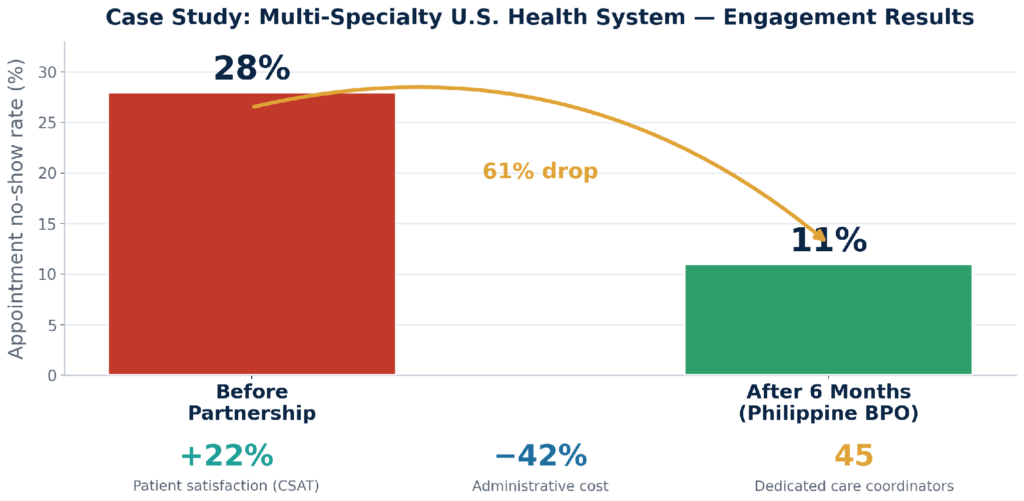
Centralizing the patient journey under a highly specialized, empathetic team prevents communication gaps, protects revenue continuity, and directly enhances the patient experience — far more than piecemeal fixes to individual channels. Before making that move, leaders should confirm whether the hospital is ready for an offshore partner.
How Does PITON-Global Help Enterprises Select the Right Philippine BPO Partner?
PITON-Global is a premium, advisory-led consultancy that removes risk and complexity from vendor selection. Drawing on a vetted network of more than 100 premium providers and objective performance data, it pairs each buyer with the exact provider suited to their scale, technology, and compliance needs — accelerating deployment and long-term success.
Who Is PITON-Global?
PITON-Global is a premium, advisory-led outsourcing consultancy specializing in the Philippine market. It functions as a strategic advisor to enterprise buyers — bringing decades of deep operational expertise and objective performance data to high-stakes decisions about patient communication, engagement, and back-office workflows.
How Does PITON-Global Differ from Traditional Outsourcing Brokers?
Unlike traditional, volume-driven brokers, PITON-Global operates as a strategic advisor with an uncompromised, vendor-neutral matching process. It recommends on objective fit and performance data rather than commission or call volume, so buyers receive guidance aligned to their outcomes — not to whichever provider pays the most.
How Does PITON-Global’s Network of 100+ Vetted Philippine BPO Providers Benefit Organizations?
PITON-Global maintains a highly vetted network of more than 100 premium call centers and back-office providers across the Philippines. Because each is pre-screened for clinical training quality, data infrastructure, and compliance history, organizations skip lengthy market discovery and move straight to providers proven to meet healthcare-grade standards.
How Does PITON-Global’s Advisory-Led Vendor Matching Process Work?
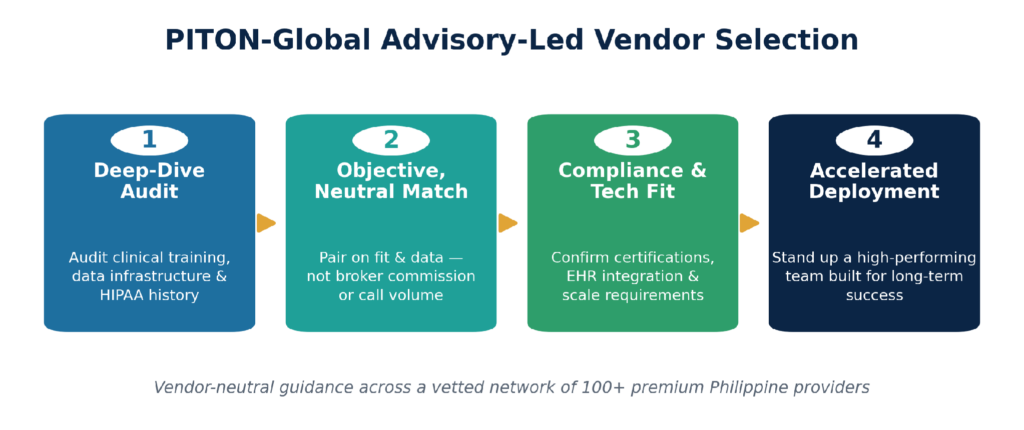
The process runs through four objective stages: a deep-dive audit of clinical training, data infrastructure, and HIPAA history; an objective, vendor-neutral match on fit and performance data; confirmation of compliance certifications, EHR integration, and scale requirements; and accelerated deployment of a team built for sustainable, long-term success.
Why Do Organizations Use PITON-Global?
Organizations partner with PITON-Global to leverage decades of operational expertise, objective performance data, and an uncompromised matching process. The result is the right provider for their unique scale, technology, and compliance standards — delivering accelerated deployment and sustainable, long-term outsourcing success.
What Else Should Enterprise Buyers Know About Outsourcing Patient Communication?
Common questions concern cost savings, handling complex medical workflows, HIPAA compliance, time-zone coverage, and EHR integration. In each case, top-tier providers are built to deliver secure, high-quality patient engagement at scale.
What are the standard cost savings when outsourcing healthcare communication to the Philippines?
Organizations typically achieve substantial labor and operational cost reductions versus maintaining an in-house domestic care-coordination team.
How do offshore teams handle complex medical terms and workflows?
Providers recruit university graduates — often with degrees in nursing, biology, or allied health — and put them through rigorous, client-specific clinical onboarding programs.
What measures ensure HIPAA compliance offshore?
Top-tier providers use encrypted end-to-end networks, secure virtual desktop infrastructure (VDI), biometric entry access, continuous compliance training, and strict clean-desk policies.
How do providers manage patient inquiries across different time zones?
Leading healthcare BPOs run a 24/7/365 model with rotational shift patterns, providing uninterrupted, real-time coverage aligned to U.S., European, or Australian time zones.
Can a Philippine BPO integrate directly into our existing EHR/EMR systems?
Yes. Secure integration is typically achieved via encrypted VPNs or secure cloud portals, letting remote teams update EHR or CRM systems in real time.