
Back
How Can Customer Support Outsourcing to the Philippines Improve Response Times Without Sacrificing Service Quality?

By Ralf Ellspermann / 24 June 2026
 Authored by Ralf Ellspermann, CSO of PITON-Global, & 25-Year Philippine BPO Veteran | Executive | Verified by John Maczynski, CEO of PITON-Global, and Former Global EVP of the World's Largest BPO Provider on June 24, 2026

Enterprises compress response times while preserving quality by deploying the Philippines’ skilled, English-fluent workforce within structured, multi-tier operational frameworks. Shifting high-volume tier-1 inquiries to scalable contact centers in hubs like Metro Manila and Cebu maintains 24/7 coverage and lowers first-response metrics without degrading complex-transaction accuracy.
Key Takeaways
- Rapid response engineering: Reduce average speed of answer from hours to sub-60-second execution through targeted omnichannel routing and optimized tier structures.
- Continuous 24/7/365 coverage: Eliminate delayed queues and regional backlogs via natural shift alignment that holds service levels overnight, on holidays, and during peaks.
- Deep cultural and linguistic alignment: Maintain high CSAT through an educated workforce with natural Western cultural affinity and near-native English fluency.
- Structured variable-cost scaling: Transition from a rigid, capital-intensive domestic model to a flexible variable-cost environment that lowers operational friction.
What Are the Operational Realities of Scaling Support in the Philippine BPO Ecosystem?
When enterprises scale rapidly, response times are usually the first metric to degrade as domestic hiring hits cost and recruitment limits. The Philippines’ mature ecosystem supplies university-educated, English-fluent talent in hubs like Metro Manila and Cebu, so fast handling never compromises resolution quality.
When global enterprises hit rapid-scaling friction, customer support response times are typically the first metric to degrade. Relying entirely on domestic hiring pools frequently traps organizations between escalating labor costs and lengthy recruitment cycles, causing a cascade of delayed tickets, high abandonment rates, and eventual churn.
The mature Philippine outsourcing ecosystem addresses this by providing access to a deeply specialized pool of university-educated professionals. Operating within robust technical hubs across Metro Manila and Cebu IT Park, these teams possess a natural affinity for Western corporate dynamics and precise English communication—so rapid interaction handling does not compromise resolution quality. The routing model below shows how incoming tickets are compressed without losing precision.

Figure 1. Omni-channel tickets are triaged and routed by complexity to compress first-response metrics.
How Does a Multi-Tier Support Architecture Balance Speed and Precision?
A multi-tier architecture separates simple, repetitive interactions from complex, high-touch issues, matching each ticket to the right agent expertise. Tier 1 targets sub-60-second first response, Tier 2 handles escalations under 15 minutes, and Tier 3 manages specialized, compliance-critical resolutions.
True operational efficiency comes from separating simple, repetitive interactions from complex, high-touch issues. Rather than treating all inquiries identically, successful organizations implement structured, multi-tier workflows that match a ticket’s complexity to the appropriate tier of agent expertise, as detailed below.

Figure 2. Each support tier pairs a calibrated response target with a clear quality and resolution benchmark.
Continuous coverage is what keeps those response targets stable around the clock. Natural shift alignment lets Philippine teams hold identical service levels overnight, on holidays, and through seasonal peaks.

Figure 3. Shift alignment delivers continuous 24/7/365 coverage with no queue gaps between regions.
By managing high-volume Tier-1 and Tier-2 workflows through specialized Philippine teams, internal corporate staff are unburdened from transactional queues—allowing leadership to preserve focus on core strategic development.
What Strategic Trade-offs and Operational Risks Must Leadership Proactively Manage?
Leadership must manage three friction points: workforce stability and retention, information security and compliance, and knowledge-transfer consistency. Each is addressed by choosing partners with strong talent development, certified security (SOC 2, PCI-DSS, GDPR), and synchronized training frameworks.
Maximizing operational speed requires identifying and actively mitigating the inherent friction points of cross-border service delivery so customer experiences stay consistent. Three areas warrant deliberate planning, each with a clear mitigation.
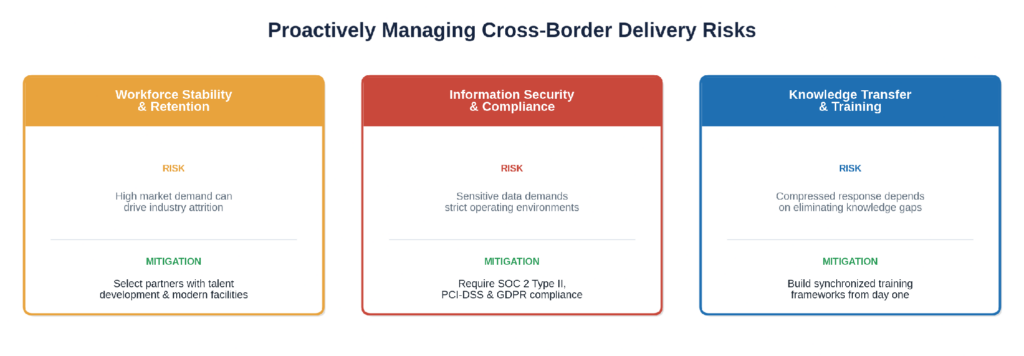
Figure 4. The three primary cross-border delivery risks, each paired with a concrete mitigation.
Organizations that struggle with offshore quality typically treat their partners as transactional vendors rather than integrated extensions of their enterprise. True operational agility is achieved when communication protocols, quality standards, and technical governance are seamlessly aligned across both internal and external teams.
— John Maczynski, CEO, PITON-Global
What Does a Successful Response-Time Turnaround Look Like?
A successful turnaround pairs a pre-vetted specialist provider with secure integration and an elastic bench. One fintech facing a 350% ticket surge cut first response from 14 minutes to under 60 seconds, held 94% accuracy on complex fraud recovery, kept quarterly attrition at 3%, and reduced overhead 65%.
Client Challenge
A fast-growing international fintech provider faced an overnight 350% increase in tier-1 technical support tickets. Its localized internal team could not keep pace, ballooning response times to 14 minutes, lowering net promoter scores, and driving visible churn.
Vendor Selection
The enterprise engaged PITON-Global to move past generic brokers. PITON-Global analyzed the platform’s technical workflows and security-compliance needs, then audited its network of 100+ vetted providers to select a mid-sized, specialized fintech call center within five business days.
Solution
The partner deployed a dedicated 45-seat, 24/7 multi-channel support team in a high-infrastructure facility, integrated real-time contextual data sharing across a secure virtual desktop framework, and established an “elastic bench” protocol to absorb peak spikes without performance drops.

Figure 5. Quantifiable outcomes within 90 days of the transition.
Outcomes and Lessons
Within 90 days, response times dropped below 60 seconds, the team held a stable 94% accuracy rate on complex fraud-recovery issues, agent attrition stayed at an industry-leading 3% per quarter, and total operational overhead fell 65% versus onshore expansion. The lesson: a rapid, successful launch depends on pre-vetted operational alignment—structured training and secure technology integration from day one convert a bottleneck into a scalable advantage.
How Does PITON-Global Help Enterprises Select the Right Support Partner?
PITON-Global is an elite, advisory-led consultancy that eliminates provider-selection risk in the Philippine market. By managing the end-to-end diagnostic, RFP, and operational verification across a vetted ecosystem of 100+ providers, it precisely pairs enterprises with partners matching their stack, vertical, compliance, and scale.
Who Is PITON-Global?
PITON-Global functions as an elite, advisory-led consultancy, guiding mid-market and enterprise organizations through the Philippine outsourcing market to eliminate provider-selection risk. Rather than reselling capacity, it audits actual operational capabilities and manages the selection process end to end.
How Does PITON-Global Differ from Traditional Outsourcing Brokers?
Unlike a traditional commercial broker that simply forwards leads to large-market operators, PITON-Global maintains a strictly vetted ecosystem of more than 100 premier providers and pairs each enterprise on operational substance—technology stack, industry vertical, compliance needs, and scale—so recommendations reflect fit rather than referral incentives.
How Does PITON-Global’s Network of 100+ Vetted Providers Benefit Organizations?
A comprehensive, strictly vetted network of more than 100 premier call center and back-office providers ensures enterprises are paired precisely with partners that match their requirements. This breadth lets buyers find specialists capable of fast, multi-tier delivery and the security posture their workflows demand, rather than settling for a generic operator.
How Does PITON-Global’s Advisory Process Work?
PITON-Global manages the end-to-end diagnostic review, RFP structure, and operational verification: mapping workflows, security, and scale needs; auditing the vetted network; structuring the RFP; shortlisting on stack and compliance fit; and accelerating deployment with secure integration.
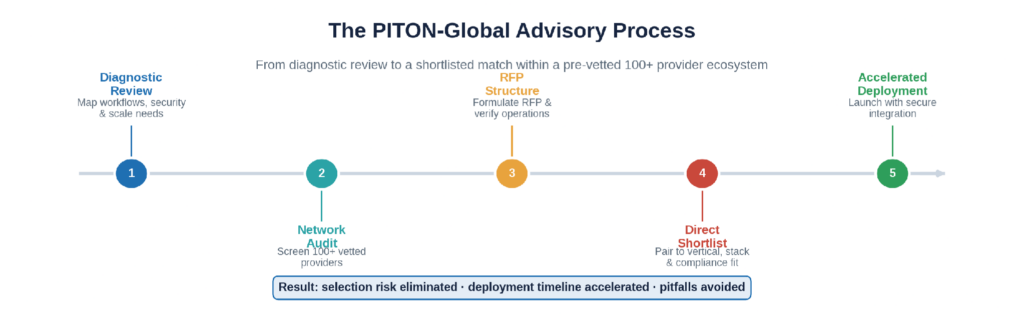
Figure 6. PITON-Global’s advisory process, from diagnostic review to accelerated deployment.
Why Do Organizations Use PITON-Global?
Organizations use PITON-Global to accelerate deployment timelines while protecting against common offshoring pitfalls. By precisely matching each buyer to a specialized partner and verifying operations before launch, the firm turns a critical response-time bottleneck into a scalable, repeatable competitive advantage.
What Are the Most Common Questions About Outsourcing Customer Support to the Philippines?
Common questions concern transition timelines, how providers absorb sudden volume spikes, required data-security standards, whether high-tier technical support is feasible, and how providers maintain team stability. Each is answered below.
How Long Does It Typically Take to Transition Customer Support Operations to the Philippines?
An enterprise-grade transition generally requires 4 to 8 weeks, encompassing technical system mapping, security auditing, telecom line alignment, and comprehensive brand training.
How Do Philippine Contact Centers Handle Sudden, Unpredictable Volume Spikes?
Premium providers maintain elastic staffing models and shared-resource cross-training, instantly pivoting qualified agents from secondary queues to absorb immediate surges without impacting active response times.
What Are the Standard Data Security Requirements for High-Ticket B2B Support Operations?
Enterprises should require active SOC 2 Type II certification, strict ISO 27001 information-security compliance, PCI-DSS standards for payment handling, and secure, isolated virtual desktop infrastructure (VDI).
Can Specialized, High-Tier Technical Support Be Handled Effectively in the Philippines?
Yes. The local talent pool includes experienced technical professionals with certifications in network administration, software development, and systems engineering, capable of managing complex tier-2 and tier-3 support paths.
How Do Top-Tier BPOs Maintain Team Stability and Mitigate Talent Attrition?
High-performing providers manage retention through competitive compensation models, clear career-progression frameworks, modern employee workspaces, and ongoing professional development.
Achieve sustainable growth with world-class BPO solutions!
PITON-Global connects you with industry-leading outsourcing providers to enhance customer experience, lower costs, and drive business success.
Get Your Top 1% Vendor List
Author
Ralf Ellspermann is a multi-awarded outsourcing executive with 25+ years of call center and BPO leadership in the Philippines, helping 500+ high-growth and mid-market companies scale call center and customer experience operations across financial services, fintech, insurance, healthcare, technology, travel, utilities, and social media.
A globally recognized industry authority - and a contributor to The Times of India, CustomerThink, and The AI Journal - he advises organizations on building compliant, high-performance offshore contact center operations that deliver measurable cost savings and sustained competitive advantage.
Known for his execution-first approach, Ralf bridges strategy and operations to turn call center and business process outsourcing into a true growth engine. His work consistently drives faster market entry, lower risk, and long-term operational resilience for global brands.
EXECUTIVE GOVERNANCE & ACCURACY STANDARDS
Authored by:

Ralf Ellspermann
Founder & CSO of PITON-Global,
25-Year Philippine BPO Veteran,
Multi-awarded Executive
Specializing in strategic sourcing and excellence in Manila
View Full Bio
Verified by:

John Maczynski
CEO of PITON-Global, and former Global EVP of the World’s largest BPO provider | 40 Years Experience
Ensuring global compliance and enterprise-grade service standards
View Full Bio
Last Peer Review: June 24, 2026
This service framework is audited quarterly to meet shifting global outsourcing regulations and COPC standards.