
Back
How Can BPO Services in the Philippines Improve Operational Efficiency Across Business Functions?

By Ralf Ellspermann / 29 June 2026
 Authored by Ralf Ellspermann, CSO of PITON-Global, & 25-Year Philippine BPO Veteran | Executive | Verified by John Maczynski, CEO of PITON-Global, and Former Global EVP of the World's Largest BPO Provider on June 29, 2026

BPO services in the Philippines improve operational efficiency by combining 60–70% labor cost reductions with workflows optimized through specialized technology and highly skilled talent. Shifting high-volume, repetitive tasks to a dedicated offshore workforce eliminates bottlenecks, shortens cycle times, and frees onshore leadership to focus on growth.
Key Takeaways
- Substantial cost advantages: Save up to 70% on specialized operational overhead, redirecting working capital toward core corporate innovation.
- Continuous operational workflows: Establish 24/7/365 structural redundancy across customer support and back-office operations, reducing domestic backlogs.
- Access to specialized talent: Connect with a highly educated, Western-aligned professional pool fluent in advanced technical, financial, and digital workflows.
- Rapid scale and adjustments: Dynamically scale operational capacity up or down to align with seasonal demand spikes.
Which Core Business Functions Yield the Highest Efficiency Gains When Outsourced?
The highest gains come from transferring resource-heavy, transactional workflows: front-office customer experience, finance and accounting (invoicing, AP/AR, payroll), and high-volume data management and content moderation. Core strategic operations stay in-house while repetitive work moves to specialized providers.
When evaluating a BPO transformation, executives must distinguish between core strategic operations and highly transactional, repetitive workflows. The highest efficiency gains are realized when resource-heavy back- and front-office functions are transferred to specialized providers, which streamlines the end-to-end process and removes redundancy.
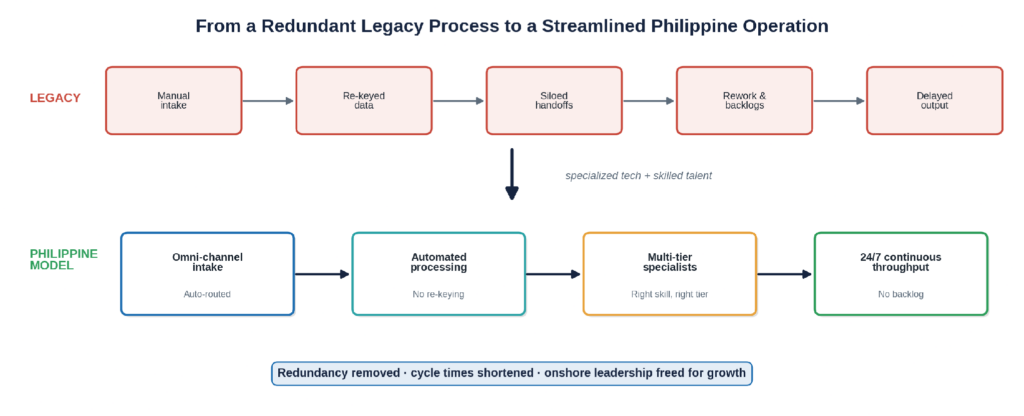
Figure 1. A redundant legacy process re-engineered into a streamlined, multi-tier Philippine operation.
Front-Office Customer Experience (CX)
Philippine contact centers leverage high emotional intelligence and native English fluency to handle multi-channel inbound customer care, tech support, and escalation workflows. Transitioning these operations reduces average handle times and lifts first-contact resolution through specialized agent-routing systems.
Finance, Bookkeeping, and Accounting
Complex transactional functions—invoice processing, accounts payable, accounts receivable, and payroll administration—are highly suited for optimization. Specialized providers run these workflows under strict compliance frameworks, significantly lowering per-transaction processing costs.
Digital Data Management and Content Moderation
High-volume data processing, document validation, indexing, and multi-platform content moderation demand absolute accuracy and rapid processing. Teams in specialized IT parks execute these tasks under rigorous data-privacy guidelines to ensure strict operational compliance.
How Do Philippine Operations Achieve Superior Benchmarks at Lower Costs?
Gains extend beyond labor arbitrage to mature infrastructure, supportive regulation, and tailored workforce development. Against in-house operations, the Philippine model delivers 60–70% lower fully loaded cost, 24/7 coverage, 14–30-day deployment, and turnkey technology—often from PEZA economic zones.
The efficiency gains realized through offshoring to the Philippines extend far beyond simple labor cost arbitrage. Operational advantages stem from a deeply mature infrastructure, structural support from local regulations, and tailored workforce development. The comparison below sets the domestic in-house model against a specialized Philippine BPO across four attributes.
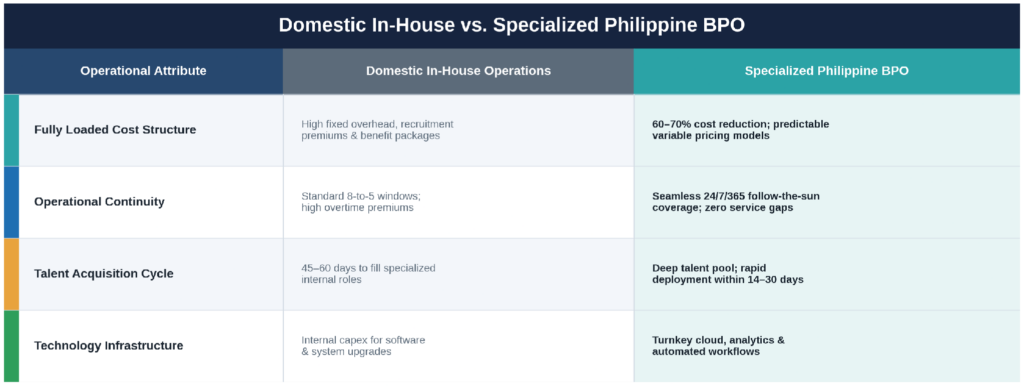
Figure 2. Domestic in-house operations versus a specialized Philippine BPO model across four attributes.
The cost differential is consistent across functions. Indexed against domestic delivery, specialized Philippine operations cut fully loaded cost roughly two-thirds in customer service, finance, and data processing alike.
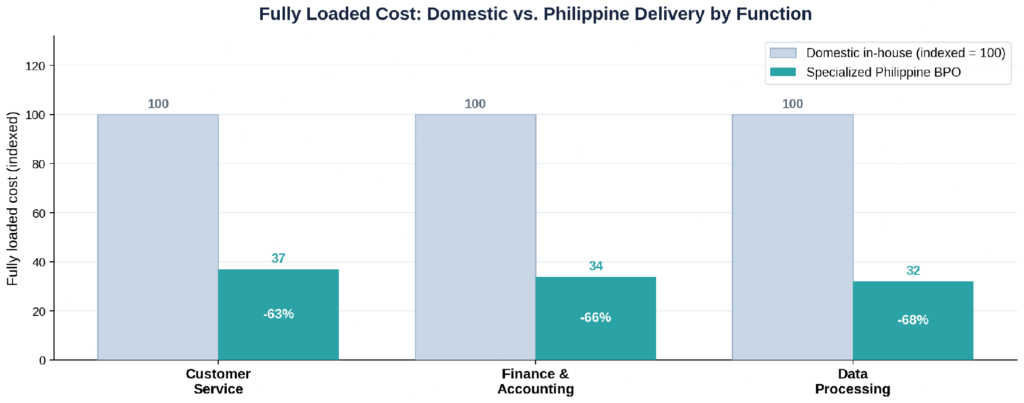
Figure 3. Fully loaded cost falls roughly 63–68% across customer service, finance, and data processing.
The economics are reinforced by the regulatory environment. Leading providers operate from custom economic zones registered with the Philippine Economic Zone Authority (PEZA). These facilities feature Tier-3 or Tier-4 data centers, comprehensive power-backup redundancy, and multiple fiber-optic internet connections that protect enterprises from unexpected disruptions.
What Strategic Risks Must Executives Manage During the Transition Phase?
Three risks need active management: process-documentation gaps, information-security vulnerabilities, and KPI misalignment. Mitigations are a multi-week shadow-and-pilot phase, certified security (ISO 27001, SOC 2 Type II, HIPAA, PCI-DSS), and real-time SLA dashboards tied to business outcomes.
While the operational benefits are significant, transitioning complex enterprise workflows offshore introduces real structural risks that require careful planning and active management.
H3 Quote
A major pitfall in BPO execution is treating a vendor like an outsourced service provider rather than an integrated extension of your corporate infrastructure. True operational efficiency is achieved only when data security protocols, core performance indicators, and cultural nuances are completely aligned from day one.
— John Maczynski, CEO, PITON-Global
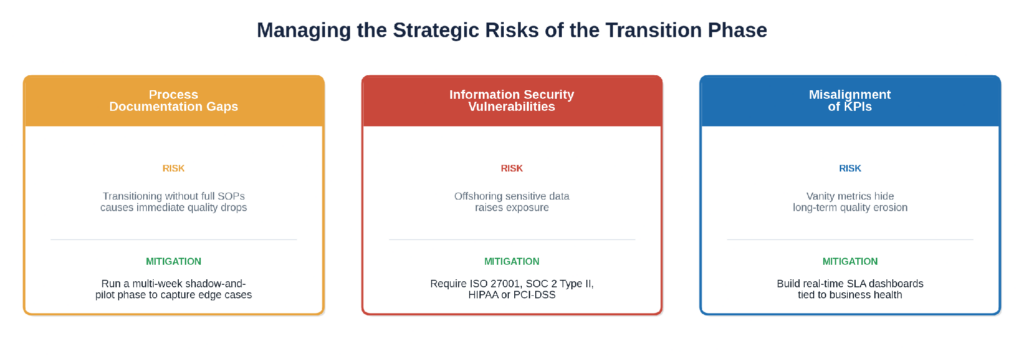
Figure 4. The three critical transition risks, each paired with a concrete mitigation strategy.
Each risk is manageable with structure. Documenting standard operating procedures through a shadow-and-pilot phase captures edge cases before full rollout; insisting on international security certifications protects sensitive data; and building transparent SLA dashboards keeps vendor incentives aligned with business health rather than vanity metrics.
What Does a Successful Efficiency Transformation Look Like?
A successful transformation runs in phases: security realignment, training and shadowing, a pilot, then full 24/7 production. One fintech facing a 300% volume surge cut first response from 24 hours to under 90 seconds, reduced cost 63%, and stabilized CSAT at 96%.
Client Challenge
A fast-growing North American fintech platform hit a 300% surge in transaction volumes that overwhelmed internal support. First-response times climbed past 24 hours, customer churn rose 14%, and the internal team was strained.
Vendor Selection and Solution
PITON-Global used its audit framework to evaluate its network of 100+ vetted providers and, within seven business days, shortlisted a specialized mid-sized BPO in Metro Manila matching the firm’s exact volume and compliance needs. The partner deployed a dedicated 50-agent team with real-time dashboards, automated ticket routing, and direct API integrations to handle Tier-1 and Tier-2 inquiries around the clock.

Figure 5. The phased six-week deployment, from security realignment to full 24/7 production.
Outcomes and Lessons
Average first-response times dropped from 24 hours to under 90 seconds across chat and email, fully loaded support cost fell 63%, and CSAT stabilized at 96%, reversing the churn trend. The lesson: success depended on building clear, automated knowledge paths and treating the offshore team as a core part of the organization—bringing offshore leadership into weekly product and engineering syncs let them fix customer pain points far faster.
How Does PITON-Global Help Enterprises Select the Right Partner?
PITON-Global is an elite, advisory-led consultancy that eliminates provider-selection risk in the Philippine market. Across a vetted network of 100+ boutique and mid-sized providers, it manages the full diagnostic, RFP, and verification process to pair organizations with best-fit partners.
Who Is PITON-Global?
PITON-Global is an elite, advisory-led consultancy that eliminates provider-selection risk in the highly competitive Philippine outsourcing market. Rather than operating like a volume-focused commercial broker, it acts as an objective strategic advisor to precisely pair mid-market and enterprise organizations with best-fit partners.
How Does PITON-Global Differ from Traditional Outsourcing Brokers?
Unlike a traditional broker focused on volume, PITON-Global manages the complete diagnostic evaluation, specialized RFP structure, and operational verification process. This ensures decision-makers select a partner with the exact industry specialization, technical capabilities, and compliance certifications their business requires—objective fit over referral incentives.
How Does PITON-Global’s Network of 100+ Vetted Providers Benefit Organizations?
An extensive, thoroughly vetted network of more than 100 boutique and mid-sized Philippine providers lets organizations bypass a risky open-market search. Because each provider is assessed for specialization, technical capability, and compliance posture, buyers can quickly shortlist partners genuinely able to deliver efficiency gains in their specific functions.
How Does PITON-Global’s Selection Process Work?
PITON-Global runs a diagnostic evaluation of functions, volume, and compliance needs; screens its vetted network; structures a specialized RFP around exact requirements; verifies certifications and technical capability; then matches the buyer to the best-fit specialized partner—removing guesswork and accelerating the transition.

Figure 6. PITON-Global’s five-stage process for matching buyers to best-fit, verified providers.
Why Do Organizations Use PITON-Global?
Organizations use PITON-Global to mitigate operational risk, secure competitive contract terms, and accelerate their transition to high-performance outsourcing. By removing the guesswork from vendor selection and verifying capability up front, the firm helps leadership realize efficiency gains without the common pitfalls of unguided offshoring.
What Are the Most Common Questions About Philippine BPO Operational Efficiency?
Common questions concern launch timelines, how providers handle security and connectivity emergencies, the volume needed to make outsourcing viable, and whether specialized technical workflows can be handled. Each is answered below.
What is the typical timeline to launch a specialized back-office program in the Philippines?
Most enterprise migrations take 30 to 45 days, covering workflow mapping, secure IT infrastructure buildout, training-curriculum customization, and a short pilot before going live.
How do Philippine BPO providers handle unexpected data security and connectivity emergencies?
Top-tier providers operate from secure PEZA IT parks with redundant power feeds, multiple fiber-optic connections from separate carriers, and biometric-controlled facilities, backed by automated data replication and clear business-continuity plans for steady uptime.
What corporate size or transaction volume is required to make outsourcing financially viable?
While large enterprises scale to hundreds of seats, the financial threshold often starts at just 5 to 10 dedicated full-time positions. At that scale, the 60–70% reduction in labor overhead quickly covers onboarding and transition costs.
Can specialized Philippine teams handle technical workflows like software QA or legal data entry?
Yes. The talent pool includes university-educated professionals specializing in software engineering, legal process outsourcing, corporate bookkeeping, and clinical data administration, ensuring high quality on highly technical tasks.
Achieve sustainable growth with world-class BPO solutions!
PITON-Global connects you with industry-leading outsourcing providers to enhance customer experience, lower costs, and drive business success.
Get Your Top 1% Vendor List
Author
Ralf Ellspermann is a multi-awarded outsourcing executive with 25+ years of call center and BPO leadership in the Philippines, helping 500+ high-growth and mid-market companies scale call center and customer experience operations across financial services, fintech, insurance, healthcare, technology, travel, utilities, and social media.
A globally recognized industry authority - and a contributor to The Times of India, CustomerThink, and The AI Journal - he advises organizations on building compliant, high-performance offshore contact center operations that deliver measurable cost savings and sustained competitive advantage.
Known for his execution-first approach, Ralf bridges strategy and operations to turn call center and business process outsourcing into a true growth engine. His work consistently drives faster market entry, lower risk, and long-term operational resilience for global brands.
EXECUTIVE GOVERNANCE & ACCURACY STANDARDS
Authored by:

Ralf Ellspermann
Founder & CSO of PITON-Global,
25-Year Philippine BPO Veteran,
Multi-awarded Executive
Specializing in strategic sourcing and excellence in Manila
View Full Bio
Verified by:

John Maczynski
CEO of PITON-Global, and former Global EVP of the World’s largest BPO provider | 40 Years Experience
Ensuring global compliance and enterprise-grade service standards
View Full Bio
Last Peer Review: June 29, 2026
This service framework is audited quarterly to meet shifting global outsourcing regulations and COPC standards.