
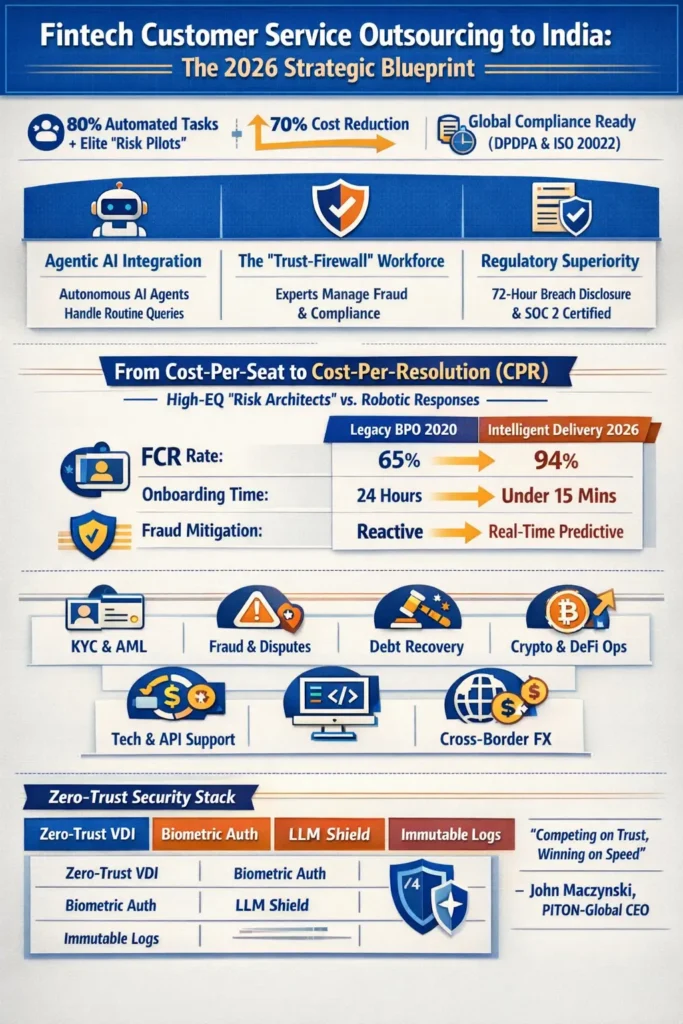
In 2026, Fintech outsourcing to India has evolved into “Intelligence Arbitrage.” By pairing Agentic AI with India’s elite financial workforce, firms automate 80% of routine tasks while local “Risk Pilots” manage high-stakes fraud and compliance. This hybrid model cuts costs by 70%, accelerates Resolution Velocity, and ensures ironclad alignment with global regulations like the DPDPA and ISO 20022.
Executive Briefing: The 2026 Indian Fintech CX Landscape
The Indian outsourcing sector has transcended its “back-office” roots to become the global nerve center for fintech innovation. As of March 2026, the strategy is defined by three fundamental pillars:
- Agentic AI Integration: Indian hubs now leverage the IndiaAI Mission’s $1.2B sovereign compute pool. Unlike the static chatbots of 2024, today’s hubs deploy autonomous agents that reason and execute multi-step financial workflows across global APIs without human intervention for routine queries.
- The “Trust-Firewall” Workforce: High-volume scaling is no longer about “answering calls”—it is about Dispute Management, KYC, and Fraud Triage. Indian human judgment serves as the ultimate security layer for high-risk exceptions.
- Regulatory Superiority: Following the full enforcement of the Digital Personal Data Protection (DPDP) Act, Indian providers offer 72-hour breach disclosure guarantees and SOC2 Type II compliance as a native operational standard, not an added service.
The Intelligence Arbitrage Pivot: Beyond the Cost-Per-Seat
In 2024, fintechs moved to the subcontinent to lower “cost-per-seat.” In 2026, the primary metrics are Cost-Per-Resolution (CPR) and Trust-Retention. India captures the global market because its workforce handles “Emotional Velocity”—the critical moment a user loses account access or identifies a fraudulent transaction. This is a high-stakes psychological junction where a robotic response leads to churn, but a high-EQ Indian “Risk Architect” creates a customer for life. With an elite talent pool of CAs, MBAs, and engineers, the region provides the cognitive labor required to manage complex global financial instruments at a 70–80% discount compared to onshore engineering teams.
Table 1: Performance Benchmarks (Legacy vs. 2026 Intelligent Delivery)
| Performance Metric | Legacy BPO (2020) | Intelligent Delivery (2026) | Strategic Impact |
| First Contact Resolution (FCR) | 65% | 94% | Drastic reduction in customer churn |
| Onboarding Speed | 24 Hours | Sub-15 Mins (DigiLocker/AI) | 40% reduction in app abandonment |
| Fraud Mitigation | Reactive / Manual | Real-Time Predictive | 70% fewer false positives |
| Operating Cost (US vs. IN) | 45% Savings | 70–80% Savings | Capital reallocated to R&D/Product |
Deep Dive: The 2026 Functional Execution Matrix
In 2026, outsourcing is categorized by Decision Complexity rather than task volume. Below is the functional breakdown of the top 20 services currently being offshored to specialized Indian hubs.
Table 2: The 2026 Fintech Service Hierarchy
| Rank | High-Volume Service | AI Role (Autonomous) | Human Role (India Risk Pilots) |
| 1 | Customer Support (Tier 1-3) | Resolves 85% of queries | Complex de-escalation & edge cases |
| 2 | KYC & Video KYC | AI Liveness & OCR checks | Manual triage of “Shadow IDs” |
| 3 | Fraud Monitoring | Real-time anomaly detection | Forensic investigation & SAR filing |
| 4 | Disputes & Chargebacks | Evidence gathering | Policy-led adjudication & appeals |
| 5 | Debt Recovery | Automated nudges/reminders | High-empathy, nuanced negotiations |
| 6 | AML / Sanctions | Database matching | Entity resolution & UBO checks |
| 7 | Technical/API Support | Documentation & Bug bots | Developer-tier JSON/Postman support |
| 8 | Wallet & Payment Ops | Auto-reconciliation | Exception handling & ledger repairs |
| 9 | Credit Underwriting | Data aggregation | “Thin-File” manual credit review |
| 10 | ATO Defense | Login anomaly alerts | Identity re-verification & recovery |
| 11 | Crypto/DeFi Ops | On-chain monitoring | Collateral & RWA audit |
| 12 | Tax & Billing Ops | Real-time GST/Tax calculation | Complex refund authorizations |
| 13 | Regulatory Reporting | Automated data pulls | Audit-ready narrative documentation |
| 14 | Retention & Sales | Predictive churn models | Proactive “Save” outreach |
| 15 | Mobile App UI Support | Basic bug triage | Real-time UX/UI walkthroughs |
| 16 | Merchant Onboarding | License & Link verification | High-risk merchant profiling |
| 17 | Financial Crime Ops | Link analysis & Graph tech | Law enforcement dossier preparation |
| 18 | Compliance Auditing | Session & Chat monitoring | Narrative audit writing & reporting |
| 19 | Wealthtech Support | Portfolio & Volatility alerts | Volatility empathy & guide support |
| 20 | Cross-Border FX | Rate lookups & spreads | SWIFT/NEFT troubleshooting |
Operational Architecture: The “Zero-Trust” Security Perimeter
For global fintechs, India’s data security protocols have become the gold standard. The 2026 “Visual-Only” policy ensures PII (Personally Identifiable Information) never touches local hardware through Pixel-Streaming.
Table 3: The 2026 “Zero-Trust” Outsourcing Stack
| Layer | Technology Standard | Strategic Benefit |
| Infrastructure | Zero-Trust VDI | Data never “rests” or resides on Indian soil |
| Identity | Biometric Continuous Auth | Prevents unauthorized screen viewing in real-time |
| Compliance | Real-Time LLM Shield | Automatically blocks PII leaks in live chats/voice |
| Auditability | Immutable Event Logs | Tamper-proof trail for RBI/SEC/FCA auditors |
Expert Insight: The Economics of Trust
“Fintech brands are no longer competing on code; they are competing on trust. In 2026, the ‘Trust Gap’ is the difference between an AI promise and a human failure. India offers the only scalable workforce capable of acting as ‘Digital Forensics Experts’ at an 80% discount compared to onshore teams. If you can’t resolve a multi-currency dispute in under 4 hours, your user will churn. Indian hubs provide the ‘Operational Liquidity’ to ensure that never happens.” — John Maczynski, CEO, PITON-Global
Strategic 2026 Implementation: Moving to “Flow-State”
The traditional “ticketing queue” is dead. Indian teams now operate as AI Orchestrators. While an autonomous agent initiates a workflow—such as a cross-border merchant dispute—the Indian specialist manages the “Edge Cases” in real-time via a unified Agent Desktop. This creates Operational Velocity, allowing fintechs to scale users 10x without a linear increase in headcount.
The Future: The “Digital Polymath”
The Indian support agent of 2026 is a Digital Polymath—trained in Prompt Engineering, Financial Forensics, and Cross-Border Compliance. These are not call center workers; they are specialized financial technicians. By offloading these high-risk, high-complexity functions to India, fintech leaders can focus their onshore resources on the one thing that matters: disrupting traditional banking.
2026 India Fintech Outsourcing: Top 5 FAQs
Can Indian agents handle complex US/EU AML?
Absolutely. India’s talent pool includes millions of commerce and law graduates who specialize in international financial regulations (FATF, BSA). They are trained specifically on the 2025/26 updates to the GENIUS Act and other global compliance mandates.
Why choose India over the Philippines or Latin America?
Technical Depth. While other regions offer great CX, India provides a unique combination of high-level financial literacy and deep engineering talent. This makes it better suited for “Technical Fintech” such as API support, DeFi operations, and Forensic Audit.
How is “Deepfake” fraud handled in Indian centers?
Providers use Hardware-Bound Cryptography and AI-driven “Heartbeat” monitors. These systems ensure a live, authorized human is present at all times, neutralizing synthetic identity risks before they can compromise an account.
Does AI reduce the need for Indian staff?
It shifts the profile rather than reducing it. While AI handles 80% of volume, the remaining 20% is significantly more complex. Fintechs are hiring fewer “entry-level” roles and more “Risk Analysts” and “Compliance Architects.”
What is the Time-to-Value for a new partnership?
Standard implementation is 60–90 days. This includes full integration with the India Stack (Aadhaar/UPI) for localized services or secure global API integration via Zero-Trust corridors.