
Back
Edge AI Data Labeling Outsourcing Philippines: Preparing Lightweight Models for On-Device Intelligence

By Ralf Ellspermann / 18 March 2026
 Authored by Ralf Ellspermann, CSO of PITON-Global, & 25-Year Philippine BPO Veteran | Executive | Verified by John Maczynski, CEO of PITON-Global, and Former Global EVP of the World's Largest BPO Provider on March 18, 2026

TL;DR: The Key Takeaway
Edge AI data labeling outsourcing in the Philippines is the strategic enabler for creating hyper-efficient, lightweight machine learning models. This approach moves beyond traditional data annotation, focusing on creating datasets that power real-time, on-device intelligence while ensuring data privacy and minimizing latency.
Edge AI data labeling in the Philippines facilitates the transition from centralized cloud processing to localized, on-device intelligence. by focusing on “data minimization” and “quantization-aware” annotation, specialized Filipino teams create the compact, high-efficiency training sets required for smartphones, wearables, and industrial sensors to perform real-time inference without relying on constant network connectivity.
- Localized Intelligence: The shift to Edge AI prioritizes real-time speed, offline capability, and enhanced data privacy.
- Strategic Minimalism: Success depends on “smart data”—dense, high-value labels that maximize performance while minimizing model size.
- Hardware Awareness: Filipino specialists act as data strategists, understanding the resource constraints of specific chips and sensors.
- Governance at the Edge: Robust human oversight ensures that decentralized models remain ethical, unbiased, and compliant with global standards.
- Elite Partnerships: PITON-Global bridges the gap between hardware innovators and the top-tier Filipino talent engineering the future of the edge.
The New Frontier: From Cloud-Centric AI to On-Device Intelligence
The initial surge of the artificial intelligence era was defined by the raw power of the cloud. Massive neural networks consumed gargantuan datasets, processed within sprawling server farms. While this model unlocked breakthroughs in pattern recognition, it introduced significant bottlenecks: high latency, a mandatory internet tether, and growing privacy risks during data transmission. These limitations have sparked a secondary revolution: the rise of Edge AI.
By migrating machine learning directly onto the hardware—whether a smart thermostat, a medical wearable, or an autonomous drone—Edge AI enables instantaneous responsiveness and keeps sensitive information local. However, this power shift introduces a formidable technical hurdle. Edge devices possess only a fraction of the memory and processing capacity found in the cloud. Consequently, the bulky models of the past are physically incompatible with the hardware of the future. The success of on-device intelligence now rests on the development of “lightweight” models that deliver high-performance logic within a microscopic digital footprint.
The Art of Data Minimization: Labeling for Lightweight Models
Engineering training data for the edge is fundamentally distinct from traditional cloud-based projects. It is an exercise in density rather than volume. In this environment, every labeled attribute must justify its existence by contributing significantly to the model’s accuracy without adding computational weight. This methodology, known as data minimization, requires a surgical approach to annotation.
This specialized process involves “quantization-aware” labeling, where data is prepared to remain robust even when the model’s precision is scaled down to save space. Instead of exhaustive, general-purpose tagging, Filipino annotators focus on the most critical features required for a specific task. This transforms the role of the annotator from a simple worker into a hardware-aware strategist. They must understand the target device’s constraints to ensure the resulting dataset is lean, effective, and perfectly calibrated for the silicon it will inhabit.
“The competition for the edge is effectively a race for efficiency. Clients no longer seek massive, all-encompassing data dumps; they demand surgically precise information that allows a model to execute a specific function flawlessly on constrained hardware. This requires an annotator who thinks like a hardware engineer. The elite teams in the Philippines provide this exact value—they aren’t just tagging images; they are engineering the very intelligence that will power the next generation of devices.” — John Maczynski, CEO, PITON-Global
Edge AI Data Strategy: Cloud vs. On-Device
Successfully transitioning to on-device AI requires a total pivot in data philosophy. The following table highlights the strategic differences between the “Big Data” approach of the cloud and the “Smart Data” requirement of the edge.
| Strategy Component | Cloud-Centric AI (Big Data) | Edge AI (Smart Data) |
| Data Volume | Massive; quantity is the primary driver. | Optimized; focus on high-density data. |
| Labeling Goal | Exhaustive and comprehensive. | Efficient and targeted feature tagging. |
| Data Diversity | Broad, general-purpose datasets. | Narrow, application-specific niche data. |
| Annotation Focus | High-resolution, granular details. | Lightweight, quantization-compatible labels. |
| Success Metric | Dataset size and label count. | Model footprint and inference speed. |
| Talent Profile | High-throughput, rule-following teams. | Strategic, hardware-literate specialists. |
Governance at the Edge: Ensuring Trust and Compliance
As AI becomes decentralized, the challenge of maintaining ethical standards and data security grows exponentially. When intelligence is distributed across millions of individual devices, governance cannot be a secondary thought. It must be baked into the foundational data labeling process. This is where “Agentic Governance” moves to the edge, embedding constraints and rules directly into the training sets.
In the Philippines, top-tier annotation teams serve as the first line of defense for AI safety. They meticulously audit data to prevent the embedding of biases that could lead to discriminatory outcomes. They also perform “red-teaming” on edge cases to identify where a lightweight model might fail in the real world. By adhering to strict GDPR and CCPA protocols—even when data never leaves the device—these powerhouses ensure that the decentralized AI ecosystem remains both trustworthy and compliant.
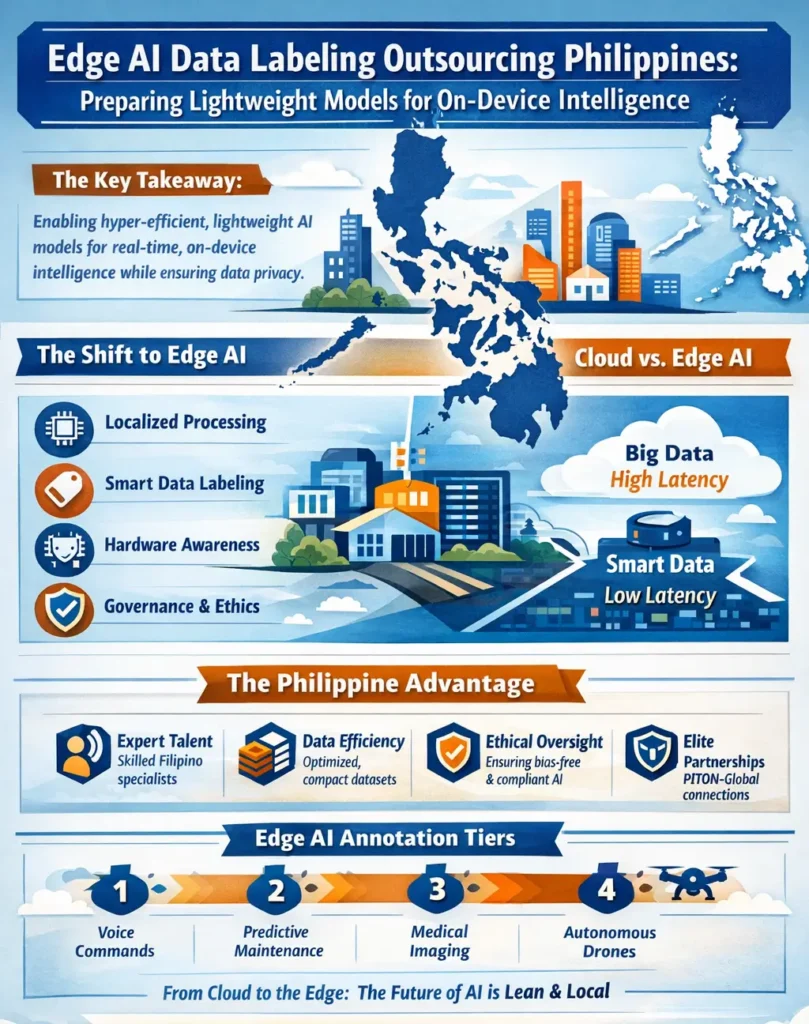
Edge AI Annotation Complexity Matrix
The difficulty of preparing data for the edge varies by use case. PITON-Global utilizes this matrix to match specific project requirements with the appropriate level of Filipino expertise.
| Annotation Tier | Example Application | Required Skillset | Primary Business Impact |
| Tier 1: Simple | Voice commands for home tech. | Basic audio transcription. | Enabling consumer voice control. |
| Tier 2: Intermediate | Industrial predictive maintenance. | Time-series and anomaly labeling. | Reducing downtime and costs. |
| Tier 3: Advanced | Point-of-care medical imaging. | High-precision semantic segmentation. | Faster diagnostics and better outcomes. |
| Tier 4: Expert | Autonomous drones (GPS-denied). | 3D point cloud and sensor fusion. | Fully autonomous real-world systems. |
The Philippine Advantage in the Edge AI Revolution
The global movement toward on-device intelligence is redefining the competitive landscape. Mastering the creation of efficient, lean models is the new gold standard, and that mastery begins with the data. The Philippines has secured a unique advantage here, offering a workforce that merges technical literacy with a cultural commitment to precision.
This ecosystem provides more than just capacity; it offers a talent pool of cognitive specialists who navigate the complex intersection of data science and hardware limitations. Supported by a mature BPO infrastructure and world-class security frameworks, the Philippines has become the strategic enabler of the Edge AI revolution. For organizations aiming to dominate the on-device market, the path to success leads directly to the specialized expertise found in this Southeast Asian powerhouse.
Expert FAQs
Q1: How does labeling for Edge AI differ from Cloud AI?
The core shift is from “quantity” to “quality.” Cloud AI thrives on massive, diverse datasets to build generalist models. Edge AI labeling is an exercise in strategic minimalism, aiming to build the leanest possible dataset that still allows a model to perform a specific, narrow task with high accuracy on a low-power device.
Q2: What role does “quantization-aware” labeling play?
Quantization reduces the numerical precision of a model to make it smaller and faster. Quantization-aware labeling anticipates this “shrinking” process. Annotators ensure that the most vital features are labeled so distinctly that they remain recognizable to the model even after the data precision is lowered.
Q3: Why is the Philippines uniquely suited for Edge AI projects?
Edge AI requires a workforce that can think critically about how data interacts with hardware. The Philippines offers a highly educated, analytical talent pool that moves beyond rote labeling to act as data architects. This strategic mindset, combined with robust infrastructure, makes the nation a premier hub for advanced AI services.
Q4: Can synthetic data replace human annotators for Edge AI?
Synthetic data is a helpful supplement, but it lacks the “messiness” of the real world. For Edge AI to work reliably in unpredictable environments, human annotators are essential for capturing nuances and edge cases that generators miss. Humans also provide the necessary ethical validation and governance that synthetic processes cannot replicate.
Achieve sustainable growth with world-class BPO solutions!
PITON-Global connects you with industry-leading outsourcing providers to enhance customer experience, lower costs, and drive business success.
Get Your Top 1% Vendor List
Author
Ralf Ellspermann is a multi-awarded outsourcing executive with 25+ years of call center and BPO leadership in the Philippines, helping 500+ high-growth and mid-market companies scale call center and customer experience operations across financial services, fintech, insurance, healthcare, technology, travel, utilities, and social media.
A globally recognized industry authority—and a contributor to The Times of India and CustomerThink —he advises organizations on building compliant, high-performance offshore contact center operations that deliver measurable cost savings and sustained competitive advantage.
Known for his execution-first approach, Ralf bridges strategy and operations to turn call center and business process outsourcing into a true growth engine. His work consistently drives faster market entry, lower risk, and long-term operational resilience for global brands.
EXECUTIVE GOVERNANCE & ACCURACY STANDARDS
Authored by:

Ralf Ellspermann
Founder & CSO of PITON-Global,
25-Year Philippine BPO Veteran,
Multi-awarded Executive
Specializing in strategic sourcing and excellence in Manila
View Full Bio
Verified by:

John Maczynski
CEO of PITON-Global, and former Global EVP of the World’s largest BPO provider | 40 Years Experience
Ensuring global compliance and enterprise-grade service standards
View Full Bio
Last Peer Review: March 18, 2026
This service framework is audited quarterly to meet shifting global outsourcing regulations and COPC standards.