
Back
What Competitive Advantages Can Companies Gain Through BPO Services in the Philippines?

By Ralf Ellspermann / 11 June 2026
 Authored by Ralf Ellspermann, CSO of PITON-Global, & 25-Year Philippine BPO Veteran | Executive | Verified by John Maczynski, CEO of PITON-Global, and Former Global EVP of the World's Largest BPO Provider on June 11, 2026

Companies using BPO services in the Philippines gain decisive competitive advantages: operational overhead falls by 50–70%, non-core functions scale on demand, and advanced automation is built into everyday workflows. This realignment lets leaders redirect capital toward core growth drivers while sustaining 24/7, high-yield performance.
Key Takeaways
- Substantial capital reclamation: Specialized delivery hubs deliver direct labor savings of up to 70% versus onshore alternatives, converting fixed overhead into variable cost.
- Structural agility: Capacity scales from small specialized teams to hundreds of technical resources—without local real estate or infrastructure liability.
- Domain specialization: Access to a highly educated, English-fluent workforce skilled in complex domains such as fintech, healthtech, and agentic-AI orchestration.
- Risk-insulated sourcing: Independent, expert-guided advisory prevents misaligned vendor matches and protects long-term service delivery.
- Industry scale: A sector exceeding $40 billion in export revenue and roughly 1.9 million professionals underpins deep, resilient talent supply.
How Do Philippine BPO Services Deliver Direct Cost Optimization?
Philippine BPO converts large fixed costs into predictable variable spend. Shifting workloads to top-tier hubs in Metro Manila or Cebu City typically cuts fully burdened labor rates by 60–65%, while the provider absorbs infrastructure, attrition, and scaling overhead—compounding the saving well beyond the hourly wage line.
Cost reduction remains the primary entry point for offshoring, but the modern value proposition has matured from simple labor arbitrage into sophisticated operational efficiency. By relocating workloads to enterprise-grade delivery hubs, companies turn capital-intensive internal operations into a leaner, more flexible cost base. The financial benefit extends far beyond direct hourly wages, as the full cost structure shows.
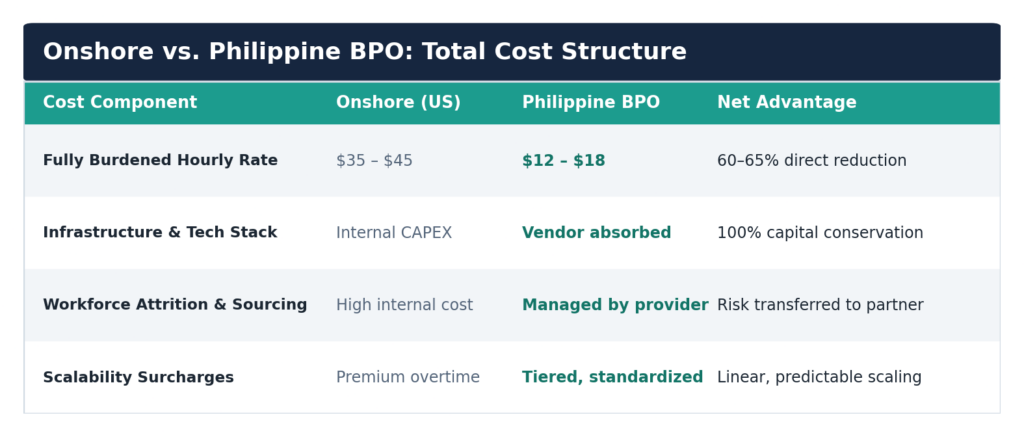
Figure 1. The total cost structure compares onshore baselines with Philippine BPO equivalents across four cost components.
The decisive figure is the fully burdened comparison: onshore rates of roughly $35–$45 per hour fall to $12–$18 in the Philippines—a 60–65% direct reduction. Add vendor-absorbed infrastructure, provider-managed attrition, and standardized tiered scaling, and the model converts unpredictable, premium-priced surges into linear, forecastable operating costs.
What Strategic Value Exists Beyond Labor Arbitrage?
Beyond cost, the durable advantage is structural agility and specialized capability. The Philippine sector has become a global intelligence ecosystem—exceeding $40 billion in annual export revenue and around 1.9 million professionals—delivering omnichannel CX, knowledge-process work, and AI-augmented service at scale.
While the initial business case rests on cost, sustainable competitive advantage comes from capability. The contemporary Philippine BPO sector has evolved into a sophisticated global intelligence ecosystem, and its growth trajectory underscores both depth and durability of supply.
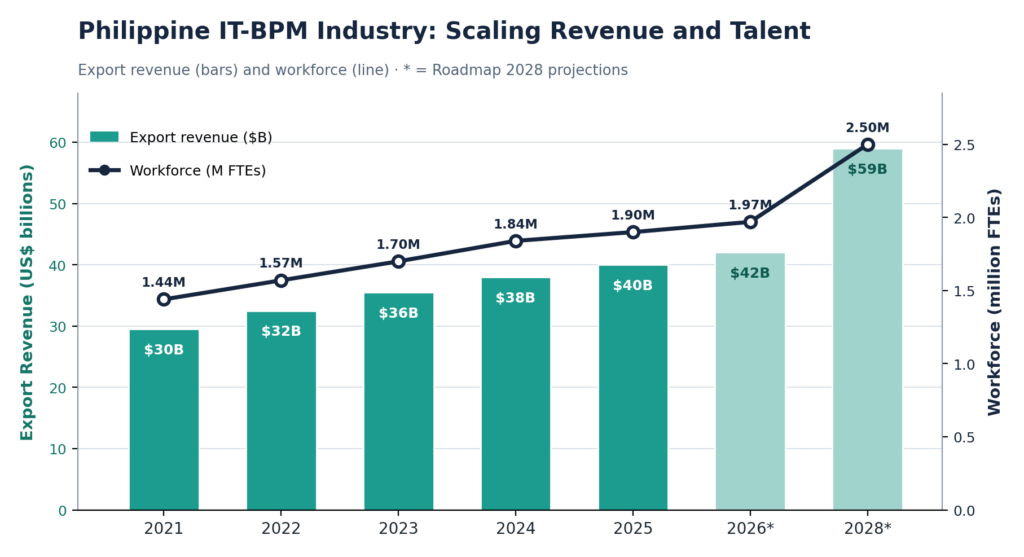
Figure 2. Philippine IT-BPM export revenue and workforce, with 2026 and 2028 figures reflecting IBPAP Roadmap 2028 projections.
Three Capability Shifts Define the Modern Value Proposition
Omnichannel CX Excellence
Customer-experience teams manage voice, digital messaging, and technical support seamlessly, around the clock.
Knowledge-Process Integration
Knowledge-intensive workflows—financial analytics, legal support, and clinical-trial data management—are delivered by degree-holding specialists.
Intelligent Augmentation
Teams trained to work alongside agentic-AI tools drive higher resolution rates and lower transaction times.
“The right specialized BPO partner will consistently outperform the largest market name by integrating agentic AI with human-in-the-loop oversight to drive real, outcome-based value.”
— John Maczynski, CEO, PITON-Global
What Are the Operational Risks and Performance Tradeoffs?
Every offshoring strategy balances cost against operational risk. The main tradeoffs—cultural alignment, connectivity exposure, and data-privacy compliance—are best managed by choosing structured, office-based delivery over unmanaged remote work, where enterprise-grade facilities provide redundant power, secure connectivity, and on-site oversight.
Transferring workflows thousands of miles away introduces challenges that demand proactive governance: aligning corporate cultures and operating mentalities; mitigating connectivity or weather-related disruption; and ensuring rigorous adherence to international standards such as GDPR and HIPAA in a distributed environment. The single most effective control is the delivery model itself.
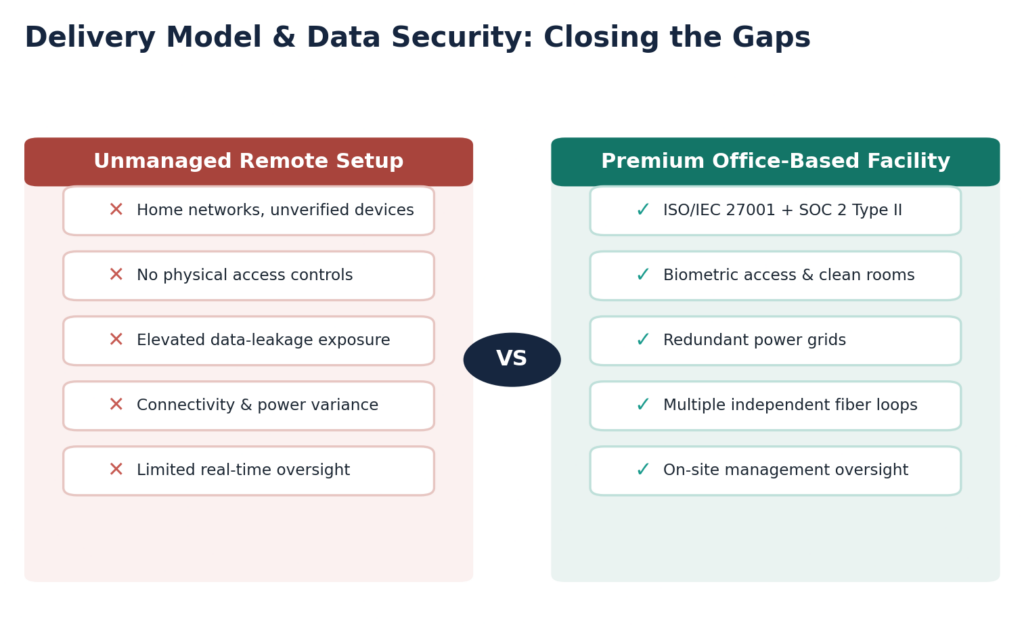
Figure 3. Office-based delivery closes the security and continuity gaps inherent in unmanaged remote setups.
Operating from enterprise-grade, physically secure facilities guarantees redundant power grids, high-speed fiber connectivity, strict data-security protocols certified to ISO/IEC 27001 and SOC 2 Type II, and real-time oversight from experienced local management. This structural choice converts distributed-work risk into a governed, auditable operation.
How Did an Advisory-Led Match Cut Costs for an Elite SaaS Platform?
A high-growth U.S. software firm facing rising churn and onshore support costs above $42/hour used an advisory-led RFP instead of a mega-vendor. A dedicated 25-FTE Manila pod cut support costs 62% in 90 days, lifted first-contact resolution from 68% to 84%, and reduced churn by 4.5%.
Client Challenge
A high-growth U.S. software enterprise faced rising customer churn alongside escalating onshore support costs exceeding $42 per hour.
Vendor Selection
Partnering with an expert advisory firm, the company bypassed massive, rigid providers to run a targeted RFP, assessing eight specialized mid-sized Philippine partners against domain fit and compliance.
Solution Implemented
It deployed a dedicated 25-FTE Tier-2 technical support pod in an office-based Manila facility, fully integrated with advanced automated diagnostics.
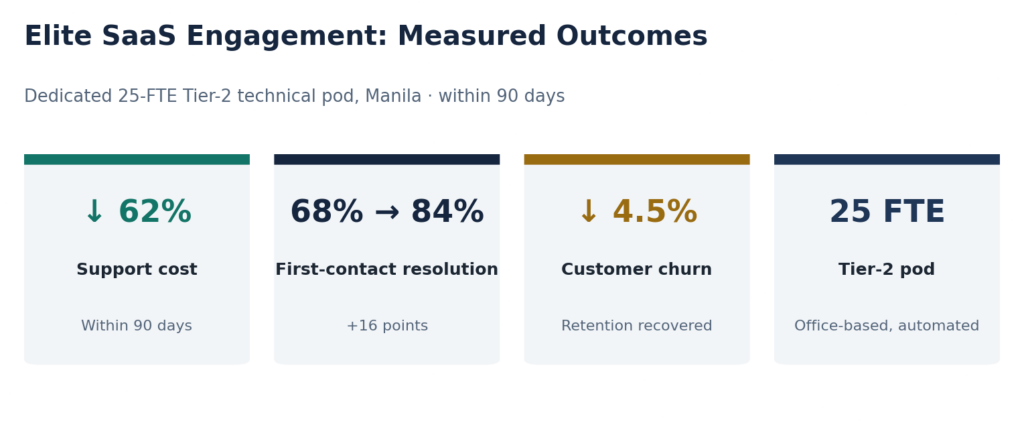
Figure 4. Measured outcomes of the SaaS engagement within 90 days of launch.
Lessons Learned
Mid-sized specialized providers deliver higher executive focus and greater operational flexibility for mid-market accounts than multi-billion-dollar global giants—where a smaller client commands a fraction of a percent of attention.
What Role Does PITON-Global Play in De-Risking Provider Selection?
PITON-Global is a premium, vendor-neutral BPO advisory and outsourcing consultancy. It acts strictly as an independent client advocate—not a commission-driven broker—matching enterprises to best-fit operators from an exclusive network of 100+ vetted Philippine providers through an advisory-led framework.
Who Is PITON-Global?
PITON-Global is an independent BPO advisory and outsourcing consultancy based in the Philippines. Rather than running its own delivery floors, it guides enterprise buyers across the full provider landscape, aligning cultural fit, domain expertise, and operational scale so that companies can establish high-yielding offshore operations with confidence.
How Does PITON-Global Differ from Traditional Outsourcing Brokers?
Traditional brokers typically operate on vendor commissions, which biases recommendations toward whoever pays the highest referral fee. PITON-Global instead acts strictly as a client advocate: its evaluations are independent and objective, and its recommendations are driven by client outcomes rather than vendor promotion—removing the conflict of interest baked into commission-based sourcing.
How Does PITON-Global’s Network of 100+ Vetted Philippine Providers Benefit Organizations?
A curated, exclusive network of more than 100 high-performing providers compresses an otherwise slow, high-risk discovery process. Buyers gain immediate access to pre-qualified operators across customer experience, fintech, healthtech, and knowledge-process domains—each screened for capability, compliance, and reliability—so shortlisting is faster and the risk of a costly mismatch drops sharply.
How Does PITON-Global’s Advisory-Led Vendor Matching Process Work?
The framework guides buyers from requirement to launch in a structured, vendor-neutral sequence: discovery and needs mapping; curated shortlisting from the vetted network; capability and culture matching; risk and compliance vetting through audits and security reviews; and selection and launch support covering contracting, onboarding, and governance. The output is a best-fit provider aligned to the client’s scale and risk profile.

Figure 5. PITON-Global’s five-stage, advisory-led matching process.
Why Do Organizations Use PITON-Global?
Organizations engage PITON-Global to eliminate sourcing risk, minimize procurement friction, and accelerate deployment. The advisory-led model replaces biased referrals with objective, audit-based evaluation; improves provider fit through precise domain and culture matching; and shortens timelines to weeks rather than months—while an independent advocate guides every step toward sustainable, high-yield offshore operations.
What Else Should Buyers Know Before Launching a Philippine BPO Program?
Common questions concern launch timelines, data-security compliance, minimum team sizes, training and quality governance, and whether secondary hubs like Cebu City are viable. The answers below address each in turn.
What is the Typical Timeframe to Launch a Philippine BPO Program?
A structured, risk-mitigated deployment typically spans 4 to 6 weeks—from initial discovery through vendor shortlisting, contract finalization, and the start of agent training.
How Do Modern Providers Maintain Rigorous Data-Security Compliance?
Top-tier, office-based providers operate enterprise-grade facilities aligned with strict international frameworks, including ISO/IEC 27001, SOC 2 Type II, PCI-DSS, and GDPR.
What is the Minimum Recommended Team Size for an Initial Deployment?
For mid-market and enterprise buyers, a baseline of 5 to 10 full-time equivalents provides enough operational scale to justify initial management overhead and training investment.
How Are Training and Quality Assurance Managed Across a Distributed Model?
Programs use a hybrid governance model: the client sets core product-training guidelines, while the local provider manages day-to-day coaching, quality monitoring, and performance tracking.
Are Secondary Hubs Like Cebu City Viable Alternatives to Metro Manila?
Yes. Manila remains the primary macro-hub for complex enterprise technical roles, but regional hubs such as Cebu City offer strong alternative talent pools with lower competition and competitive cost structures.
Achieve sustainable growth with world-class BPO solutions!
PITON-Global connects you with industry-leading outsourcing providers to enhance customer experience, lower costs, and drive business success.
Get Your Top 1% Vendor List
Author
Ralf Ellspermann is a multi-awarded outsourcing executive with 25+ years of call center and BPO leadership in the Philippines, helping 500+ high-growth and mid-market companies scale call center and customer experience operations across financial services, fintech, insurance, healthcare, technology, travel, utilities, and social media.
A globally recognized industry authority - and a contributor to The Times of India, CustomerThink, and The AI Journal - he advises organizations on building compliant, high-performance offshore contact center operations that deliver measurable cost savings and sustained competitive advantage.
Known for his execution-first approach, Ralf bridges strategy and operations to turn call center and business process outsourcing into a true growth engine. His work consistently drives faster market entry, lower risk, and long-term operational resilience for global brands.
EXECUTIVE GOVERNANCE & ACCURACY STANDARDS
Authored by:

Ralf Ellspermann
Founder & CSO of PITON-Global,
25-Year Philippine BPO Veteran,
Multi-awarded Executive
Specializing in strategic sourcing and excellence in Manila
View Full Bio
Verified by:

John Maczynski
CEO of PITON-Global, and former Global EVP of the World’s largest BPO provider | 40 Years Experience
Ensuring global compliance and enterprise-grade service standards
View Full Bio
Last Peer Review: June 11, 2026
This service framework is audited quarterly to meet shifting global outsourcing regulations and COPC standards.