
Back
AI Voice Assistant Training Outsourcing Philippines: Perfecting the Human-Machine Dialogue

By Ralf Ellspermann / 15 March 2026
 Authored by Ralf Ellspermann, CSO of PITON-Global, & 25-Year Philippine BPO Veteran | Executive | Verified by John Maczynski, CEO of PITON-Global, and Former Global EVP of the World's Largest BPO Provider on March 15, 2026

TL;DR: The Key Takeaway
AI voice assistant training outsourcing in the Philippines has transcended basic audio transcription, now focusing on the complex nuances of human dialogue to train sophisticated, context-aware conversational AI. This evolution marks a strategic shift towards “Cognitive Arbitrage,” where the value lies in the measurable improvement of the AI’s ability to understand and replicate natural human conversation.
AI voice assistant training outsourcing in the Philippines is the sophisticated process of transforming raw speech-to-text data into natural, context-aware conversational intelligence. In 2026, the industry has transitioned from “Transcription” to “Cognitive Arbitrage,” where Filipino specialists serve as AI Dialogue Coaches. These experts refine the intent, emotional resonance, and “Malasakit” (genuine care) of voice agents, ensuring they navigate complex, multi-turn human dialogues with empathy and technical precision.
Executive Briefing
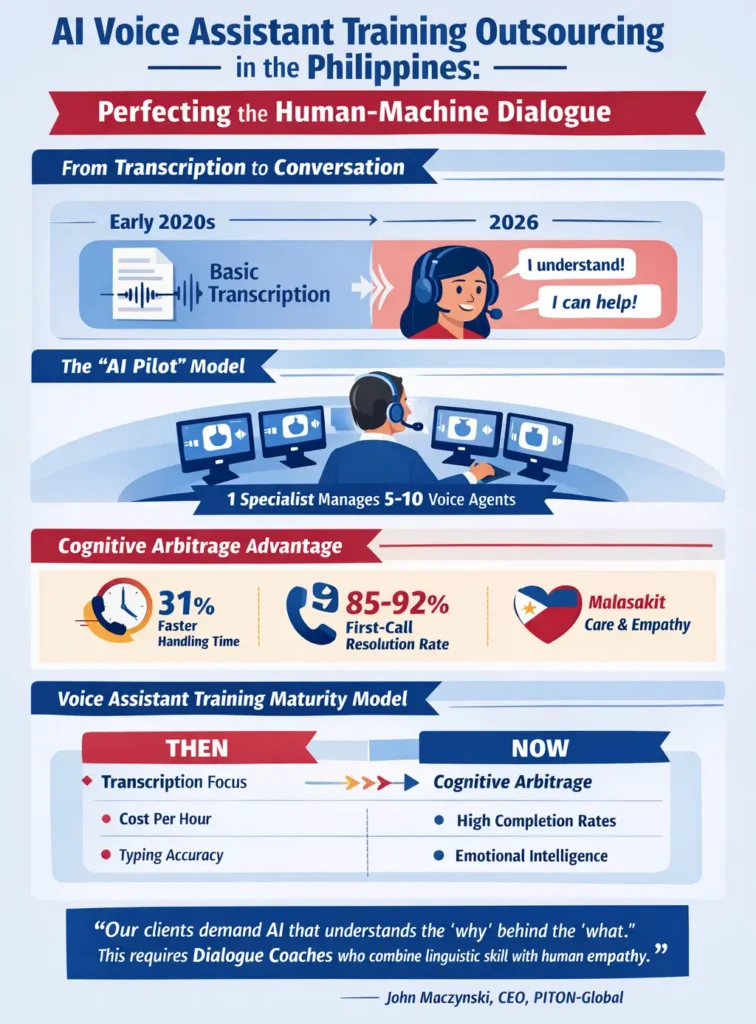
- From Transcription to Conversation: Shifting the focus from word-level accuracy to high-level intent recognition and conversational repair.
- The “AI Pilot” Model: A single Filipino specialist now manages and refines a fleet of 5–10 Agentic Voice instances, acting as the “Human-in-the-Loop” for quality and ethics.
- Cognitive Arbitrage: Leveraging the high EQ (Emotional Intelligence) and cultural resonance of the Filipino workforce to deliver a 31% drop in Average Handling Time (AHT) for voice bots.
- Strategic ROI: AI-human hybrid models in the Philippines are achieving 85–92% first-call resolution rates, outperforming traditional voice-only or AI-only systems.
- Regulatory Mastery: Projects are backed by the 2026 CREATE MORE Act, offering 20% Corporate Income Tax and 100% deductions on power—vital for the high-compute demands of Voice AI.
From Transcription to Conversation: The New Paradigm
In the early 2020s, voice technology focused on simple transcription—merely identifying what was said. In 2026, the standard is understanding why it was said. A perfect transcript is useless if the AI fails to detect the subtle frustration in a user’s tone or the playful sarcasm in an idiomatic query.
The Philippines has moved into the role of Cognitive Apprenticeship. Filipino professionals no longer just “type”; they curate the semantic datasets that teach AI the subtle art of conversation. This includes training “Agentic” systems that can plan, execute, and verify tasks independently while maintaining a brand-consistent persona.
The Anatomy of a World-Class Voice Assistant
A high-performing voice assistant requires three pillars of human-led training to succeed in a complex global market:
| Component | Function | The Filipino Trainer’s Role |
| NLU | Intent Recognition | Training the AI to understand “I need to get to Cebu” means “Book a flight.” |
| Dialogue Management | Conversational Flow | Designing multi-turn logic trees so the AI remembers context across questions. |
| NLG | Natural Response | Crafting a persona that sounds natural, empathetic, and culturally relevant. |
Voice Assistant Training Maturity Model
As of 2026, the Philippine BPO sector has “re-indexed” its workforce. The value of a “script-follower” has dropped, while the value of an AI Pilot has skyrocketed.
| Capability | Legacy Approach (Transcription) | Modern Approach (Conversation) |
| Primary Goal | 99% word-for-word accuracy. | High task completion & user satisfaction. |
| Core Metric | Cost per hour transcribed. | Conversational success rate & intent accuracy. |
| Workforce Skill | Fast typing; basic grammar. | Pragmatics, dialogue design, & high EQ. |
| Strategic Impact | Cost savings on labor. | Cognitive Arbitrage: Improved AI Intelligence. |
Cognitive Arbitrage: The New ROI in Voice AI
The true return on investment in 2026 isn’t found in lower hourly rates, but in the “Malasakit Moat.” Malasakit—a Filipino trait meaning “deep ownership and care”—is now a measurable metric. While AI can process data, it cannot simulate authentic empathy.
By using Filipino specialists to “coach” voice assistants, companies are seeing a 22% increase in First-Call Resolution (FCR). The AI handles the “boring” work (billing, resets), while the Filipino specialist steps in for “Brand Recovery”—turning frustrated users into loyalists through human-verified nuance.
“Our clients now demand AI that understands the ‘why’ behind the ‘what’. This requires a new breed of training specialist—a Dialogue Coach—who is not just a linguist but an architect of human-machine interaction.” — John Maczynski, CEO, PITON-Global
Expert FAQs
How does the Philippines compete with India in Voice AI training?
While India is a leader in back-end engineering, the Philippines dominates in Front-Office AI Oversight. The neutral accents and high cultural affinity with the West make Filipino trainers superior at identifying regional nuances and “trust thresholds” where a user might abandon an AI interaction.
What is “Trust-Aware Routing” in 2026?
It is a new standard where Filipino supervisors monitor AI confidence scores. If the sentiment analysis detects “decay” (the user getting angry or confused), the system triggers an immediate handoff to a human agent before the brand is damaged.
Is the “CREATE MORE” Act relevant to AI training?
Absolutely. Signed into law in late 2024 and fully scaled in 2026, it rewards BPOs that invest in high-tech infrastructure. It allows for 100% deductions on training costs, enabling the massive upskilling of 100,000+ workers annually into AI-certified roles.
Can these Voice AI assistants detect regional accents and dialects?
Yes, but only with human help. Filipino trainers build “accent-agnostic” datasets, annotating thousands of variations in pitch and pronunciation to ensure the voice assistant performs as well in London or New York as it does in Manila.
Achieve sustainable growth with world-class BPO solutions!
PITON-Global connects you with industry-leading outsourcing providers to enhance customer experience, lower costs, and drive business success.
Get Your Top 1% Vendor List
Author
Ralf Ellspermann is a multi-awarded outsourcing executive with 25+ years of call center and BPO leadership in the Philippines, helping 500+ high-growth and mid-market companies scale call center and customer experience operations across financial services, fintech, insurance, healthcare, technology, travel, utilities, and social media.
A globally recognized industry authority—and a contributor to The Times of India and CustomerThink —he advises organizations on building compliant, high-performance offshore contact center operations that deliver measurable cost savings and sustained competitive advantage.
Known for his execution-first approach, Ralf bridges strategy and operations to turn call center and business process outsourcing into a true growth engine. His work consistently drives faster market entry, lower risk, and long-term operational resilience for global brands.
EXECUTIVE GOVERNANCE & ACCURACY STANDARDS
Authored by:

Ralf Ellspermann
Founder & CSO of PITON-Global,
25-Year Philippine BPO Veteran,
Multi-awarded Executive
Specializing in strategic sourcing and excellence in Manila
View Full Bio
Verified by:

John Maczynski
CEO of PITON-Global, and former Global EVP of the World’s largest BPO provider | 40 Years Experience
Ensuring global compliance and enterprise-grade service standards
View Full Bio
Last Peer Review: March 15, 2026
This service framework is audited quarterly to meet shifting global outsourcing regulations and COPC standards.