
Back
AI-Powered Document Processing Outsourcing Philippines: Automating the Enterprise Paper Trail

By Ralf Ellspermann / 19 March 2026
 Authored by Ralf Ellspermann, CSO of PITON-Global, & 25-Year Philippine BPO Veteran | Executive | Verified by John Maczynski, CEO of PITON-Global, and Former Global EVP of the World's Largest BPO Provider on March 19, 2026

TL;DR: The Key Takeaway
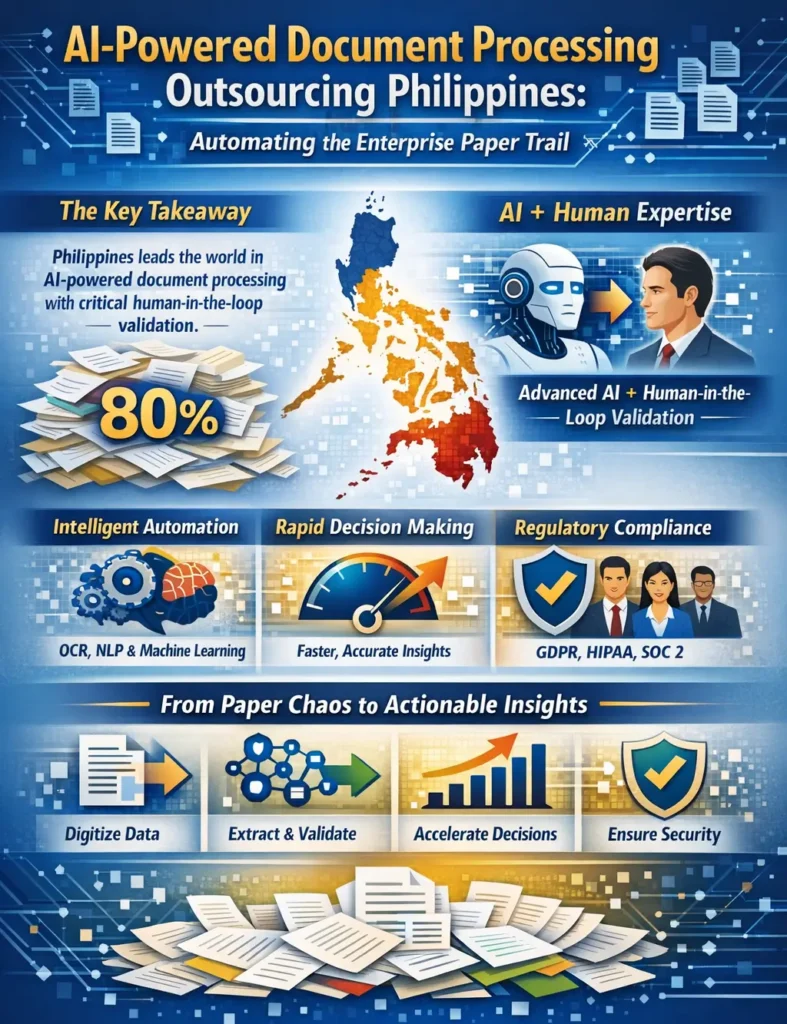
AI-powered document processing outsourcing has matured into a strategic imperative for enterprises buried in unstructured data. The Philippines is the global leader, providing not just automated extraction but the critical human-in-the-loop cognitive validation required to turn digital noise into verifiable, actionable intelligence.
Modern corporations are often paralyzed by “dark data” locked within physical and digital paperwork. By leveraging AI-powered document processing in the Philippines, organizations can convert these stagnant archives into fluid, actionable intelligence. This strategic shift uses advanced neural networks and human-in-the-loop validation to eliminate manual entry bottlenecks, drastically accelerating decision-making while ensuring near-perfect data accuracy and regulatory compliance.
Executive Briefing
- The Data Paradox: While enterprises are flooded with information, 80% remains trapped in unstructured formats, stalling digital evolution.
- Technological Convergence: Modern Intelligent Document Processing (IDP) fuses OCR, NLP, and machine learning to categorize and validate data at scale.
- Strategic Evolution: The industry has transitioned from simple data entry to high-accuracy automated workflows that mitigate enterprise risk.
- The Philippine Hub: The nation offers a sophisticated blend of cutting-edge AI platforms and elite knowledge workers for complex exception handling.
- Seamless Integration: PITON-Global connects global firms with premier Filipino providers to deliver end-to-end, sovereign document automation.
Executive Summary
The days of manual ledger entries have faded, yet the struggle to manage the corporate paper trail has never been more intense. Today’s solution is AI-powered document processing outsourcing Philippines, a sophisticated framework that reimagines unstructured PDFs and images as a stream of verified, high-velocity data. This discipline goes far beyond basic scanning; it employs cognitive AI to interpret, extract, and cross-reference information with a speed that exceeds human capability. As global brands look to liberate value from dense contracts, medical charts, and financial filings, the Philippines has solidified its role as the essential theater for this digital transformation. PITON-Global bridges this gap, providing the conduit to specialized technical talent that is effectively winning the war against information overload.
From Digitization to Intelligence: The New Frontier of Document Processing
Organizations in 2026 find themselves in a strange position: they possess more data than ever but struggle to extract actual insights. Research indicates that the vast majority of business-critical intelligence is buried in emails, messy PDFs, and intricate forms. Old-school document management, which prioritized simple storage and retrieval, is no longer a viable strategy. The new competitive standard is the ability to automatically ingest and analyze this flood of information in real time. This requirement has birthed the era of Intelligent Document Processing (IDP), representing a massive leap from passive “reading” to active “understanding.”
By utilizing Natural Language Processing (NLP) to grasp intent and computer vision to map layouts, IDP systems do more than just record text. They comprehend the relationship between data points, such as linking an invoice number to a specific purchase order, while simultaneously checking external databases for discrepancies. This transition moves document handling from an administrative cost center to a primary engine of corporate agility and foresight.
The Cognitive Validation Layer: Why Human Insight is Mandatory
Artificial Intelligence provides the horsepower for massive scale, yet human cognition remains the final safeguard for accuracy and trust. No algorithm is perfect; models frequently stumble when faced with rare handwriting styles, ambiguous legal phrasing, or unfamiliar document structures. This is where the “human-in-the-loop” (HITL) model—a cornerstone of the Philippine BPO sector—becomes an indispensable asset. These specialists do not merely fix typos; they apply nuanced judgment that software cannot simulate.
This “Cognitive Validation” is a sophisticated discipline. It requires professionals to interpret the spirit of a contract or verify the complex logic of a balance sheet against regulatory standards. They act as a human firewall, preventing expensive downstream errors and ensuring that the data fueling a company’s ERP or CRM is beyond reproach.
“Companies are no longer looking for clerical support; they are hunting for validation experts who serve as the ultimate arbiters of truth,” explains John Maczynski, CEO of PITON-Global. “They need teams capable of reviewing an AI-flagged clause and determining if it aligns with a Master Service Agreement. This level of service is the new gold standard in the Philippines, providing a layer of reliability that pure software vendors simply can’t match.”
The IDP Implementation Maturity Curve
The path toward total document automation is a progressive journey. Understanding where an enterprise sits on this curve is vital for setting realistic benchmarks and achieving long-term ROI.
| Maturity Level | Defining Characteristics | Core Technologies | Business Impact |
| Level 1: Digitization | Converting paper to digital files. | Scanners, Basic OCR | Searchable archives; reduced physical footprint. |
| Level 2: Template-Based | Extraction from fixed forms. | Zonal OCR, Rules | Faster processing for structured invoices/forms. |
| Level 3: Intelligent | Handling unstructured data. | NLP, ML, Computer Vision | High accuracy across diverse, complex files. |
| Level 4: Orchestration | Full workflow automation. | IDP + RPA | Straight-through processing; zero-touch cycles. |
| Level 5: Predictive | Insights from extracted data. | BI, Predictive Analytics | Proactive risk modeling and new revenue streams. |
Intelligence Arbitrage: Transforming Document Workflows
The advantage of partnering with elite providers in the Philippines is rooted in “Intelligence Arbitrage.” This concept moves the conversation away from cheap labor toward the superior cognitive value delivered by specialized teams. In document processing, this manifests as higher accuracy that prevents costly rework, faster turnaround times that keep supply chains moving, and enhanced security that satisfies global auditors.
This paradigm shifts the vendor relationship from a transactional “cost-per-page” model to a strategic alliance focused on continuous optimization. The provider isn’t just a processor; they are an active participant in training the AI models, refining business rules, and identifying new efficiencies. This collaborative spirit, deeply embedded in the Philippine service culture, ensures that AI’s potential is fully extracted.
Document Processing Automation Use Case Matrix
The impact of AI-driven processing touches every corner of the enterprise, turning administrative burdens into streamlined assets.
| Department | Specific Use Case | Old Manual Pain Points | AI-Powered Benefits |
| Finance | AP Invoice Processing | High error rates; late fees; fraud risk. | Instant extraction; automated 3-way matching. |
| Human Resources | Onboarding & Records | Document fatigue; compliance gaps. | Automated resume parsing; instant record creation. |
| Legal | Contract Management | Slow review cycles; missed obligations. | Clause extraction; proactive risk flagging. |
| Logistics | Shipping & Customs Docs | Data silos; clearance delays. | Real-time tracking; automated compliance. |
| Healthcare | Patient Claims | HIPAA risks; slow billing; coding errors. | Secure extraction; automated coding; faster payouts. |
The Governance Gateway: Data Integrity and Security
When a corporation hands over its sensitive contracts and records to a partner, security becomes the highest priority. Top-tier Philippine providers operate within a rigorous ecosystem of international compliance, adhering to standards like GDPR, HIPAA, and SOC2. These facilities maintain strict access controls and comprehensive audit trails that track every data interaction. PITON-Global architects these governance layers, ensuring that every partnership is built on transparency and absolute data sovereignty. This commitment to protection is why the world’s most regulated industries continue to choose the Philippines for their mission-critical automation needs.
Expert FAQs
How does the system manage poor-quality scans or cursive handwriting?
Modern IDP platforms utilize deep-learning models trained on millions of diverse image samples. While initial machine accuracy may vary, the system is designed to intelligently flag “low-confidence” fields, instantly routing them to a human expert in the Philippines for verification.
What is the realistic timeline for seeing results from an IDP rollout?
Most organizations take a phased approach. A pilot program for a single, high-volume document type can be operational in about 4 to 6 weeks. A comprehensive, enterprise-wide deployment typically matures over 6 to 12 months as the AI continues to learn from human feedback.
Does the automation become more efficient over time?
Yes, continuous learning is a fundamental component. Through the human-in-the-loop feedback cycle, every correction made by a validator is fed back into the machine learning model. This creates a “flywheel effect” where the system becomes increasingly autonomous and accurate with every document processed.
Is it possible to connect these AI tools with our legacy CRM or ERP?
Seamless connectivity is a core design principle. Professional IDP solutions in the Philippines utilize robust APIs to push validated data directly into systems like SAP, Salesforce, or Oracle. This enables a “straight-through” processing model that eliminates the need for any manual data entry.
Achieve sustainable growth with world-class BPO solutions!
PITON-Global connects you with industry-leading outsourcing providers to enhance customer experience, lower costs, and drive business success.
Get Your Top 1% Vendor List
Author
Ralf Ellspermann is a multi-awarded outsourcing executive with 25+ years of call center and BPO leadership in the Philippines, helping 500+ high-growth and mid-market companies scale call center and customer experience operations across financial services, fintech, insurance, healthcare, technology, travel, utilities, and social media.
A globally recognized industry authority—and a contributor to The Times of India and CustomerThink —he advises organizations on building compliant, high-performance offshore contact center operations that deliver measurable cost savings and sustained competitive advantage.
Known for his execution-first approach, Ralf bridges strategy and operations to turn call center and business process outsourcing into a true growth engine. His work consistently drives faster market entry, lower risk, and long-term operational resilience for global brands.
EXECUTIVE GOVERNANCE & ACCURACY STANDARDS
Authored by:

Ralf Ellspermann
Founder & CSO of PITON-Global,
25-Year Philippine BPO Veteran,
Multi-awarded Executive
Specializing in strategic sourcing and excellence in Manila
View Full Bio
Verified by:

John Maczynski
CEO of PITON-Global, and former Global EVP of the World’s largest BPO provider | 40 Years Experience
Ensuring global compliance and enterprise-grade service standards
View Full Bio
Last Peer Review: March 19, 2026
This service framework is audited quarterly to meet shifting global outsourcing regulations and COPC standards.