
TL;DR: The Key Takeaway
AI output verification has surpassed simple automated checks, becoming a critical discipline requiring nuanced human judgment. The strategic outsourcing of this final, decisive checkpoint to the Philippines provides the essential layer of cognitive oversight necessary to ensure generative AI models are not just accurate, but also safe, logical, and aligned with enterprise standards. It is the last step in a wider stack of evaluation and RLHF services for AI labs.
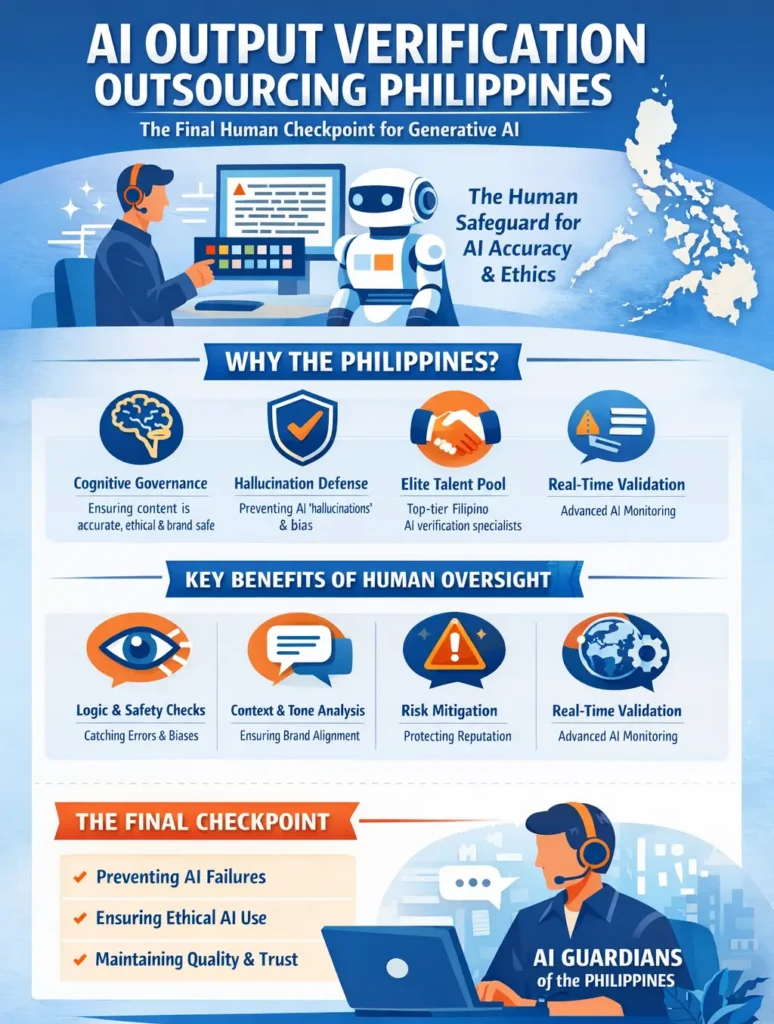
In the era of “hallucinations” and algorithmic bias, AI output verification in the Philippines provides the essential human-in-the-loop (HITL) safeguard. By shifting from simple fact-checking to “Cognitive Governance,” Filipino specialists ensure generative AI content is accurate, ethically sound, and perfectly aligned with brand voice, preventing reputational damage before deployment.
Executive Briefing
- The Hallucination Hedge: Human oversight is now the primary defense against AI-generated inaccuracies, logical fallacies, and nonsensical “hallucinations.”
- Cognitive Governance: Moving beyond traditional QA, this discipline focuses on the qualitative nuances of tone, empathy, and cultural context.
- Risk Over Cost: Modern enterprises view Philippine verification as a strategic risk mitigation tool rather than a simple cost-saving measure.
- The “AI Guardian” Role: Filipino specialists utilize advanced reasoning to validate the complex outputs of autonomous agents in real-time.
- Elite Ecosystem Access: PITON-Global bridges the gap between AI developers and the most capable Filipino talent specializing in high-stakes output validation.
The Imperative for Human Oversight in an AI-Driven World
The potential of generative AI is boundless, yet its vulnerabilities are significant. Large language models, often trained on unvetted data, frequently produce subtle biases or complete fabrications presented with total confidence. While automated filters can intercept crude errors, they lack the “common sense” and ethical discernment required to evaluate complex human communication. The final checkpoint before an AI interacts with the public cannot be another machine; it must be a sophisticated human mind.
This requirement for human intervention is not a temporary hurdle. As models gain autonomy, the demand for independent verification will intensify. We are witnessing a shift where humans are no longer just the primary creators of data, but the essential validators of an AI-generated reality. The country, with its massive talent pool and decades of BPO excellence, has become the global headquarters for this new discipline of AI governance.
Beyond Accuracy: The Nuances of High-Quality AI Output Verification
Effective verification is a multidimensional craft that transcends basic fact-checking. A human-in-the-loop process assesses content for contextual relevance, ethical alignment, and brand consistency—nuances that software remains unable to master. For instance, an AI might generate a customer response that is technically correct but entirely devoid of the empathy required for a sensitive support ticket.
A human verifier identifies these subtle disconnects immediately. Whether it is ensuring a marketing email captures a specific brand “personality” or verifying that a technical summary hasn’t lost its logical thread, these specialists ensure AI-generated content is not just “right,” but effective and safe. Their findings also feed back into better-engineered prompts upstream.
Automated Heuristics vs. Human Cognitive Review
The following table illustrates why automated tools are insufficient for high-stakes generative AI workflows.
| Aspect | Automated Heuristics | Human Cognitive Review |
| Scope of Review | Pattern matching and keywords | Holistic accuracy, tone, and context |
| Error Detection | Syntax and predictable bugs | Nuanced, logical, and “hidden” errors |
| Ethical Assessment | Basic word flagging | Deep cultural and ethical understanding |
| Brand Voice | Unable to perceive personality | Ensures consistency with brand identity |
| Adaptability | Requires constant updates | Real-time adaptation to new challenges |
| Strategic Value | Basic quality control | Brand protection and risk mitigation |
Intelligence Arbitrage in AI Verification: The Philippine Advantage
The rise of the Philippines as a hub for AI verification is a prime example of “Intelligence Arbitrage.” This isn’t about seeking the lowest price point; it is about accessing a workforce with the specific analytical skills and cultural fluency required to govern advanced AI.
This is a high-value partnership model. It allows AI innovators to focus on technical development while delegating the critical “last mile” of safety and accuracy to dedicated experts, often working beside upstream teams that handle tasks such as audio annotation for voice models. In this ecosystem, the Philippines acts as a strategic partner, providing the human intelligence necessary to make artificial intelligence viable for enterprise use.
AI Output Verification Service Tier Matrix
| Service Tier | Example Tasks | Strategic Value |
| Tier 1: Foundational | Fact-checking, grammar, spelling | Basic readability and quality |
| Tier 2: Intermediate | Tone analysis, brand alignment | Engagement and consistency |
| Tier 3: Advanced | Bias detection, logical consistency | Misinformation risk mitigation |
| Tier 4: Expert | Adversarial testing, hallucination detection | Total system trustworthiness |
“Our clients are no longer asking for simple quality assurance; they are asking for cognitive governance. They need to know that every piece of content generated by their AI models has been reviewed by a human who can vouch for its accuracy, its safety, and its alignment with their brand. The Philippines is the only location that can provide this service at scale.” — John Maczynski, CEO, PITON-Global
Agentic Governance: The Future of AI Quality Assurance
As AI systems transition into autonomous agents—performing tasks like financial trading or grid management—”Agentic Governance” becomes the ultimate frontier. Filipino “AI Guardians” are leading this charge, providing real-time oversight to ensure these agents remain within their intended operational and ethical boundaries. This role represents the most complex form of verification, cementing the country’s position as a global leader in the AI-powered economy.
Expert FAQs
Q: Why can’t we use one AI to verify another?
AI-on-AI verification often creates a “closed loop” where the second model shares the same logical blind spots or training biases as the first. Human professionals provide the “outside-the-box” reasoning and ethical skepticism that software cannot generate.
Q: What makes the Philippine workforce better for this than other regions?
The combination of high-level English proficiency and a deep cultural affinity for Western market nuances is unmatched. This allows Filipino specialists to catch subtle issues in tone and intent that are invisible to those without that specific cultural shorthand.
Q: How does this impact the development speed of AI?
While it adds a step to the process, it actually accelerates long-term deployment by preventing the costly rollbacks, legal issues, and PR disasters that occur when a flawed AI output goes viral. The same logic applies upstream, where edge-case accuracy in ML training data decides how often those flaws appear.
Q: Is this just a temporary need until AI gets “smarter”?
Actually, the opposite is true. As AI becomes more powerful and handles more sensitive tasks, the “stakes” of an error rise exponentially. The more advanced the AI, the more critical the human checkpoint becomes.