

TL;DR: The Key Takeaway
Prompt engineering outsourcing in the Philippines is evolving from a technical task into a strategic art form. It’s no longer about just writing instructions for AI, but about crafting nuanced dialogues that unlock higher-order reasoning, creativity, and problem-solving, establishing the nation as a hub for cognitive AI enablement and a natural home for the prompt, dialogue and evaluation work AI builders outsource.
Prompt engineering outsourcing in the Philippines provides the strategic “cognitive craftsmanship” needed to maximize generative AI performance. By utilizing a linguistically gifted and culturally adaptable workforce, enterprises can move beyond simple commands to complex “prompt chaining” and multi-step reasoning. This partnership ensures AI outputs are contextually accurate, brand-aligned, and capable of solving sophisticated business problems with human-level nuance.
Executive Briefing
- Maximizing Model ROI: Shift from generic AI outputs to high-value, specific results through expert-level instruction design.
- Cognitive Craftsmanship: Leverage the Philippines’ unique talent for nuanced communication to guide AI through complex reasoning tasks.
- Accelerated Innovation: Deploy specialized “AI Whisperers” to rapidly build and test prompt libraries, shortening development cycles.
- Strategic Risk Mitigation: Reduce “hallucinations” and brand inconsistencies by implementing rigorous constraint-based prompting and human validation.
- Scalable AI Orchestration: Build sustainable “Cognitive Supply Chains” that integrate human creativity with machine efficiency at an industrial scale.
From Command to Conversation: The New Paradigm of AI Interaction
The first wave of generative AI adoption was defined by a primitive, command-based relationship. Users treated models as sophisticated search engines, issuing simple directives and receiving literal—often superficial—results. While effective for basic tasks, this approach failed to tap into the true reasoning capabilities of large language models (LLMs). We are now entering a more sophisticated era of “Cognitive Craftsmanship,” where interaction is viewed as a collaborative dialogue.
In this new paradigm, the prompt engineer acts as a director or co-creator. Rather than just asking for a result, they guide the AI’s internal “thought process” through iterative refinement, contextual layering, and logical constraints. This evolution has made prompt engineering outsourcing in the Philippines a strategic necessity. The Filipino workforce excels here, blending the art of conversation with the science of logic—the same blend behind designing dialogues that feel authentically human—to transform AI from a passive tool into a dynamic, problem-solving partner.
The Anatomy of an Expert Prompt: Designing Cognitive Scaffolding
An elite prompt is a blueprint for machine logic. While a novice might provide a single sentence, an expert engineer in the Philippines constructs a multi-dimensional framework that includes persona, context, constraints, and specific formatting.
- Persona: Assigns a specific professional identity (e.g., “Act as a Senior UX Researcher”).
- Context: Provides the “why” and “who,” feeding the AI the background data necessary for relevance.
- Constraints: Establishes the guardrails, dictating what the AI must not do.
- Format: Defines the structural output, from JSON code to persuasive long-form essays.
This methodical “reverse-engineering” of desired outcomes is a core strength of the Filipino talent pool. Their innate ability to navigate subtle communication styles ensures that generative AI produces work that is not only accurate but also emotionally resonant and aligned with complex corporate goals. The same skill underpins training chatbots that genuinely understand users.
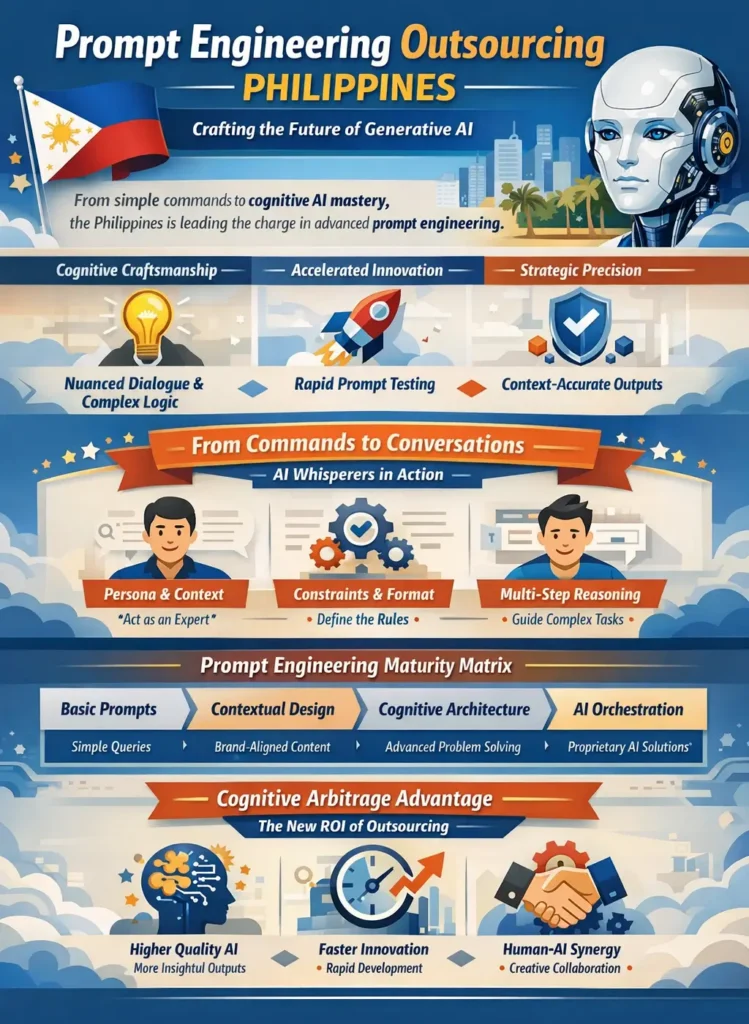
Prompt Engineering Maturity Matrix: Scaling Strategic AI Orchestration
Organizations that treat prompt engineering as a tactical afterthought often hit a ceiling. True value is found by moving up the maturity spectrum toward strategic orchestration.
| Maturity Level | Core Competency | Key Activities | Business Impact |
| Level 1: Foundational | Basic Instruction | Single-turn prompts, simple Q&A. | Basic task automation. |
| Level 2: Intermediate | Contextual Depth | Persona adoption, tone replication. | Brand-aligned content creation. |
| Level 3: Advanced | Cognitive Architecture | Multi-prompt chaining, logical constraints. | Sophisticated problem solving. |
| Level 4: Strategic | AI Orchestration | Prompt A/B testing, library management. | Proprietary AI-driven solutions. |
“The industry is moving from scaling simple instructions to managing ‘Cognitive Supply Chains.’ Our clients need teams that can stress-test the logic of financial models and design the intricate conversational flows of the future. This is the strategic frontier of the Philippine BPO industry.” — John Maczynski, CEO, PITON-Global
Cognitive Arbitrage: The New ROI of Outsourcing
The old outsourcing model focused on “Labor Arbitrage”—saving money on wages. The 2026 landscape is dominated by Cognitive Arbitrage. This is the strategic advantage gained by accessing a workforce that offers higher linguistic nuance and creative problem-solving than is available locally or through automation.
Locally, this manifests as a measurable “lift” in the quality of AI outputs. Filipino prompt engineers act as “AI Whisperers,” using their deep cultural alignment with Western markets to guide models toward superior performance. The ROI here is measured not just in dollars saved, but in the speed of innovation and the distinct market differentiation that high-fidelity AI provides—part of the wider story of how the country came to support leading AI companies.
The Rise of the AI Curator
As businesses integrate LLMs into core functions, the role of the AI Curator has become vital. This professional doesn’t just write prompts; they act as the human guardian of the AI’s voice. They are responsible for:
- Maintaining Prompt Libraries: Ensuring the company’s “intellectual scaffolding” remains updated.
- Output Auditing: Reviewing AI content for accuracy, safety, and brand alignment.
- Human-in-the-Loop Intervention: Identifying where the model’s logic fails and applying “surgical” prompt adjustments to fix it.
This role requires a unique blend of a writer’s creativity and a scientist’s analytical rigor—a profile that the Philippine talent market is uniquely positioned to fill.
Prompt Engineering Service Tiers
| Service Tier | Representative Tasks | Strategic Goal |
| Tier 1: Foundational | Bulk content generation, data extraction. | Operational efficiency. |
| Tier 2: Professional | Campaign development, brand voice tuning. | High-quality customer engagement. |
| Tier 3: Strategic | R&D support, complex analytical reporting. | Decision-support and deep analysis. |
| Tier 4: Transformational | Workflow design, human-AI integration. | Core business transformation. |
Expert FAQs
How does prompt engineering differ from traditional coding?
Coding is deterministic—if you write “A,” the computer always does “B.” Prompting is probabilistic; you are using natural language to guide a system that thinks in patterns. It is more akin to being a film director than a programmer; you are providing the vision and constraints, and the AI provides the performance.
Why is the Philippines a leader in this specific AI niche?
It comes down to “Cognitive Empathy.” Filipino specialists have a high degree of emotional and linguistic intelligence, allowing them to anticipate how an AI might misinterpret a vague instruction. This allows them to “pre-fix” prompts before they ever generate a faulty output.
Can’t AI just write its own prompts?
While AI can optimize or iterate on prompts, it lacks “Strategic Intent.” A machine doesn’t understand your business goals, your brand’s “soul,” or the nuances of your specific market competition. High-value prompt design remains a deeply human, strategic endeavor.
How do you measure the success of an outsourced prompt team?
Success is measured by “Innovation Velocity” (how fast you can deploy new AI features) and “Output Fidelity” (how often the AI’s first response is the correct one). High-quality prompt engineering reduces the need for expensive human re-writes and model re-training.