
TL;DR: The Key Takeaway
AI model evaluation outsourcing has transcended simple validation, becoming a critical pre-deployment strategy to benchmark and harden complex AI systems. The Philippines is emerging as the premier destination for this specialized discipline, offering the sophisticated human-in-the-loop cognitive capabilities required to ensure model accuracy and reliability.
In 2026, the deployment of an AI model is no longer just a technical milestone—it is a significant liability if not preceded by rigorous, independent validation. The Philippines has emerged as a premier “data-sovereign corridor,” providing the specialized human intelligence required to transform AI from an unpredictable “black box” into a reliable, enterprise-ready “glass box.” By outsourcing model evaluation to this talent-rich region, global firms gain an impartial layer of scrutiny that identifies logical inconsistencies, safety risks, and alignment gaps before they reach the end user.
Executive Briefing
- Beyond Accuracy: Modern evaluation prioritizes “tricategorical reasoning”—measuring whether a model provides thoughtful, context-aware restraint rather than just a binary pass/fail.
- The Cognitive Guardrail: The Philippines offers a workforce skilled in adversarial thinking, capable of designing edge-case tests that expose model vulnerabilities.
- Trust as a Metric: Evaluation has moved from a quality check to a trust-building exercise, ensuring models align with brand values and ethical safety guidelines.
- Intelligence Arbitrage: The value is found in the “uplift” of model reliability. Leveraging specialized Filipino evaluators provides a level of critical analysis that is cost-prohibitive to build in-house.
- Strategic Readiness: PITON-Global connects developers with elite teams in the Philippines who specialize in “red-teaming” and multi-turn narrative stress testing.
Executive Summary
The discourse around AI model evaluation outsourcing Philippines has moved from the IT department to the boardroom. As AI systems take on agentic roles—making decisions and executing tasks autonomously—the risk of “hallucination-driven” business failure has skyrocketed. Meticulous, human-in-the-loop validation is now the industry standard for risk mitigation. The Philippines has successfully cultivated an ecosystem where highly educated professionals apply human cognition to benchmark AI reasoning, safety, and cultural alignment. This is a shift in the BPO paradigm: the objective is no longer simple labor arbitrage, but “Intelligence Arbitrage”—the delivery of trust and reliability for the next generation of artificial intelligence.
From Black Box to Glass Box: The Scrutiny Imperative
Treating AI as an inscrutable black box is a relic of the experimental era. In 2026, transparency is a regulatory and reputational requirement. Deploying a model without a deep understanding of its decision-making logic invites catastrophic failure, from biased financial approvals to medical diagnostic errors.
Comprehensive evaluation is now integrated into every stage of the AI Development Life Cycle (AIDLC). It involves subjecting the model to adversarial “stress tests” designed to break its logic. This requires experts who can anticipate how a model might misinterpret a prompt or bypass a safety guardrail. These human insights provide the essential feedback loop needed to refine weights, adjust fine-tuning, and ensure a robust deployment.
The Human Element: Cognition as the Ultimate Benchmark
While automated benchmarks like MMLU or HumanEval provide a baseline, they cannot capture the nuance of real-world interaction. A model may achieve 90% accuracy on a test set but fail miserably in a conversation by being unhelpful, rude, or factually inconsistent in a way that is “hallucinatory” rather than just wrong.
This is where the Philippine talent pool excels. Evaluators in the region provide a sophisticated assessment of:
- Tricategorical Reasoning: Distinguishing between a “mechanical refusal” (safe but unhelpful) and a “thoughtful refusal” (explaining why a request is unsafe).
- Persona Adherence: Ensuring a model maintains its specific brand voice over long, multi-turn interactions.
- Cultural Sensitivity: Identifying when a model’s output might be technically correct but culturally offensive or inappropriate in specific global markets.
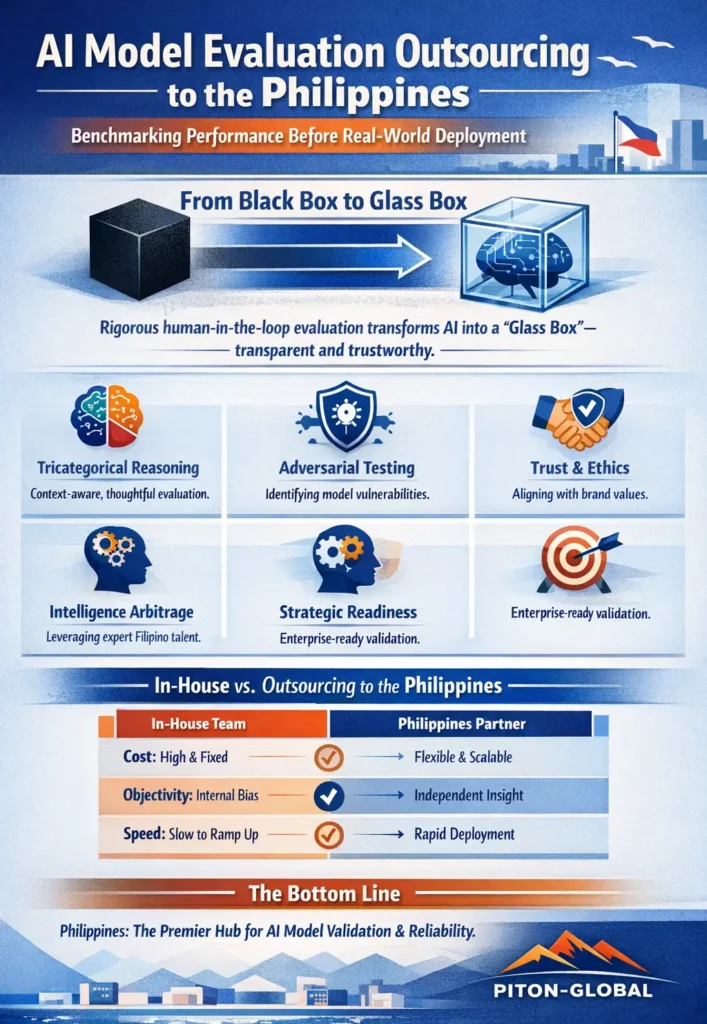
In-House vs. Outsourced AI Model Evaluation: A Strategic Comparison
Building an internal evaluation team often leads to “groupthink,” where the evaluators are too close to the developers to remain impartial. Outsourcing to a specialized partner in the Philippines provides the necessary distance for an objective assessment.
| Feature | In-House Evaluation Team | Outsourced Partner (Philippines) |
| Talent Acquisition | High cost; slow to hire specialized AI-ready talent. | Immediate access to a vast, scalable pool of AI evaluators. |
| Objectivity | High risk of internal bias and “confirmation bias.” | Independent, third-party perspective; impartial results. |
| Scalability | Rigid; difficult to scale for short-term “red-teaming” sprints. | On-demand elasticity; scale up for major launches. |
| Cost Structure | High fixed costs (salaries, benefits, office space). | Variable, project-based pricing; pay for results, not overhead. |
| Time to Market | Slower; requires internal team building and training. | Accelerated; leverages existing expertise and frameworks. |
Intelligence Arbitrage: The New Value Metric
“Intelligence Arbitrage” represents the shift from saving money to gaining intelligence. In the context of evaluation, the “arbitrage” is the significant improvement in a model’s safety and effectiveness when vetted by a specialized human team.
By partnering with elite providers in the Philippines, companies tap into “AI Auditors”—professionals who don’t just label data, but analyze the logic of the machine. They act as the human guardians of AI quality, ensuring that your digital agents are not just technically proficient, but aligned with human intent and corporate ethics.
Vendor Selection Scorecard for AI Model Evaluation
Choosing the right partner is critical for the success of your AI roadmap. PITON-Global uses a rigorous scorecard to vet potential Philippine BPO partners for our clients:
- Domain Expertise (25%): Does the team understand your specific industry (e.g., Fintech, Healthcare)?
- Quality of Talent (20%): Do evaluators possess the analytical skills to perform complex reasoning checks?
- Data Security & Compliance (15%): Are they operating in a SOC2-compliant, data-sovereign environment?
- Adversarial Capabilities (15%): Can the team successfully perform “Red-Teaming” to bypass model safety?
- Communication & Reporting (15%): Do they provide actionable feedback that developers can use to improve the model?
- Infrastructure (10%): Do they utilize modern evaluation harnesses (e.g., LangSmith, OpenAI Evals)?
Expert FAQs
What is the difference between AI “testing” and “evaluation”?
Testing is functional (does the button work?); Evaluation is qualitative (is the answer helpful, safe, and logical?). Evaluation is a holistic assessment of a model’s readiness for human interaction.
How do you prevent evaluators from being biased themselves?
We implement “Inter-Annotator Agreement” (IAA) metrics, where multiple evaluators score the same output. If their scores differ significantly, a lead evaluator mediates to ensure consistency and objectivity.
Is it safe to share our proprietary models with an outsourced team?
Yes. Elite Philippine providers operate in highly secure environments where data never leaves their secure cloud. PITON-Global only partners with firms that adhere to the strictest international data privacy standards.
How is the rise of Agentic AI changing evaluation?
Evaluation is moving from “Single-Turn” (one question, one answer) to “Multi-Turn Trajectory Analysis.” We now evaluate if an AI agent can plan and execute a multi-step task correctly while maintaining safety over a long duration.