
Back
AI Data Collection Outsourcing Philippines: Sourcing the Raw Material for Intelligent Systems

By Ralf Ellspermann / 18 March 2026
 Authored by Ralf Ellspermann, CSO of PITON-Global, & 25-Year Philippine BPO Veteran | Executive | Verified by John Maczynski, CEO of PITON-Global, and Former Global EVP of the World's Largest BPO Provider on March 18, 2026

TL;DR: The Key Takeaway
Successful AI development hinges on the quality of its foundational data, and the future of acquiring this data at scale lies in strategic outsourcing. The Philippines has emerged as a global leader, providing the essential human-in-the-loop services that are the bedrock of intelligent systems.
To build high-performing AI, developers must prioritize the caliber of their training data over sheer volume. The Philippines has emerged as a premier global hub, offering a sophisticated workforce that excels at capturing the nuanced, context-aware information necessary for modern machine learning. By partnering with elite local teams, AI innovators can secure the high-fidelity datasets required to ensure model precision and long-term reliability.
Executive Briefing
- Data Quality as a Ceiling: An AI model’s potential is strictly capped by the integrity and relevance of its training inputs.
- The Philippine Advantage: A specialized ecosystem in the archipelago provides the human-centric, context-rich data that automated tools miss.
- Scalability and Integrity: Outsourcing creates a pathway to expand operations rapidly while maintaining rigorous data verification standards.
- Value Shift: Modern partnerships focus on “Intelligence Arbitrage,” prioritizing high-fidelity data over simple cost reduction.
- Strategic Supply Chain: PITON-Global bridges the gap between global tech pioneers and the specialized Filipino teams refining the “raw materials” of AI.
Executive Summary
The landscape of AI data collection outsourcing Philippines has undergone a fundamental transformation. Moving far beyond basic data entry, the sector now focuses on the strategic acquisition of contextually dense information that powers the world’s most sophisticated neural networks. As algorithms grow in complexity, the necessity for human-verified, high-quality data has surged. The Philippines has met this challenge by establishing itself as a center of excellence for human-in-the-loop services. These experts are the essential architects behind the scenes, ensuring that intelligent systems are safe, accurate, and culturally aware. Leading this transition, PITON-Global serves as the vital link connecting AI developers with the specialized talent required to fuel the next generation of digital intelligence.
The Unseen Engine of AI: Transforming Raw Information into Intelligence
Every landmark achievement in artificial intelligence—from the linguistic fluidity of LLMs to the split-second decisions of self-driving cars—rests upon a massive data foundation. This information serves as the digital bedrock upon which all intelligent behavior is structured. However, the industry is learning that quantity does not guarantee quality. A system’s ultimate success depends entirely on the accuracy and depth of the information it digests during its formative training cycles. Raw, unorganized data is essentially a dormant resource; it requires active curation and contextualization to become a functional asset.
In this environment, data collection has evolved into a high-stakes strategic operation. It is the hidden motor driving technical progress. Rather than just hoarding files, the process now involves the targeted sourcing of information designed for specific algorithmic needs. This spans everything from massive, categorized video libraries to highly sensitive datasets for medical imaging or financial security. Because “garbage in, garbage out” remains the fundamental law of computer science, the precision of this initial phase dictates the ceiling of the final product.
“Our partners are no longer chasing data volume; they are pursuing a data edge,” observes John Maczynski, CEO of PITON-Global. “They require information that is clean, diverse, and saturated with the kind of subtle human context that machines cannot yet replicate. This is the new threshold for excellence. We facilitate connections with Philippine teams that deliver this level of precision, acting as a primary catalyst for rapid AI advancement.”
As the hunger for premium data intensifies, tech leaders are moving away from DIY pipelines. The sheer scale and intricate requirements of modern models often dwarf the capacity of internal departments, making external expertise a core requirement for any serious AI roadmap.
Moving Past Automation: Why Humans Remain Essential
While the promise of fully automated data harvesting is enticing, the most impactful datasets still require a human touch. Automated scrapers can collect mountains of text or imagery, but they frequently fail to understand intent, cultural nuance, or situational relevance. This gap is glaring when training AI to navigate human language or interpret complex, high-stakes visual environments where a single misinterpretation has real-world consequences.
Human-in-the-loop (HITL) strategies solve this by embedding human judgment directly into the production line. Whether it involves professional photographers capturing specific environmental variables or clinical experts validating medical records, people provide the “ground truth” that software cannot manufacture. This isn’t about replacing technology; it’s about a collaborative synergy where human cognition corrects biases and adds layers of meaning, ensuring the resulting AI is grounded in reality.
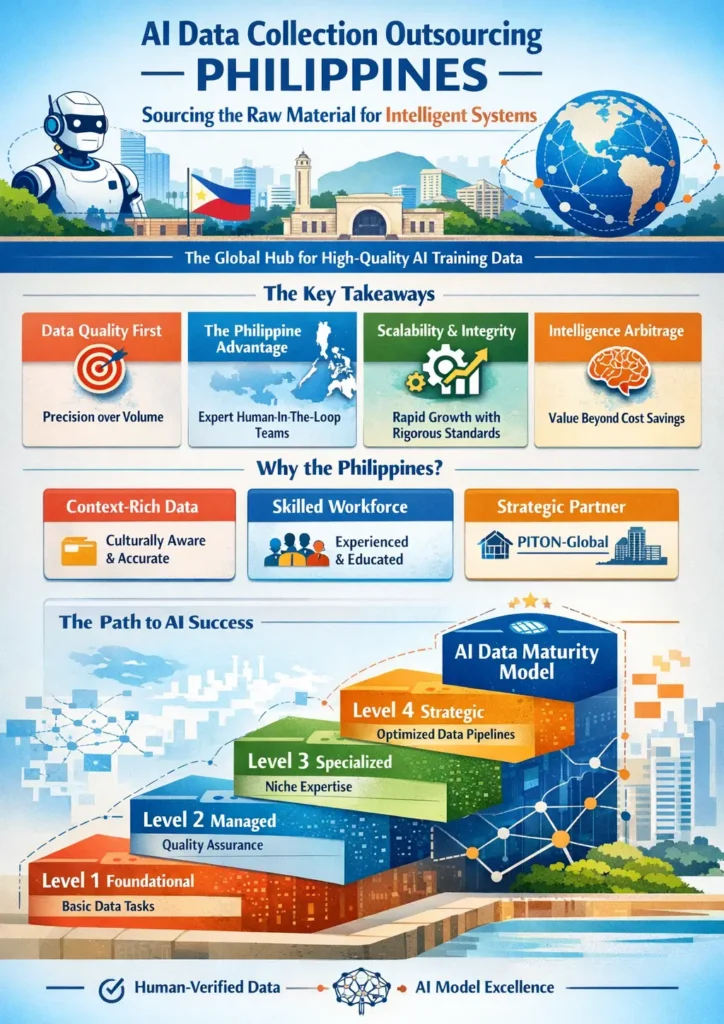
AI Data Collection Maturity Model
The service landscape in the Philippines has matured through distinct stages, evolving from basic labor into high-level strategic collaboration.
| Maturity Level | Central Priority | Primary Activities | Value Delivered |
| Level 1: Foundational | Cost Savings | Manual entry, simple scraping | Large-scale, affordable labor for repetitive tasks. |
| Level 2: Managed | Reliability | Managed teams, basic QA | Consistent delivery of large sets with set quality bars. |
| Level 3: Specialized | Expertise | Sourcing niche data (Legal, Med) | Access to SMEs who provide contextually accurate info. |
| Level 4: Strategic | Model Performance | Pipeline optimization, synthetic data | Deep integration focused on measurable AI accuracy gains. |
Intelligence Arbitrage: A New Strategic Paradigm
The shift toward “Intelligence Arbitrage” defines the current era of outsourcing. Unlike traditional models that focused strictly on lower wages, this new framework prioritizes the gap in expertise and cognitive capability. In the realm of data sourcing, this means finding a workforce capable of critical thinking—people who don’t just collect data points but understand the “why” behind them.
By tapping into a highly educated workforce, companies can build datasets that are nuanced reflections of the real world rather than just sterile lists of facts. For any organization aiming to lead in the AI space, the ability to generate human-verified data at scale is a significant competitive moat. The Philippines has become the global epicenter for this specialized expertise.
Strategic Comparison: In-House vs. External Sourcing
Deciding whether to build an internal data wing or hire a specialized firm is a pivotal choice for CTOs.
- Cost Efficiency: Internal setups require massive capital for tools and staffing; outsourcing converts these into predictable, lower-cost operational expenses.
- Agility: Specialized providers offer instant scalability, allowing projects to ramp up or down in days rather than months.
- Depth of Talent: Third-party partners provide immediate access to diverse subject matter experts that are often too expensive to hire full-time in-house.
- Organizational Focus: Moving data logistics to a partner allows internal engineers to focus on the “brain” of the AI rather than the “food” it eats.
- Time to Market: Pre-existing infrastructure in the Philippines significantly accelerates the journey from concept to deployment.
Most industry leaders now favor a hybrid strategy: maintaining a small internal team for oversight while utilizing Philippine partners to handle the heavy lifting of data acquisition.
The Philippines: A Global Epicenter for AI Data Excellence
The country’s ascent in the AI sector is a natural evolution of its long-standing dominance in the BPO world. The Philippines offers a unique blend of a highly literate, English-speaking population and a deep cultural resonance with Western markets, ensuring that data is interpreted with high accuracy.
Beyond talent, the local government has fortified this position by establishing a rigorous legal framework regarding data privacy and intellectual property. This trifecta of skilled labor, technical infrastructure, and legal security makes the archipelago the definitive choice for tech firms building the future of intelligent systems.
Expert FAQs
What specific data formats can be sourced via Philippine partners?
Teams can handle a massive spectrum, including high-resolution video, audio files, multi-lingual text, and complex sensor data. They can also assemble specialized units for high-barrier fields like radiology, legal discovery, or forensic financial analysis.
How is the accuracy of the data verified?
Quality is maintained through multi-stage validation, involving advanced QA software and manual review by domain experts. This layered approach ensures that every data point meets the strict requirements of the AI’s training objective.
What should be the top priority when selecting a local partner?
While cost is a factor, expertise in your specific niche is more important. Evaluate their security protocols, their ability to scale quickly, and their track record with similar AI projects. A strong cultural alignment is also essential for smooth communication.
Will synthetic data eventually replace the need for real-world collection?
Synthetic data is a helpful supplement, but it cannot replace real-world inputs. To function effectively in the real world, AI must be anchored by real-world data. The most resilient models utilize a blend of both, meaning the demand for high-quality human collection remains a permanent fixture of the industry.
Achieve sustainable growth with world-class BPO solutions!
PITON-Global connects you with industry-leading outsourcing providers to enhance customer experience, lower costs, and drive business success.
Get Your Top 1% Vendor List
Author
Ralf Ellspermann is a multi-awarded outsourcing executive with 25+ years of call center and BPO leadership in the Philippines, helping 500+ high-growth and mid-market companies scale call center and customer experience operations across financial services, fintech, insurance, healthcare, technology, travel, utilities, and social media.
A globally recognized industry authority—and a contributor to The Times of India and CustomerThink —he advises organizations on building compliant, high-performance offshore contact center operations that deliver measurable cost savings and sustained competitive advantage.
Known for his execution-first approach, Ralf bridges strategy and operations to turn call center and business process outsourcing into a true growth engine. His work consistently drives faster market entry, lower risk, and long-term operational resilience for global brands.
EXECUTIVE GOVERNANCE & ACCURACY STANDARDS
Authored by:

Ralf Ellspermann
Founder & CSO of PITON-Global,
25-Year Philippine BPO Veteran,
Multi-awarded Executive
Specializing in strategic sourcing and excellence in Manila
View Full Bio
Verified by:

John Maczynski
CEO of PITON-Global, and former Global EVP of the World’s largest BPO provider | 40 Years Experience
Ensuring global compliance and enterprise-grade service standards
View Full Bio
Last Peer Review: March 18, 2026
This service framework is audited quarterly to meet shifting global outsourcing regulations and COPC standards.