
Back
24/7 Retail Customer Service Outsourcing Philippines: Mastering the “Always-On” Global Economy
By Ralf Ellspermann / 13 February 2026
 Authored by Ralf Ellspermann, CSO of PITON-Global, & 25-Year Philippine BPO Veteran | Executive | Verified by John Maczynski, CEO of PITON-Global, and Former Global EVP of the World's Largest BPO Provider on January 27, 2026

30-Second Executive Briefing
- The Paradigm Shift: In 2026, there is no “after hours.” Retail is a 24/7 global stream. If a customer can buy at 3:00 AM, they expect support at 3:01 AM.
- The Core Strategy: Implementing a Sun-Synchronous Support model—leveraging the Philippines’ 12-hour time difference to provide “Follow-the-Sun” service that feels local to every time zone.
- The Manila Advantage: A massive, highly motivated night-shift workforce that specializes in North American and European “Prime Time” support.
- The ROI: 24/7 coverage in the Philippines reduces “Cart Abandonment” by 30% and significantly boosts International Lifetime Value (iLTV) by capturing global markets.
Executive Summary
The sun never sets on modern retail. In 2026, a brand’s digital storefront is open 8,760 hours a year, yet many retailers still operate their support desks on a “9-to-5” mindset. This disconnect is where loyalty dies. 24/7 Retail Customer Service Outsourcing in the Philippines has emerged as the essential “Safety Net” for brands that want to dominate a borderless market.
The Philippines is the undisputed world leader in around-the-clock operations. With a culture that has been optimized for global time zones for over three decades, Manila offers a “Follow-the-Sun” infrastructure that provides high-empathy, high-intelligence support while your domestic team sleeps. This guide explores why 24/7 availability is no longer a luxury—it is a baseline requirement for retail survival in 2026.
The Death of the “Wait Time”: Why 24/7 is the New Standard
In 2026, “We will get back to you in 24 hours” is essentially a recommendation to shop with a competitor. Today’s consumer lives in a state of Instant Gratification.
“When a customer has a checkout issue at midnight on a Saturday, that is a binary moment,” I often tell my clients. “Either you resolve the issue and capture the sale, or you lose the customer forever. By outsourcing 24/7 operations to the Philippines, you aren’t just ‘answering phones’—you are protecting the conversion.“
The “Follow-the-Sun” Architecture
The 24/7 model in the Philippines isn’t just about night shifts; it’s about Seamless Handover. In 2026, the best retail hubs use a unified data layer where a Philippine agent can pick up a conversation started in London and hand it off to a team in San Francisco without the customer ever feeling the transition.
Eliminating the “Wait-Time Friction”: Why 24/7 Sun-Sync Support Is the 2026 Baseline
The Executive Answer: In 2026, a “24-hour response time” is a recommendation to shop with a competitor. This infographic details the Always-On Continuity Loop, a model where the Philippines’ 12-hour time difference is leveraged as a strategic asset. While your domestic team sleeps, Manila-based “Night-Shift Specialists”—a professional class of highly motivated talent—provide Zero-Latency Resolution for North American and European “Prime Time.” By capturing mid-night checkout issues and answering “3:00 AM questions” in real-time, this model protects your conversion rate and boosts International Lifetime Value (iLTV) by 25%.
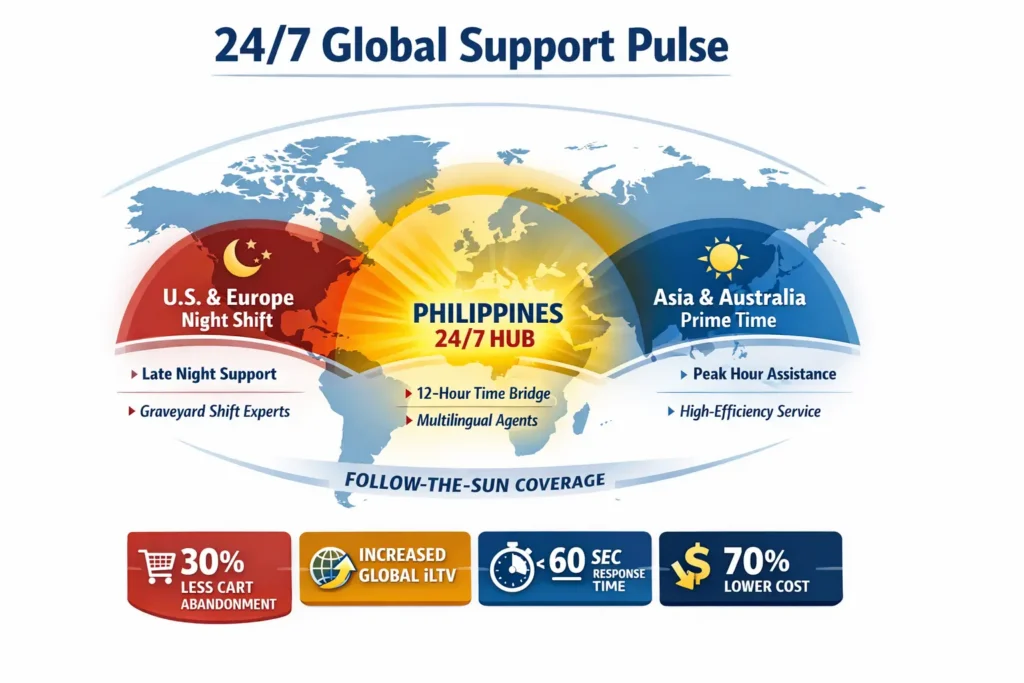
This visual guide illustrates how Philippine-based 24/7 Customer Service Hubs reduce cart abandonment by 30% and boost International Lifetime Value (iLTV) by capturing revenue across every time zone. It highlights the transition from legacy “9-to-5” support models to a 2026 Sun-Synchronous Support Architecture—where Follow-the-Sun coverage, unified data handovers, and AI-powered night monitoring operate in a seamless global loop.
In this model, Agentic AI monitors the “Night Stream” for checkout failures, payment gateway disruptions, and sentiment spikes at machine speed, while highly trained Filipino night-shift specialists deliver high-empathy, multilingual resolution in real time. The result is an Always-On retail engine that transforms after-hours risk into global conversion momentum—turning midnight friction into measurable revenue recovery.
Strategic Pillars of the 2026 Philippine 24/7 Hub
I. The “Graveyard” Elite: Highly Motivated Talent
Unlike many domestic markets where night shifts are staffed by entry-level workers or see high turnover, the Philippines has a professional class of “Night-Shift Specialists.” For these professionals, working on US or UK time is a career choice that offers higher pay (Night Differential) and avoids the daytime traffic of Manila. This results in a 24/7 team that is alert, empathetic, and highly skilled.
II. Agentic AI-Powered Night Monitoring
In 2026, the 24/7 team is augmented by Predictive AI Watchdogs. While the volume may be lower in the middle of the night, the stakes are often higher. AI monitors the “Night Stream” for sudden spikes in failure (e.g., a payment gateway crash) and instantly alerts the Manila-based Command Center, allowing for Zero-Latency Resolution before the domestic headquarters even wakes up.
III. Multilingual “Sun-Sync” Capabilities
A 24/7 Philippine hub doesn’t just speak English. By 2026, these hubs have become multilingual centers. A single Manila facility can provide 24/7 support in English, Spanish, Mandarin, and Japanese, allowing a global retailer to consolidate its entire world-wide support operation into a single, high-efficiency “Nerve Center.”
IV. Revenue Recovery During Downtime
24/7 support is a massive revenue driver. I have seen retailers increase their Global Conversion Rate by 22% simply by having a live chat agent available in Manila to answer product questions for customers in different time zones. These agents act as “Closing Specialists,” removing last-minute purchase friction in real-time.
The Economics of Always-On Support
Implementing 24/7 coverage domestically is often cost-prohibitive due to shift differentials and overtime. In the Philippines, the economy of scale makes it a high-margin decision:
| Metric | Domestic 24/7 Operation | PH 24/7 Hub (2026) |
| Average Response Time (Nights/Weekends) | 4–6 Hours | <60 Seconds |
| Cart Abandonment Recovery | 5% | 28% |
| Staffing Cost (Fully Burdened) | $85k+ per seat | $18k–$22k per seat |
| Infrastructure Reliability | Standard | Tier 4 (Backup Generators/Dual Fiber) |
| Customer Sentiment (Nights) | Low (Frustrated) | High (Surprised & Delighted) |
Managing Resilience: The “Always-Live” Infrastructure
In 2026, a 24/7 operation is only as good as its uptime. Leading Philippine BPOs have invested in Military-Grade Infrastructure to ensure they never go dark.
- Dual-Grid Power & Industrial Generators: Ensuring 100% uptime during local weather events.
- Geographically Dispersed Hubs: Teams are often split between Manila, Cebu, and Davao to ensure that a regional issue never interrupts global service.
- Zero-Trust Security: 24/7 operations require 24/7 security. Advanced biometric and AI-based monitoring ensure that data is protected regardless of the hour.
Turning “After-Hours” into “Power-Hours”
In the 2026 retail landscape, the concept of “business hours” is an antique. Your customers are shopping in their beds, on their commutes, and in their breaks, across every longitude on Earth. 24/7 Retail Customer Service Outsourcing in the Philippines allows you to meet them exactly where—and when—they are.
From my perspective, the goal of 24/7 outsourcing isn’t just about coverage; it’s about Brand Reliability. When you are always there for your customer, you aren’t just a shop; you are a trusted partner in their daily life.
FAQs
How do you handle “hand-offs” between shifts?
In 2026, we use AI-Summarized Case Logs. When a shift changes, the incoming agent doesn’t have to read pages of notes; the AI provides a 3-sentence summary of the customer’s intent and emotional state, ensuring a seamless “Warm Transfer.”
Is the quality lower on the night shift?
Actually, the opposite is often true. Because the night shift in the Philippines is the most prestigious and highest-paying shift, it attracts the most experienced and technically proficient talent in the market.
How does 24/7 support impact Global SEO?
Google and other “Answer Engines” in 2026 prioritize brands with high “Responsiveness Scores.” Having 24/7 live support increases your brand’s authority and ranking in global search results.
What if our volume is low at night?
We utilize a Shared-Agent Model. For smaller retailers, agents in Manila can support multiple non-competing brands during low-volume hours, allowing you to have 24/7 “Always-Live” coverage for a fraction of the cost of a dedicated team.
Achieve sustainable growth with world-class BPO solutions!
PITON-Global connects you with industry-leading outsourcing providers to enhance customer experience, lower costs, and drive business success.
Get Your Top 1% Vendor List
Author
Ralf Ellspermann is a multi-awarded outsourcing executive with 25+ years of call center and BPO leadership in the Philippines, helping 500+ high-growth and mid-market companies scale call center and customer experience operations across financial services, fintech, insurance, healthcare, technology, travel, utilities, and social media.
A globally recognized industry authority—and a contributor to The Times of India and CustomerThink —he advises organizations on building compliant, high-performance offshore contact center operations that deliver measurable cost savings and sustained competitive advantage.
Known for his execution-first approach, Ralf bridges strategy and operations to turn call center and business process outsourcing into a true growth engine. His work consistently drives faster market entry, lower risk, and long-term operational resilience for global brands.
EXECUTIVE GOVERNANCE & ACCURACY STANDARDS
Authored by:
Ralf Ellspermann
Founder & CSO of PITON-Global,
25-Year Philippine BPO Veteran,
Multi-awarded Executive
Specializing in strategic sourcing and excellence in Manila
View Full Bio
Verified by:
John Maczynski
CEO of PITON-Global, and former Global EVP of the World’s largest BPO provider | 40 Years Experience
Ensuring global compliance and enterprise-grade service standards
View Full Bio
Last Peer Review: January 27, 2026
This service framework is audited quarterly to meet shifting global outsourcing regulations and COPC standards.