
30-Second Executive Briefing
- The Paradigm Shift: In 2026, A/R is no longer about “collecting money”—it’s about Data Liquidity. The goal is matching complex payment data to invoices in real-time, which is why A/R now sits within the back-office and finance support for retail brands run offshore.
- The Core Strategy: Moving from reactive collections to Atomic Reconciliation, where high-IQ Filipino specialists resolve the small share of exceptions that break automated systems.
- The Manila Advantage: Access to a massive pool of CPA-qualified talent familiar with US GAAP, IFRS, and 2026 banking standards like ISO 20022.
- The ROI: Retailers leveraging offshore A/R hubs report a marked reduction in Days Sales Outstanding (DSO) and a near-zero unapplied cash ratio.
Executive Summary
In the high-velocity retail environment of 2026, cash flow is the ultimate metric of survival. As payment methods fragment across digital wallets, “Buy Now, Pay Later” (BNPL) schemes, live-shopping and social commerce checkouts, and cross-border instant settlements, the traditional back-office has become a bottleneck. Retail Accounts Receivable Outsourcing in the Philippines has emerged as the definitive solution for brands that need to bridge the gap between “Funds Received” and “Funds Reconciled.”
Manila has evolved into the global “Alpha Hub” for finance operations. By combining the country’s surplus of accounting talent with Agentic AI—systems that can autonomously investigate payment discrepancies—global retailers are turning their A/R departments into high-speed engines of working capital. This guide explores the 2026 operational shift from manual bookkeeping to intelligent cash orchestration.
From “Collections” to “Atomic Reconciliation”
In 2026, the bottleneck isn’t getting paid; it’s knowing what was paid. With fragmented data coming from hundreds of sources across store, web, and app channels, the same sprawl that omnichannel retail support has to stitch together, “Reconciliation Ghosts” can haunt a ledger for months, tying up capital and confusing audits.
“In 2026, A/R is a data challenge, not a phone call challenge,” says John Maczynski, CEO of PITON-Global. “The Philippines provides the ‘Human-in-the-Loop’ (HITL) needed for Atomic Reconciliation. Our specialists don’t just ask for payment; they resolve the underlying data friction that prevents a payment from being applied. This ensures your ledger remains a Single Source of Truth in real-time.”
The “Continuous Close” Evolution
The most significant shift in 2026 is the transition from a “Month-End Scramble” to a Continuous Close model. Historically, retail finance teams spent the first week of every month reconciling the previous month’s mess. By leveraging offshore teams that operate in “Follow-the-Sun” shifts, reconciliation happens within minutes of a transaction occurring.
Manila-based analysts perform “Micro-Closes” every 24 hours. This means that by the time a US or European CFO logs in on Monday morning, the previous week’s cash is already fully reconciled, aged, and reflected in real-time cash flow projections. This level of agility allows retailers to make inventory and expansion decisions based on current liquidity rather than month-old data.
Accelerating Data Liquidity: How Atomic Reconciliation Solves the 2026 A/R Bottleneck
In 2026, the A/R bottleneck isn’t “getting paid”—it’s the Reconciliation Ghost caused by fragmented data from BNPL, digital wallets, and cross-border instant settlements. This infographic details the Atomic Cash Conversion Loop, a model where Filipino CPA talent uses Agentic AI to match malformed remittance data to invoices within hours. By moving from a “Month-End Scramble” to a Continuous Close, Manila-based hubs ensure your ledger is a “Single Source of Truth” every 24 hours, effectively turning your A/R department into a high-speed engine of working capital that steadily reduces DSO.
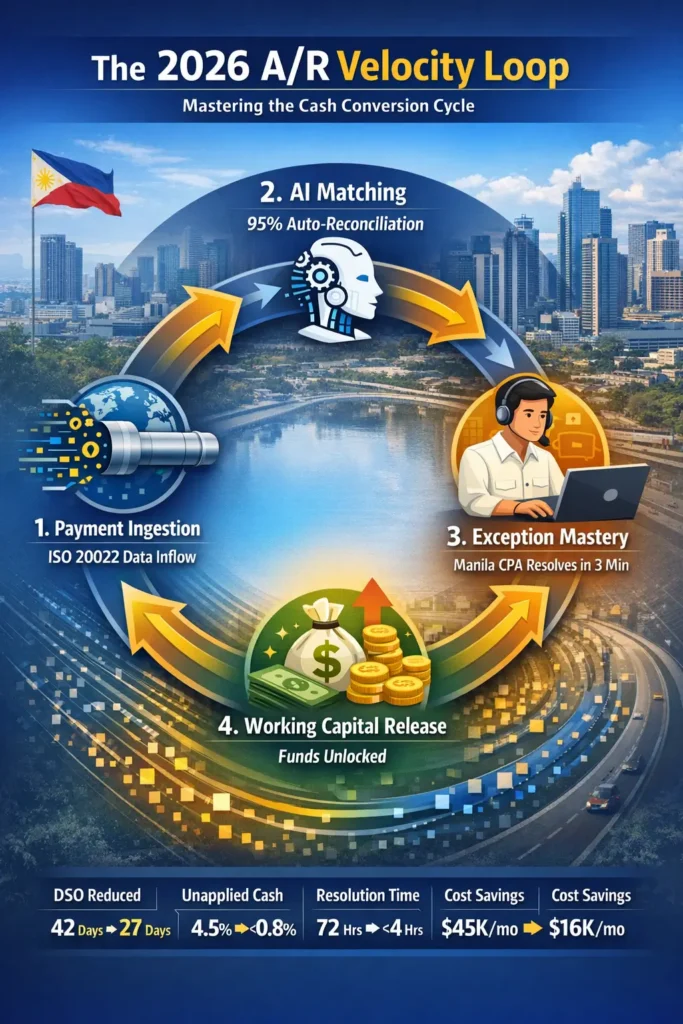
This visual guide illustrates how offshore Atomic A/R Hubs reduce Days Sales Outstanding (DSO) and drive unapplied cash toward zero in a fragmented, ISO 20022-driven payments landscape. It highlights the shift from reactive collections to real-time Atomic Reconciliation—where ISO 20022 data ingestion, Agentic AI auto-matching, and CPA-led exception mastery operate in a continuous velocity loop.
In this model, AI instantly reconciles the vast majority of transactions at machine speed, while CPA-qualified Filipino specialists resolve the remaining high-friction exceptions in under minutes, eliminate reconciliation ghosts, and safeguard ledger integrity. The result is a Continuous Close environment—where working capital is unlocked daily, cash visibility is real-time, and the A/R function transforms from a back-office cost center into a strategic engine of liquidity and competitive growth.
Strategic Pillars of the 2026 Philippine A/R Hub
I. ISO 20022 & Data-Rich Ingestion
2026 marks the full global adoption of the ISO 20022 standard. Offshore A/R teams are trained to map these “rich data” messages directly into ERPs like NetSuite, SAP, and Sage. This allows for the simultaneous ingestion of funds and metadata, ensuring that every dollar has an immutable “data tail” for audit and compliance.
II. Dispute-Link Remediation
Disputes are the primary cause of A/R drag. Traditional models bounce clients back to customer service or the retail call center, creating days of delay. Filipino A/R specialists are cross-trained in Dispute-Link Remediation—they solve billing discrepancies, tax exemptions, and short-payments on the spot, accelerating the cash conversion cycle while protecting the customer relationship.
III. Predictive Delinquency Management
In 2026, waiting for an invoice to become “overdue” is too late. Offshore hubs use Predictive AI Co-Pilots to analyze customer payment patterns. If a client typically pays on Day 12 but hasn’t opened the invoice by Day 10, the system triggers a “Gentle Nudge” from a Manila specialist, preventing the delinquency before it happens.
IV. CAMS-Certified Fraud Prevention
Accounts Receivable is the new front line for fraud. In 2026, sophisticated “Synthetic Identity” and “Business Email Compromise” (BEC) attacks target the payment redirection process. Leading hubs now employ CAMS-trained analysts (Certified Anti-Money Laundering Specialists) who monitor the A/R pipeline for anomalous payment origins or sudden changes in vendor banking details, stopping fraudulent redirects before the ledger is compromised.
The Strategic Advantage of the Filipino CPA Pool
The Philippines produces thousands of accounting graduates annually, many of whom are specifically trained in US GAAP and IFRS. This surplus of high-level talent is the “Secret Sauce” of 2026 retail outsourcing.
Unlike domestic markets where CPAs are often overqualified and too expensive for A/R roles, the offshore model allows retailers to staff their entire A/R department with Qualified Accountants. This “Intelligence Arbitrage” means that the person managing your unapplied cash isn’t a data entry clerk; they are a financial professional capable of complex audit preparation and strategic reporting.
Reclaiming Working Capital: The 2026 Benchmarks
Retailers moving their A/R operations offshore see a transformation in their balance sheet health:
| Financial Metric | Legacy In-House A/R | PH Atomic Hub (2026) |
| Days Sales Outstanding (DSO) | 42 Days | 27 Days |
| Unapplied Cash Ratio | 4.5% | <0.8% |
| Exception Resolution Time | 72 Hours | <4 Hours |
| Cost of A/R Operation | $45,000/mo | $16,000/mo |
| Bad Debt Write-Offs | 1.2% | 0.4% |
| Reconciliation Accuracy | 94% | 99.9% |
Turning the Ledger into a Competitive Weapon
In 2026, accounts receivable is no longer a back-office chore; it is the heartbeat of your business. An offshore retail accounts receivable team provides the perfect balance of technical rigor, accounting expertise, and AI integration.
As John Maczynski notes, “A dollar stuck in reconciliation is a dollar that isn’t driving growth. The Philippines doesn’t just manage your receivables; it unlocks your capital, providing the liquidity needed to out-compete and out-scale the market.”
Expert FAQs
Is the service truly compliant with 2026 global banking standards?
Yes. Leading providers are ISO 20022 compliant and operate within SOC 2 Type II and PCI-DSS 4.0 frameworks, ensuring bank-grade security for all financial data.
Can Philippine A/R teams handle B2B retail disputes?
Absolutely. Specialists in Manila are trained in complex B2B contract logic, handling volume-based discounts and multi-entity billing reconciliations that typically stall automated systems.
How does Agentic AI help the A/R specialist?
Agentic AI acts as a “Digital Auditor.” It autonomously scans bank statements, cross-references internal sales orders, and drafts the reconciliation entry, leaving only the “judgment-critical” final approval to the human specialist.
What is “Atomic Reconciliation”?
It is the process of matching payments to invoices at the line-item level in near real-time, even when remittance data is malformed, missing, or split across multiple accounts.