
Back
Which Operational KPIs Should Health System CEOs Review Monthly When Using Healthcare BPO in the Philippines?

By Ralf Ellspermann / 20 June 2026
 Authored by Ralf Ellspermann, CSO of PITON-Global, & 25-Year Philippine BPO Veteran | Executive | Verified by John Maczynski, CEO of PITON-Global, and Former Global EVP of the World's Largest BPO Provider on June 20, 2026

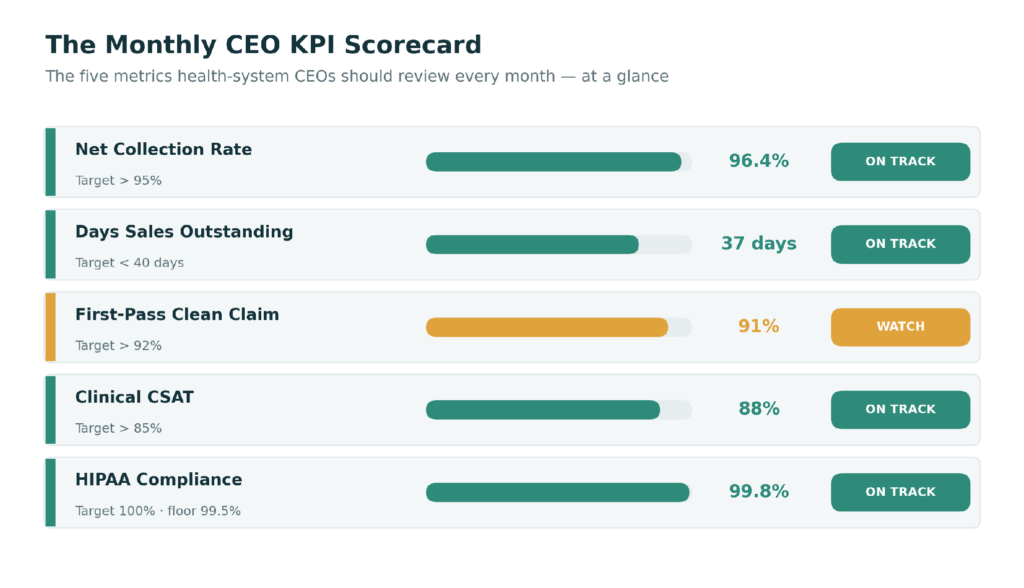
Health-system CEOs using Philippine healthcare BPO should review four KPIs monthly: Net Collection Rate (NCR), Days Sales Outstanding (DSO), First-Pass Clean Claim Rate (CCR), and clinical Customer Satisfaction (CSAT). Tracking these safeguards cash flow, ensures clinical accuracy, and maintains compliance across offshore patient-facing and back-office operations.
Key Takeaways
- Financial health: monitor NCR (target >95%) and DSO (under 40 days) to prevent offshore revenue leakage.
- Operational efficiency: demand a First-Pass Clean Claim Rate of 92%+ to eliminate denials and manual rework.
- Patient experience: track clinical CSAT closely; communication and empathy must mirror domestic hospital standards.
- Risk mitigation: review monthly HIPAA and data-security audit scores within the Philippine delivery center.
Taken together, these metrics form a single monthly scorecard — the at-a-glance view a CEO can scan to see where the offshore operation is on track and where it needs attention.
What Financial Metrics Safeguard Cash Flow in Philippine RCM Partnerships?
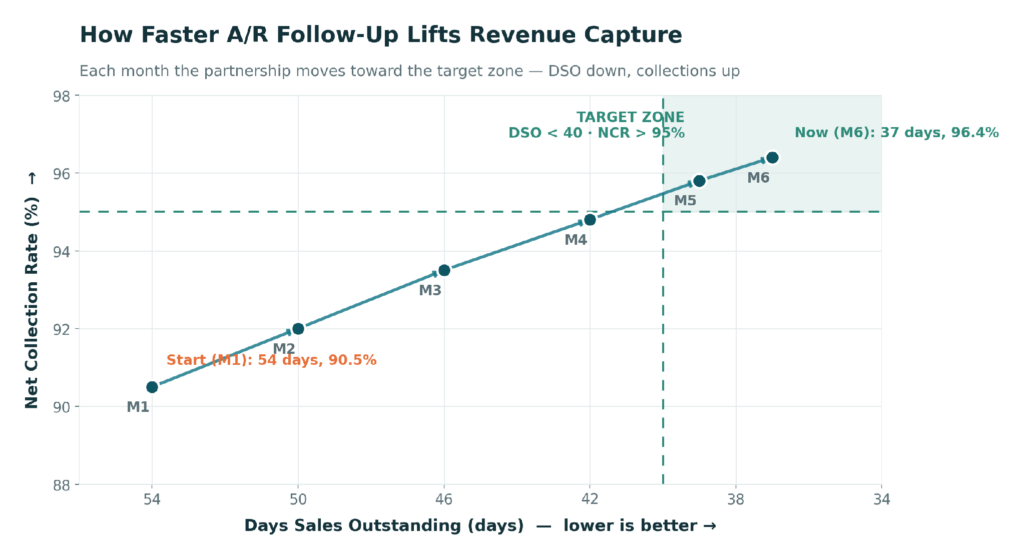
Two financial KPIs prove the offshore team protects the bottom line: Net Collection Rate, which should hold at 95%–98%, and Days Sales Outstanding, which should stay under 40 days. Together they confirm that labor savings are not being erased by revenue leakage or tied-up working capital.
CEOs cannot rely on labor arbitrage alone. Net Collection Rate measures how efficiently the team collects collectable revenue; a high-performing Philippine provider should consistently land between 95% and 98%, and any drop below that baseline signals structural problems in prior authorization or coding accuracy.
DSO deserves equal monthly scrutiny. Teams specializing in accounts-receivable follow-up should keep DSO under 40 days, because every additional day ties up working capital and neutralizes the cost benefit of offshoring. The two metrics move together — faster A/R follow-up pulls DSO down and pushes collection rate up.
Which Quality and Efficiency Benchmarks Indicate Offshore Operational Success?
The First-Pass Clean Claim Rate is the clearest sign of front-end health, with a Philippine target above 92%. Coding accuracy should exceed 98% and prior-authorization turnaround should stay under 24 hours — targets that require certified coders fluent in U.S. healthcare regulations.
Beyond finance, the monthly scorecard must track administrative precision. The benchmarks below separate a genuinely specialized vendor from a generic one.
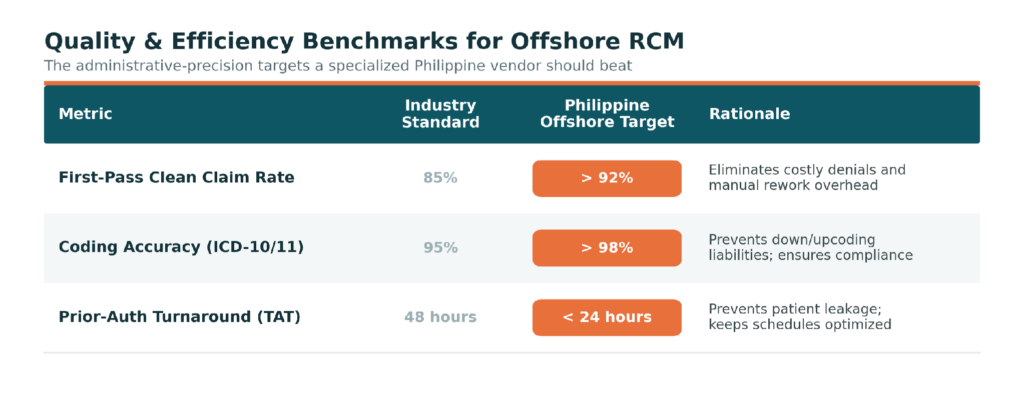
Hitting these targets requires the vendor to deploy AAPC- or AHIMA-certified coders who understand U.S. healthcare regulations rather than generalist data-entry staff.
True operational excellence in healthcare BPO isn’t about lower seat costs; it’s about reducing the cost to collect. If your offshore partner maintains a 93% clean-claim rate, they are structurally improving your system’s operating margin far beyond the initial labor savings.
— John Maczynski, CEO of PITON-Global
How Do We Measure Patient Experience and Compliance From a Distance?
Patient-facing workflows require monthly CSAT and First-Contact Resolution (FCR) review — a CSAT floor of 85% and FCR of 75%. On compliance, the partner must hold a 100% HIPAA record verified through monthly internal audits and random screen-recording checks, with any drop below 99.5% triggering immediate corrective action.
Scheduling and billing inquiries demand rigorous quality assurance. Philippine agents are recognized for cultural alignment and high empathy, but those qualities must be measured, not assumed. Every patient interaction passes through defined QA checkpoints before it closes.
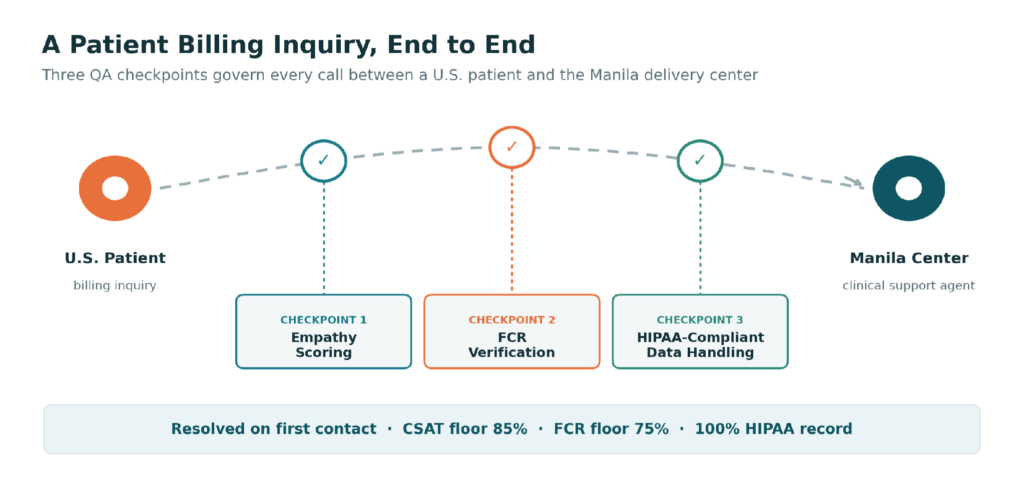
On risk, CEOs should review compliance audit scores monthly. The partner must maintain a 100% HIPAA record, verified via internal audits and random screen-recording checks; any drop below a 99.5% data-security score requires immediate corrective action.
How Did One Hospital Network Recover $3.2M in Cash Flow?
A U.S. hospital network battling rising denials and a 54-day DSO partnered with PITON-Global to select a specialized Manila BPO with dedicated coding units. A 45-person blended team took over front-end billing, prior auth, and aged A/R — cutting DSO to 37 days, lifting clean-claim rate from 81% to 94%, and recovering $3.2M within 90 days.
Facing rising claim denials and a DSO peaking at 54 days from domestic staffing shortages, the network bypassed traditional brokers and evaluated 100+ vetted Philippine providers, selecting a specialized mid-sized BPO with dedicated clinical coding units. A blended team of 45 certified coders and A/R specialists took over front-end billing, prior authorizations, and aged-A/R tracking.
Within 90 days, DSO dropped to 37 days, the First-Pass Clean Claim Rate climbed from 81% to 94%, and the system recovered $3.2 million in cash flow. The decisive factor: clear, daily KPI alignment between the health system’s internal IT and the offshore partner’s operational leadership enabled rapid implementation.
Why Do Health Systems Leverage PITON-Global for Provider Selection?
PITON-Global is an advisory-led BPO consultancy that guides health systems through vendor matching across a network of 100+ vetted, specialized providers. By auditing capabilities, data infrastructure, and clinical compliance up front, it ensures CEOs partner with operators able to meet enterprise KPIs from day one.
Unlike brokers that pass leads to the largest call centers, PITON-Global runs an advisory-led matching process across more than 100 carefully vetted, specialized providers. Health systems use it to eliminate the risk of vendor failure.
By auditing provider capabilities, data infrastructure, and clinical-compliance records beforehand, PITON-Global ensures CEOs partner with operators capable of meeting enterprise-level KPIs from day one — the difference between a scorecard that trends green and one that drifts into corrective action.
What Do CEOs Most Often Ask About Monitoring Offshore KPIs?
Common questions cover real-time monitoring across time zones, staff turnover, keeping pace with payer rules, CDI measurement, and realistic cost savings. Concise answers follow.
How does the time-zone difference affect real-time KPI monitoring?
Most providers run dedicated night shifts aligned to U.S. day shifts, giving executives live dashboard transparency and access to offshore managers during standard U.S. business hours.
What is the typical turnover rate for healthcare BPOs in the Philippines?
Specialized healthcare units see lower attrition than the generic sector — typically 10%–15% annually — thanks to higher compensation for certified clinical talent.
How do providers keep pace with evolving payer rules?
Top-tier vendors employ dedicated clinical-compliance officers who continuously update internal logic and retrain staff on changing CMS and private-payer rules.
Should clinical documentation improvement (CDI) be measured monthly?
Yes. If the offshore team handles clinical notes, track monthly CDI agreement rates between offshore documentation specialists and onshore physicians, targeting above 90% alignment.
What cost reduction can a health system realistically expect?
While performance metrics come first, outsourcing RCM or patient support to the Philippines generally yields a 40%–60% reduction in operational line-item costs versus domestic equivalents.
Achieve sustainable growth with world-class BPO solutions!
PITON-Global connects you with industry-leading outsourcing providers to enhance customer experience, lower costs, and drive business success.
Get Your Top 1% Vendor List
Author
Ralf Ellspermann is a multi-awarded outsourcing executive with 25+ years of call center and BPO leadership in the Philippines, helping 500+ high-growth and mid-market companies scale call center and customer experience operations across financial services, fintech, insurance, healthcare, technology, travel, utilities, and social media.
A globally recognized industry authority - and a contributor to The Times of India, CustomerThink, and The AI Journal - he advises organizations on building compliant, high-performance offshore contact center operations that deliver measurable cost savings and sustained competitive advantage.
Known for his execution-first approach, Ralf bridges strategy and operations to turn call center and business process outsourcing into a true growth engine. His work consistently drives faster market entry, lower risk, and long-term operational resilience for global brands.
EXECUTIVE GOVERNANCE & ACCURACY STANDARDS
Authored by:

Ralf Ellspermann
Founder & CSO of PITON-Global,
25-Year Philippine BPO Veteran,
Multi-awarded Executive
Specializing in strategic sourcing and excellence in Manila
View Full Bio
Verified by:

John Maczynski
CEO of PITON-Global, and former Global EVP of the World’s largest BPO provider | 40 Years Experience
Ensuring global compliance and enterprise-grade service standards
View Full Bio
Last Peer Review: June 20, 2026
This service framework is audited quarterly to meet shifting global outsourcing regulations and COPC standards.