
TL;DR: The Key Takeaway
AI knowledge graph building outsourcing has matured from simple data linking to a sophisticated discipline of semantic architecture. The Philippines is the premier destination for this complex work, providing the expert human cognition required to structure the world’s information for more intelligent and context-aware AI systems.
To transcend simple pattern recognition, modern artificial intelligence requires structured semantic frameworks known as knowledge graphs. Outsourcing these complex builds to the Philippines provides AI developers with elite “Semantic Architects” who map intricate entity relationships, ensuring that machine learning models possess the logical depth, factual accuracy, and contextual reasoning necessary for next-generation cognitive computing.
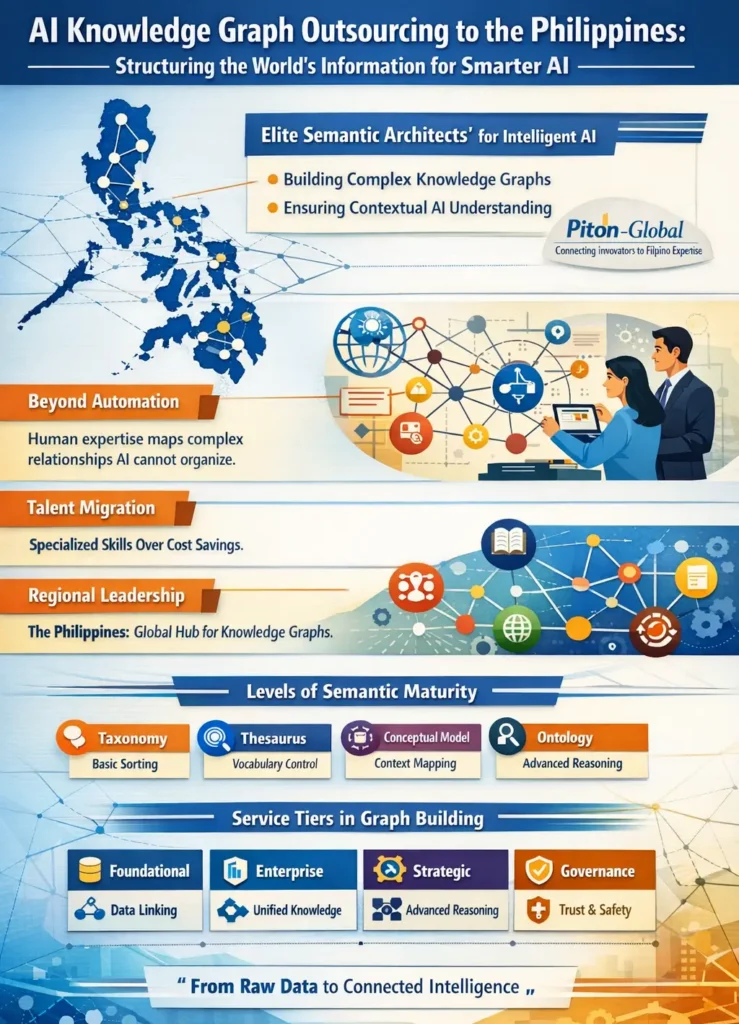
- Beyond Automation: Developing sophisticated knowledge graphs requires human logic to codify complex hierarchies that AI cannot yet autonomously organize.
- Talent Migration: The primary driver for Philippine outsourcing has shifted from basic cost reduction to securing specialized experts in semantic modeling.
- Regional Leadership: The Philippines is now a global epicenter for this niche, combining analytical rigor with advanced data governance and linguistic mastery.
- Architectural Role: Filipino specialists act as “Semantic Architects,” designing the foundational logical webs that dictate how AI understands the world.
- Strategic Sourcing: PITON-Global serves as the vital link between AI innovators and the high-tier Philippine teams constructing these essential knowledge infrastructures.
Transforming Raw Data into Interconnected Intelligence
Early iterations of artificial intelligence thrived on vast, disorganized datasets. While these systems excelled at spotting trends, they lacked a fundamental grasp of the concepts they manipulated. A computer might identify a “feline” in a photo and process the term “mammal” in a document without ever recognizing the biological link between the two. Knowledge graphs rectify this gap by establishing a formal, organized architecture of information. By defining entities, their specific traits, and their multidimensional relationships, these graphs create a “semantic web” that serves as the backbone for sophisticated machine reasoning.
This structured approach allows systems to deduce new information, grasp subtle nuances, and resolve complex queries in a manner that closely mimics human thought processes. Constructing these expansive networks is a massive undertaking, requiring a blend of automated data harvesting and precise human oversight. In this arena, the analytical talents of specialists in the Philippines have become essential. As we progress through 2026, the success of global AI initiatives increasingly depends on the integrity of these underlying knowledge frameworks.
Navigating the Semantic Maturity Curve
The transition from isolated data points to a comprehensive knowledge graph involves several stages of increasing complexity. For developers utilizing AI knowledge graph building outsourcing Philippines, recognizing these levels is vital for project scaling. The following breakdown tracks the journey from basic sorting to advanced inferential structures.
| Maturity Level | Technical Focus | Primary Objective | Practical Use Case |
| Level 1: Taxonomy | Hierarchical grouping | Organization and navigation | Simple website content tagging and tree-based filing. |
| Level 2: Thesaurus | Vocabulary control | Enhancing discovery | Linking “footwear” to “sneakers” to improve retail search. |
| Level 3: Conceptual Model | Relationship mapping | Defining context | Helping medical AI link “pathogens” to specific “symptoms.” |
| Level 4: Ontology | Axiomatic logic | Enabling inference | AI deducing a diagnosis based on a set of logical rules. |
As the complexity grows, the need for human intervention rises. While initial categorization can be automated, building a robust ontology demands the expert judgment and logical consistency checks that top-tier Philippine service providers are known for delivering.
The Emergence of the Semantic Architect
The technical demands of modern knowledge engineering have birthed a specialized role: the Semantic Architect. These professionals are far more than data processors; they are skilled logicians who craft the cognitive blueprints for intelligent software. Their responsibilities encompass several high-level tasks:
- Entity Resolution: Clarifying ambiguous terms, such as distinguishing “Mercury” the planet from “Mercury” the element or the Roman god.
- Relationship Extraction: Isolating and defining the exact nature of connections within unstructured text.
- Ontology Mapping: Merging diverse schemas and external graphs into a single, cohesive “source of truth.”
- Logical Validation: Auditing the entire structure to ensure internal harmony and the absence of contradictory data.
The Philippine labor market, rich with graduates in engineering, hard sciences, and logic, provides the ideal foundation for this work. For AI enterprises, the challenge has moved past whether to outsource, focusing instead on how to capture the best analytical talent in the archipelago to maintain a competitive edge.
“A fundamental shift is occurring in the AI industry. The obsession with model size is being replaced by a focus on structured knowledge quality. Our partners are demanding validated, sophisticated ontologies because they know an AI’s intelligence is only as good as the graph it stands upon.” — John Maczynski, CEO, PITON-Global
Categorizing Service Tiers in Graph Construction
Knowledge graph requirements vary based on the specific goals of the AI application. PITON-Global assists organizations in identifying which service tier aligns with their technical needs to ensure optimal resource allocation.
| Service Tier | Operational Focus | Core Tasks | Best For |
| Tier 1: Foundational | Data Linking | Entity extraction and record cleaning | Merging disparate customer records across CRM tools. |
| Tier 2: Enterprise | Unified Knowledge | Relationship extraction and custom ontology | Creating a 360-degree view of corporate assets and clients. |
| Tier 3: Strategic | Advanced Reasoning | Real-time updates and multi-modal fusion | Scientific AI predicting new chemical reactions or drug paths. |
| Tier 4: Governance | Trust and Safety | Bias auditing and inference validation | Financial or autonomous systems where logic errors carry high risk. |
By 2026, the most influential AI breakthroughs will be powered by Tier 3 and Tier 4 structures, where the precision of the knowledge base directly dictates the reliability of the output.
Establishing a Unified Semantic Truth
In an era of information overload, the most valuable asset is organizational clarity. A expertly designed enterprise knowledge graph offers this by synthesizing all data into a single, coherent framework. When every department and AI agent references the same interconnected reality, data silos vanish and operational efficiency skyrockets. This is the ultimate promise of outsourcing this work to the Philippines: creating a semantic heart for the modern enterprise. While technology facilitates the process, the human element remains the indispensable factor in ensuring these systems are both intelligent and accurate.
Expert Insights: Frequently Asked Questions
Why is human oversight still necessary if we have automated extraction tools?
Software is excellent at scale but poor at nuance. Semantic Architects are needed to handle ambiguity—like knowing if a document refers to “Georgia” the country or the state. Humans provide the essential validation layer that prevents logical fallacies and biases from entering the AI’s core reasoning engine.
What specific factors make the Philippines the preferred hub for this work?
The country offers a “trifecta” of benefits: a massive talent pool with high-level analytical skills, exceptional English fluency for parsing complex linguistic data, and a mature BPO infrastructure that prioritizes rigorous data security and governance.
How does a knowledge graph provide more value than a traditional database?
Traditional databases use rigid tables that struggle with fluid relationships. A knowledge graph uses a flexible, network-like structure. This allows the system to understand context and “infer” new facts that aren’t explicitly written down, a capability essential for true artificial intelligence.
What is the bottom-line ROI for investing in high-quality knowledge graphs?
The returns are both operational and strategic. It eliminates redundant data and streamlines workflows, but more importantly, it creates unique intellectual property. For AI-centric firms, a high-fidelity knowledge graph is the primary asset that determines their market value and long-term viability.