

How many of last night’s delivery incidents did our support desk refund instead of save?
Ask for median time-to-resolution on live incidents at peak: a desk replying in hours refunds by default — the order died while the courier was in range. A live-ops desk resolves diner, courier and merchant in one motion. The delivery platform moved from multi-hour replies to 3.5-minute median resolution: auto-refunds −34%, 98.7% of orders saved before make-good, rider retention +12 points.
BPO Partners
Resolved / Year
Delivery Hubs
A delivery issue has a shelf life measured in minutes, not days. Resolve the late order while the courier is still nearby and you keep three customers — the diner, the rider and the restaurant. Miss the window and you refund the meal, lose the rider’s pay and earn a one-star review on all three sides.
The services delivery platforms outsource most — in the order they outsource them.







Your order mix and your rush decide which side strains first.
Every marketplace has its own peak rhythm — the daily dinner rush, not the annual one. For annual peak elasticity see retail and e-commerce; this page is the daily 9pm rush. These are the four delivery profiles we build for most often.
Three-sided live ops through every dinner and weekend peak, with the diner kept, the rider paid, and the restaurant informed on one resolution.
Anchors to: The 9pm Rush Board · the delivery platform →Real-time substitution and inventory support, order-accuracy operations, and rapid-delivery coordination at q-commerce speed.
Anchors to: The Risk Matrix · Merchant-error row →Courier onboarding, dispatch coordination, route-exception resolution, and the fair-pay-on-failure protocol that lifted rider retention 12 points.
Anchors to: Supply-Side Make-Good · +12pt rider retention →Menu onboarding, listing accuracy, inventory sync, and merchant-side incident support before the diner is charged.
Anchors to: The Risk Matrix · Merchant-error row →One order goes wrong at peak — who gets hurt, and how fast can you fix it?
Every live incident touches all three sides of the marketplace at once. Select an incident to see who it hits — diner, courier, merchant — the resolution play, the clock you are racing, and what it costs if you miss the window.
Three-sided live ops is a support model where one trained team resolves a single delivery incident across the diner, the courier and the merchant simultaneously — measured by time-to-resolution and orders saved, not tickets closed.

“Delivery support is the only customer service I know where the asset is melting while you type. The teams that win treat every contact as a dispatch problem with a stopwatch — and they keep all three sides of the order whole, not just the one who called.”
A ticket queue vs. a live dispatch desk.
The delta between a generic ticket team and a PITON-Global-vetted live-ops desk — across seven dimensions that decide whether the order is saved or refunded.
Four ways a marketplace bleeds — each on a different side, each on a clock.
A delivery platform’s risk isn’t one surface; it’s four, and each lands on a different side of the three-sided event. A ticket queue absorbs the contacts these risks generate; a live-ops desk contains each one while the clock is still running.
The through-line: the fourth row is why the first three matter — every risk gets worse at peak, and a desk that collapses at 9pm loses all three sides in the same hour. The Rush Board above shows the incident; this matrix shows the four ways it was generated.
Where does the value come from when you save the order instead of refunding it?
From four streams a ticket count never shows: refunds avoided, riders and merchants retained, fraud stopped and re-orders kept. A saved order is two dollars of make-good you did not spend and a customer who opens the app again tomorrow.
Illustration, not a client result: 75 FTEs × 1,920 paid hours at about $11.46/hour ($22,000 per FTE per year) plus a 10% transition provision, against $63,000 per FTE onshore — a modelled difference of $2.91M. The bars above are value categories to evaluate with your own data, not booked benefits. Dedicated specialist and leadership roles are priced separately.
One side, one metric — a courier-support-only deployment, measured.
The flagship engagement proves the three-sided desk. This is the floor — and it proves it on the side most platforms fix last: a courier-support-only engagement, diner and merchant support left with the client’s existing operation.
Here is the cost per seat. Now here is what the refund-by-default desk actually costs.
Every RFP compares cost-per-contact, so we publish the seat math. Then we switch the denominator — because a ticket closed with an auto-refund isn’t a resolution, it’s a margin event, and the cheapest desk is the one that saves the order instead.
The seat lens prices the agent; the saved order prices the outcome. The ticket-queue desk is cheap per contact and expensive per event: it refunds by default (a margin hit), leaves the rider unpaid (a supply hit), and replies in hours (a churn hit) — three costs on one incident, none of them on the invoice. Switch the denominator and the four streams a ticket count omits — refunds avoided ($1.4M–$2.8M), courier & merchant retention ($0.9M–$1.8M), fraud prevented ($0.7M–$1.4M), and re-orders kept ($1.1M–$2.2M) — stack to a $4.1M–$8.2M annual net benefit.
That is how the flagship engagement’s $960K desk was followed by a client-reported gross benefit of $6.4M (6.7× cost, not audited) by cutting auto-refunds 34% and lifting rider retention 12 points. A saved order is two dollars of make-good you didn’t spend and a customer who opens the app again tomorrow. The cheapest contact is the one that ends with the order delivered.
Indicative 2026 rates — the live-ops dispatcher shown apart from the ticket agent.
Async support has a generic market; the live-ops dispatcher — hired for real-time aptitude, drilled on the 9pm simulation, working a dispatch stack against a stopwatch — does not. A quote at the ticket-agent band for live-incident work is the batch-vs-live gap with a price on it: you’ll get replies in hours for orders that die in minutes.
The live-ops dispatcher has no generic equivalent because closing a three-sided event in one motion — in minutes, at 9pm, on a live dispatch stack — is a real-time aptitude that a ticket queue neither hires nor trains for. A quote at the ticket band for live work is the tell. Rates confirmed per engagement against order volume and peak profile.
Price my desk against the 9pm-simulation standard →A three-sided dispatch desk, live, in 7 weeks — drilled at peak before it carries one.
A gated stand-up built around your dinner rush. No team takes live volume until it clears a 9pm-peak simulation against your real incident mix.
What does a great live-ops partner do at 9pm on a Friday that a cheap one simply can’t?
Three capabilities separate a desk that saves your dinner rush from one that drowns in it — and each is demonstrable before you sign. Ask any prospective partner to show you these three things working live, not on a slide.

“The tell is simple: ask a prospective partner to resolve one live incident in front of you at peak. The good ones keep the diner, the rider and the restaurant whole in a few minutes; the rest issue a refund and call it service. That single demo decides the contract.”
Where live ops doesn’t fit — and whose money the make-good is.
A shortlist that includes “no” is the only kind worth having. Three engagements we turn down — and why the refusal is the point.
Our dispatchers recover the order first and compensate second, inside the goodwill thresholds you set. A desk with unlimited make-good authority isn’t saving your margin — it’s spending it faster with better manners. The resolution plays, the credit ceilings, and the escalation rules are yours; the stopwatch discipline is ours.
The live-ops model only pays off when it’s measured in minutes — TTR, orders saved, sides kept whole. If your incident mix genuinely tolerates multi-hour replies, you don’t need a dispatch desk, and we’ll say so rather than sell you a stopwatch you won’t use. Our value is the order saved while the courier is still in range; if there’s no clock, there’s no case for us.
Three-sided resolution requires being inside your dispatch and comms stack (Bringg, Onfleet, Salesforce, Twilio) under Zero-Trust VDI — courier location, order state, and merchant status on one screen, with PII and location data at zero local residency. Without that access, we’d be reconstructing a live event from an email thread, which is the exact batch failure this page audits against.
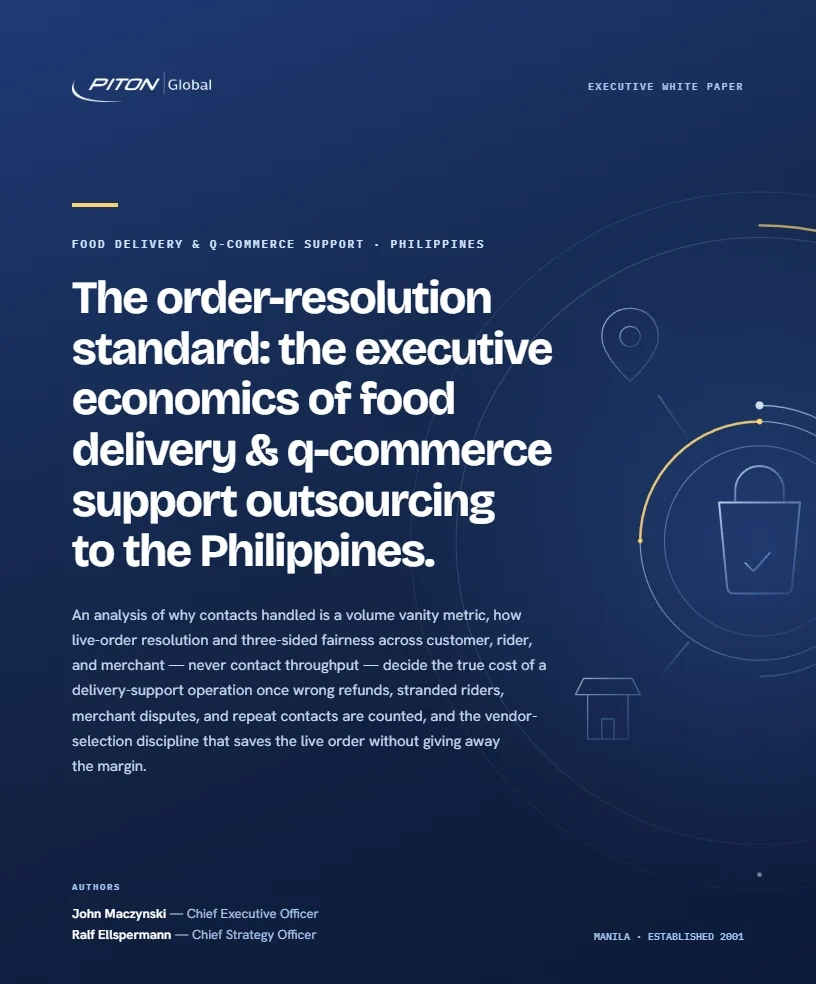
The order-resolution standard: the economics of food delivery & q-commerce support outsourcing.
Why contacts handled is a volume vanity metric, how live-order resolution and three-sided fairness across customer, rider and merchant — never contact throughput — decide the true cost of a delivery-support operation once wrong refunds, stranded riders, merchant disputes and repeat contacts are counted, and the vendor-selection discipline that saves the live order without giving away the margin. Part of PITON-Global’s Executive White Paper Series, by John Maczynski and Ralf Ellspermann.
What food-delivery leaders ask before they outsource.
In-depth answers to the questions that decide a food-delivery BPO engagement — from the principals who run them.
How many of last night’s delivery incidents did our support desk refund instead of save?
Ask for median time-to-resolution on live incidents at peak: a desk replying in hours refunds by default — the order died while the courier was in range. A live-ops desk resolves diner, courier and merchant in one motion. The delivery platform moved from multi-hour replies to 3.5-minute median resolution: auto-refunds −34%, 98.7% of orders saved before make-good, rider retention +12 points.
BPO Partners
Resolved / Year
Delivery Hubs
A delivery issue has a shelf life measured in minutes, not days. Resolve the late order while the courier is still nearby and you keep three customers — the diner, the rider and the restaurant. Miss the window and you refund the meal, lose the rider’s pay and earn a one-star review on all three sides.
The services delivery platforms outsource most — in the order they outsource them.
Your order mix and your rush decide which side strains first.
Every marketplace has its own peak rhythm — the daily dinner rush, not the annual one. For annual peak elasticity see retail and e-commerce; this page is the daily 9pm rush. These are the four delivery profiles we build for most often.
Three-sided live ops through every dinner and weekend peak, with the diner kept, the rider paid, and the restaurant informed on one resolution.
Anchors to: The 9pm Rush Board · the delivery platform →Real-time substitution and inventory support, order-accuracy operations, and rapid-delivery coordination at q-commerce speed.
Anchors to: The Risk Matrix · Merchant-error row →Courier onboarding, dispatch coordination, route-exception resolution, and the fair-pay-on-failure protocol that lifted rider retention 12 points.
Anchors to: Supply-Side Make-Good · +12pt rider retention →Menu onboarding, listing accuracy, inventory sync, and merchant-side incident support before the diner is charged.
Anchors to: The Risk Matrix · Merchant-error row →One order goes wrong at peak — who gets hurt, and how fast can you fix it?
Every live incident touches all three sides of the marketplace at once. Select an incident to see who it hits — diner, courier, merchant — the resolution play, the clock you are racing, and what it costs if you miss the window.
Three-sided live ops is a support model where one trained team resolves a single delivery incident across the diner, the courier and the merchant simultaneously — measured by time-to-resolution and orders saved, not tickets closed.
“Delivery support is the only customer service I know where the asset is melting while you type. The teams that win treat every contact as a dispatch problem with a stopwatch — and they keep all three sides of the order whole, not just the one who called.”
A ticket queue vs. a live dispatch desk.
The delta between a generic ticket team and a PITON-Global-vetted live-ops desk — across seven dimensions that decide whether the order is saved or refunded.
Four ways a marketplace bleeds — each on a different side, each on a clock.
A delivery platform’s risk isn’t one surface; it’s four, and each lands on a different side of the three-sided event. A ticket queue absorbs the contacts these risks generate; a live-ops desk contains each one while the clock is still running.
The through-line: the fourth row is why the first three matter — every risk gets worse at peak, and a desk that collapses at 9pm loses all three sides in the same hour. The Rush Board above shows the incident; this matrix shows the four ways it was generated.
Where does the value come from when you save the order instead of refunding it?
From four streams a ticket count never shows: refunds avoided, riders and merchants retained, fraud stopped and re-orders kept. A saved order is two dollars of make-good you did not spend and a customer who opens the app again tomorrow.
Illustration, not a client result: 75 FTEs × 1,920 paid hours at about $11.46/hour ($22,000 per FTE per year) plus a 10% transition provision, against $63,000 per FTE onshore — a modelled difference of $2.91M. The bars above are value categories to evaluate with your own data, not booked benefits. Dedicated specialist and leadership roles are priced separately.
One side, one metric — a courier-support-only deployment, measured.
The flagship engagement proves the three-sided desk. This is the floor — and it proves it on the side most platforms fix last: a courier-support-only engagement, diner and merchant support left with the client’s existing operation.
Here is the cost per seat. Now here is what the refund-by-default desk actually costs.
Every RFP compares cost-per-contact, so we publish the seat math. Then we switch the denominator — because a ticket closed with an auto-refund isn’t a resolution, it’s a margin event, and the cheapest desk is the one that saves the order instead.
The seat lens prices the agent; the saved order prices the outcome. The ticket-queue desk is cheap per contact and expensive per event: it refunds by default (a margin hit), leaves the rider unpaid (a supply hit), and replies in hours (a churn hit) — three costs on one incident, none of them on the invoice. Switch the denominator and the four streams a ticket count omits — refunds avoided ($1.4M–$2.8M), courier & merchant retention ($0.9M–$1.8M), fraud prevented ($0.7M–$1.4M), and re-orders kept ($1.1M–$2.2M) — stack to a $4.1M–$8.2M annual net benefit.
That is how the flagship engagement’s $960K desk was followed by a client-reported gross benefit of $6.4M (6.7× cost, not audited) by cutting auto-refunds 34% and lifting rider retention 12 points. A saved order is two dollars of make-good you didn’t spend and a customer who opens the app again tomorrow. The cheapest contact is the one that ends with the order delivered.
Indicative 2026 rates — the live-ops dispatcher shown apart from the ticket agent.
Async support has a generic market; the live-ops dispatcher — hired for real-time aptitude, drilled on the 9pm simulation, working a dispatch stack against a stopwatch — does not. A quote at the ticket-agent band for live-incident work is the batch-vs-live gap with a price on it: you’ll get replies in hours for orders that die in minutes.
The live-ops dispatcher has no generic equivalent because closing a three-sided event in one motion — in minutes, at 9pm, on a live dispatch stack — is a real-time aptitude that a ticket queue neither hires nor trains for. A quote at the ticket band for live work is the tell. Rates confirmed per engagement against order volume and peak profile.
Price my desk against the 9pm-simulation standard →A three-sided dispatch desk, live, in 7 weeks — drilled at peak before it carries one.
A gated stand-up built around your dinner rush. No team takes live volume until it clears a 9pm-peak simulation against your real incident mix.
What does a great live-ops partner do at 9pm on a Friday that a cheap one simply can’t?
Three capabilities separate a desk that saves your dinner rush from one that drowns in it — and each is demonstrable before you sign. Ask any prospective partner to show you these three things working live, not on a slide.
“The tell is simple: ask a prospective partner to resolve one live incident in front of you at peak. The good ones keep the diner, the rider and the restaurant whole in a few minutes; the rest issue a refund and call it service. That single demo decides the contract.”
Where live ops doesn’t fit — and whose money the make-good is.
A shortlist that includes “no” is the only kind worth having. Three engagements we turn down — and why the refusal is the point.
Our dispatchers recover the order first and compensate second, inside the goodwill thresholds you set. A desk with unlimited make-good authority isn’t saving your margin — it’s spending it faster with better manners. The resolution plays, the credit ceilings, and the escalation rules are yours; the stopwatch discipline is ours.
The live-ops model only pays off when it’s measured in minutes — TTR, orders saved, sides kept whole. If your incident mix genuinely tolerates multi-hour replies, you don’t need a dispatch desk, and we’ll say so rather than sell you a stopwatch you won’t use. Our value is the order saved while the courier is still in range; if there’s no clock, there’s no case for us.
Three-sided resolution requires being inside your dispatch and comms stack (Bringg, Onfleet, Salesforce, Twilio) under Zero-Trust VDI — courier location, order state, and merchant status on one screen, with PII and location data at zero local residency. Without that access, we’d be reconstructing a live event from an email thread, which is the exact batch failure this page audits against.
The order-resolution standard: the economics of food delivery & q-commerce support outsourcing.
Why contacts handled is a volume vanity metric, how live-order resolution and three-sided fairness across customer, rider and merchant — never contact throughput — decide the true cost of a delivery-support operation once wrong refunds, stranded riders, merchant disputes and repeat contacts are counted, and the vendor-selection discipline that saves the live order without giving away the margin. Part of PITON-Global’s Executive White Paper Series, by John Maczynski and Ralf Ellspermann.
What food-delivery leaders ask before they outsource.
In-depth answers to the questions that decide a food-delivery BPO engagement — from the principals who run them.