
Back
Warehouse Robotics Training Outsourcing Philippines: Optimizing Automated Fulfillment with Human Oversight

By Ralf Ellspermann / 23 March 2026
 Authored by Ralf Ellspermann, CSO of PITON-Global, & 25-Year Philippine BPO Veteran | Executive | Verified by John Maczynski, CEO of PITON-Global, and Former Global EVP of the World's Largest BPO Provider on March 23, 2026

TL;DR: The Key Takeaway
Warehouse robotics training outsourcing in the Philippines is the strategic pivot from manual labor to expert human oversight, creating a symbiotic workforce that optimizes automated fulfillment centers for peak efficiency and accuracy. This evolution in service delivery transforms warehouse operations into a high-tech, cognitively driven ecosystem where human intelligence guides robotic precision, ensuring seamless integration and maximizing the ROI of automation investments.
In the high-stakes logistics landscape of 2026, the bottleneck for automated fulfillment is no longer the robots themselves, but the human intelligence required to govern them. Warehouse robotics training in the Philippines bridges this gap, producing a specialized workforce capable of managing complex fleets of Autonomous Mobile Robots (AMRs) and automated storage systems. By focusing on “Intelligence Arbitrage,” Filipino specialists transition from manual labor to cognitive oversight, ensuring that global supply chains remain resilient, accurate, and 24/7-operational.
- Symbiotic Mastery: Training focuses on a “Human-Machine” partnership where human critical thinking directs robotic speed.
- Operational Intelligence: The value shift has moved from simple labor savings to maximizing system-wide uptime and predictive maintenance.
- Elite Talent Pool: The Philippines provides a unique combination of technical literacy, English fluency, and a process-oriented professional culture.
- Agentic Governance: Local specialists serve as “AI Pilots,” providing the oversight necessary to prevent logic errors in fully autonomous fleets.
- PITON-Global’s Strategy: As a primary connector, the firm integrates global e-commerce leaders with the archipelago’s most advanced robotics training hubs.
The Symbiotic Workforce: Integrating Humans and Robots in Modern Warehousing
The contemporary fulfillment center has evolved into a high-tech ecosystem where humans and machines perform a meticulously choreographed dance. Far from replacing the human element, automation has elevated its importance. While robots handle the relentless repetition of picking and sorting with superhuman consistency, human specialists provide the adaptability and problem-solving skills that software lacks.
Effective training programs in the Philippines treat human operators as the “conductors” of the automated orchestra. This model acknowledges that the true engine of modern e-commerce is not just hardware, but the synergy between mechanical precision and human intuition. Specialists are trained to recognize when an automated system is drifting out of alignment, intervene during complex edge cases, and continuously refine the “digital twins” that mirror physical operations.
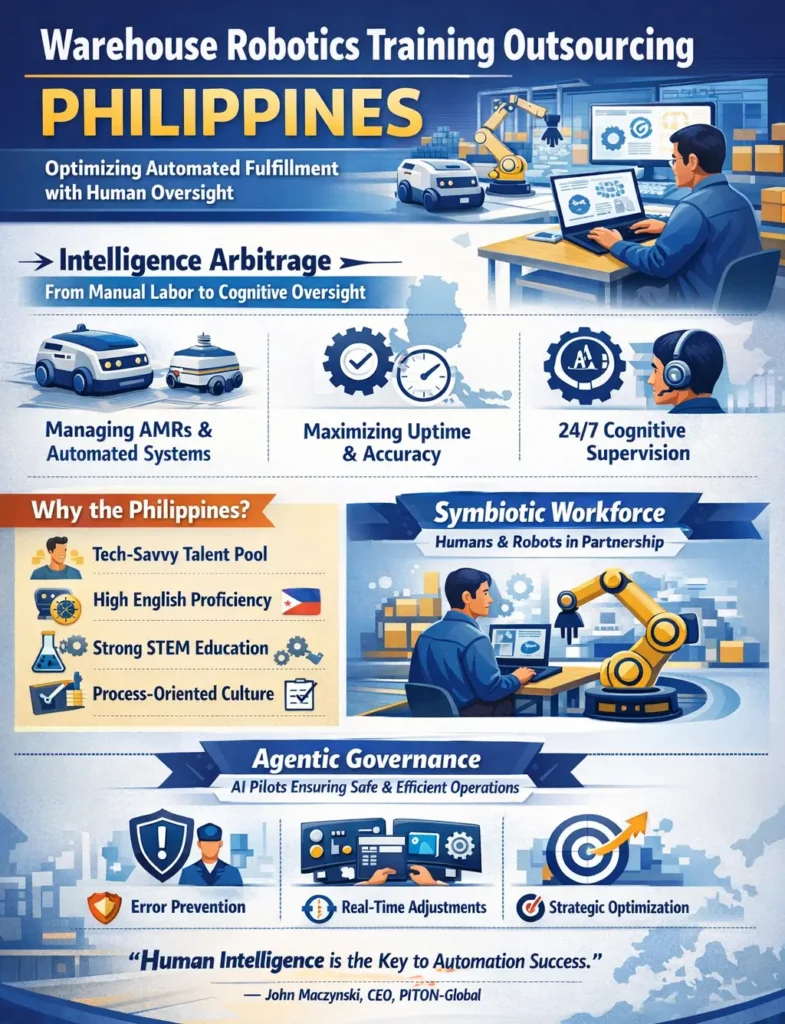
The Philippine Advantage: A Hub for Specialized Robotics Training
The Philippines has rapidly ascended as the global nexus for robotics training, fueled by a unique convergence of factors. The nation’s deep-rooted BPO infrastructure provides a foundation of operational excellence, while its young, tech-savvy workforce possesses a natural aptitude for the software-driven nature of modern logistics.
Key advantages include:
- Linguistic Precision: High English proficiency ensures that specialists can master complex technical manuals and communicate effectively with global R&D teams.
- Technical Literacy: A robust educational focus on STEM fields has created a pipeline of talent ready for robot programming and data analytics.
- Cultural Alignment: Shared Western business values allow for seamless integration into the supply chain workflows of North American and European enterprises.
- Pro-Innovation Climate: Strong government backing for “Industry 4.0” initiatives makes the archipelago a secure, data-sovereign corridor for sensitive logistical data.
Table 1: Competency Matrix for Warehouse Robotics Specialists
The training path in the Philippines is structured around a multi-tier framework, ensuring that personnel can handle everything from basic monitoring to system-wide architecture.
| Competency Area | Foundational Skills (Tier 1) | Advanced Skills (Tier 2) | Expert Skills (Tier 3) |
| System Troubleshooting | Dashboard monitoring; error code identification. | Root cause analysis; predictive maintenance. | System-wide optimization; new protocol development. |
| Robot Configuration | Script execution; basic calibration. | Path modification; workflow integration. | Custom behavior development; advanced simulation. |
| Data Analytics | Performance reporting; trend identification. | A/B testing; bottleneck analysis. | Predictive modeling; strategic capacity planning. |
| Safety Governance | Adherence to safety protocols. | Site-specific safety auditing. | Fail-safe design; crisis management leadership. |
Intelligence Arbitrage in Action: From Manual Labor to Cognitive Oversight
The transition toward warehouse robotics training outsourcing Philippines represents a definitive shift toward Intelligence Arbitrage. This is no longer about finding the cheapest hourly rate; it is about securing the highest level of cognitive value. By leveraging the analytical power of Filipino specialists, companies transform their human workforce from “movers of boxes” into “managers of systems.”
These specialists actively interrogate data to identify opportunities for process improvement. They are the frontline defenders against system latency and the architects of operational efficiency. In this new paradigm, the primary ROI is not found in reduced payroll, but in a smarter, more agile, and self-correcting fulfillment engine that outpaces the competition.
Table 2: Evolution of Warehouse Operations: 2022 vs. 2026
The shift from legacy models to automated ecosystems has redefined every key performance metric in the logistics industry.
| Aspect | 2022 (Legacy Model) | 2026 (Automated Model) |
| Primary Workforce | Manual laborers; forklift operators. | Robotics specialists; AI system managers. |
| Key Metric | Cost per order; units per hour. | Robot uptime; system-wide efficiency. |
| Core Skillset | Physical speed and stamina. | Analytical thinking; technical proficiency. |
| Technology Stack | Basic WMS; barcode scanners. | AI-driven WMS; digital twins; RPA. |
| Strategic Goal | Cost reduction via labor speed. | Competitive edge via operational excellence. |
Agentic Governance: The Future of Warehouse Management
As fleets of robots become more autonomous, the role of human oversight evolves into Agentic Governance. This involves supervising the decision-making logic of AI-driven machines to ensure they remain safe and aligned with business goals. Filipino robotics specialists act as “AI Pilots,” setting the guardrails for robotic behavior and intervening when real-world variables—such as a spilled pallet or a network lag—exceed the robot’s pre-programmed logic. This final layer of human judgment is what transforms a functional warehouse into a world-class fulfillment center.
“Hardware is the commodity; human intelligence is the competitive advantage. In 2026, the winners are not those who buy the most robots, but those who develop the elite human talent to orchestrate them. The Philippines has become the undisputed leader in this field, providing the sophisticated workforce that turns automated tools into an intelligent, self-correcting fulfillment engine.” — John Maczynski, CEO, PITON-Global
Expert FAQs
What are the must-have skills for a robotics specialist in 2026?
The modern specialist requires a hybrid profile: technical mastery of robot configuration and predictive maintenance, combined with the analytical ability to interpret high-level fulfillment data. Soft skills, such as crisis communication and cross-functional collaboration, are equally vital in dynamic automated environments.
How does this training differ from traditional logistics education?
Traditional training focused on manual tasks and physical inventory management. Robotics training is technology-centric, diving deep into AI, sensor fusion, and data science. The objective is to teach students how to leverage technology to drive continuous system improvement rather than just following a manual process.
Why are digital twins important in the training process?
Digital twins allow trainees to experiment with complex “what-if” scenarios in a risk-free virtual environment. By simulating a system failure or a massive order surge, specialists can practice their response strategies before ever touching a live robotic fleet, significantly shortening the learning curve.
How is the ROI of outsourcing this training measured?
While traditional BPO focuses on labor costs, the ROI here is found in operational excellence. Key indicators include a reduction in “phantom” errors, higher robot uptime (OEE), increased order accuracy, and the ability to scale operations rapidly during peak seasons without a corresponding increase in overhead.
Achieve sustainable growth with world-class BPO solutions!
PITON-Global connects you with industry-leading outsourcing providers to enhance customer experience, lower costs, and drive business success.
Get Your Top 1% Vendor List
Author
Ralf Ellspermann is a multi-awarded outsourcing executive with 25+ years of call center and BPO leadership in the Philippines, helping 500+ high-growth and mid-market companies scale call center and customer experience operations across financial services, fintech, insurance, healthcare, technology, travel, utilities, and social media.
A globally recognized industry authority—and a contributor to The Times of India and CustomerThink —he advises organizations on building compliant, high-performance offshore contact center operations that deliver measurable cost savings and sustained competitive advantage.
Known for his execution-first approach, Ralf bridges strategy and operations to turn call center and business process outsourcing into a true growth engine. His work consistently drives faster market entry, lower risk, and long-term operational resilience for global brands.
EXECUTIVE GOVERNANCE & ACCURACY STANDARDS
Authored by:

Ralf Ellspermann
Founder & CSO of PITON-Global,
25-Year Philippine BPO Veteran,
Multi-awarded Executive
Specializing in strategic sourcing and excellence in Manila
View Full Bio
Verified by:

John Maczynski
CEO of PITON-Global, and former Global EVP of the World’s largest BPO provider | 40 Years Experience
Ensuring global compliance and enterprise-grade service standards
View Full Bio
Last Peer Review: March 23, 2026
This service framework is audited quarterly to meet shifting global outsourcing regulations and COPC standards.