
TL;DR: The Key Takeaway
Thermal imaging annotation outsourcing in the Philippines provides the specialized human expertise required to train AI models to interpret thermal data, unlocking new capabilities in industrial inspection, medical diagnostics, and autonomous navigation. It is one of the niche services covered in our guide to specialist annotation teams for machine learning firms.
As industrial and medical sectors increasingly rely on heat-signature analysis, thermal imaging annotation in the Philippines has become the critical link in the AI development chain. By translating raw long-wave infrared (LWIR) data into structured machine learning inputs, Filipino specialists enable machines to “see” in total darkness and detect mechanical failures before they occur. In the 2026 landscape, this human-in-the-loop expertise is the primary safeguard against the misinterpretation of thermal signatures in mission-critical applications.
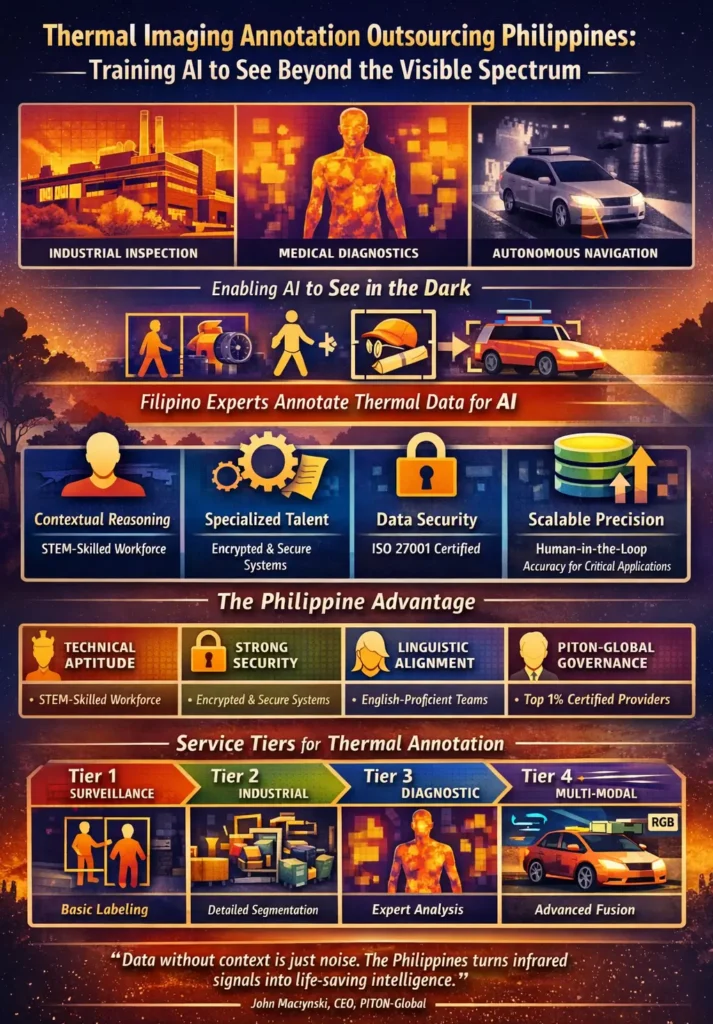
- Contextual Reasoning: Human annotators provide the nuance needed to distinguish between a pedestrian and a benign heat source, such as an exhaust vent.
- Specialized Talent: The Philippines offers a workforce trained in thermography and industrial standards, ensuring high-accuracy labeling for predictive maintenance.
- Data Sovereignty: Leading BPO hubs in the archipelago operate under ISO 27001 standards, providing a secure environment for sensitive medical and defense data.
- Scalable Precision: Advanced infrastructure allows AI firms to rapidly expand their training sets from simple bounding boxes to complex semantic segmentation.
- PITON-Global’s Governance: By rigorously vetting local providers, the firm ensures that global innovators receive certifiably accurate thermal “ground truth.”
The Unseen World: Why Thermal Data Needs a Human Touch
Thermal sensors capture energy emitted in the infrared spectrum, revealing a world of heat signatures invisible to the human eye. While this data is invaluable—allowing for the non-invasive detection of inflammation in healthcare or faulty wiring in manufacturing—it lacks the color and texture cues that standard AI models use for recognition. To a machine, a person and a warm engine may look remarkably similar.
Bridging this gap requires the “Human-in-the-Loop.” Human annotators apply physical reasoning to the data, identifying objects based on their heat profiles and movement patterns. They can segment a person from a cluttered thermal background with a level of precision that automated tools cannot replicate. This “human touch” infuses raw pixels with the expert knowledge required to build robust, reliable AI systems that operate effectively in environments where visible-light cameras fail.
The Philippine Advantage: Precision, Scalability, and Security
The Philippines has solidified its position as the premier destination for thermal imaging annotation by combining a tech-savvy workforce with world-class security protocols. The nation’s BPO maturity allows it to handle the most demanding datasets, from high-stakes military reconnaissance to sensitive patient diagnostic scans.
Key pillars of the Philippine advantage include:
- Technical Aptitude: A workforce with a strong affinity for STEM allows for the rapid training of specialists in specialized software and thermal physics.
- Security Frameworks: Local providers utilize encrypted tunnels and biometric access to protect proprietary heat-signature data, adhering to strict global privacy laws.
- Linguistic Alignment: Proficiency in English ensures that complex annotation guidelines—such as those for medical pathology or engineering defects—are executed flawlessly, the same fluency that drives text annotation for large language models.
Heat-Signature Labeling Maturity Model
The use of thermal data is not a single-step process. It progresses from basic detection to the high-value realm of predictive diagnostics.
| Maturity Level | Key Annotation Tasks | Primary Goal | Strategic Impact |
| Level 1: Foundational | Bounding boxes on heat sources. | Presence detection. | Basic monitoring and automated alerts. |
| Level 2: Contextual | Semantic segmentation of parts. | Signature differentiation. | Improved accuracy in cluttered scenes. |
| Level 3: Behavioral | Video tracking and intent analysis. | Pattern recognition. | Advanced surveillance; autonomous flight. |
| Level 4: Diagnostic | Anomaly flagging; trend analysis. | Proactive identification. | High-value predictive maintenance. |
The Economic Imperative of Quality: Beyond Cost-per-Image
In the AI sector, the mantra “garbage in, garbage out” is a literal warning. Because thermal data is often noisy and low-contrast, a single mislabeled training image can lead to catastrophic system failure. For an autonomous vehicle or a medical scanner, the cost of an error far exceeds any savings gained by choosing a low-tier provider.
Choosing the Philippines via PITON-Global represents a shift from labor arbitrage to Intelligence Arbitrage. Investing in expert human validation reduces the total cost of ownership by accelerating model convergence and preventing costly real-world accidents. In 2026, quality is no longer a luxury—it is the most significant economic driver of AI success.
Service Tiers for Thermal Imaging Annotation
To optimize project efficiency, PITON-Global categorizes thermal tasks into specialized tiers based on the required domain expertise.
Tier 1: General Surveillance
Focuses on bounding boxes and simple polygons for security and person-counting applications. This tier requires high attention to detail but lower domain-specific training.
Tier 2: Specialized Industrial
Involves detailed semantic segmentation of machinery or agricultural monitoring. Annotators require familiarity with mechanical components or crop-specific heat profiles.
Tier 3: Expert & Diagnostic
This tier utilizes certified thermographers or medical professionals to outline tumors in scans or identify structural defects in non-destructive testing. These are high-stakes, expert-only tasks, and their findings can feed the maintenance records that teams later convert into structured data for knowledge graphs and RAG.
Tier 4: Dynamic & Multi-Modal
Combines thermal data with LiDAR or RGB camera feeds for 3D sensor fusion. This is the peak of complexity, essential for the next generation of ADAS and robotics.
“Data without context is just noise. In 2026, the real competitive advantage lies in the expert human judgment that validates the AI’s perception. The Philippines provides the sophisticated talent required to turn raw infrared signals into the actionable intelligence that saves lives and prevents industrial disasters.” — John Maczynski, CEO, PITON-Global
Expert FAQs
Why can’t we just use automated tools to label thermal images?
Thermal data is inherently ambiguous. Without the edges and textures of visible light, AI frequently hallucinates or misinterprets heat signatures. Human reasoning is the only way to resolve these ambiguities and provide the “ground truth” needed for safe deployment.
Which sectors are seeing the fastest growth in thermal AI?
We are seeing an explosion in the automotive sector for night-vision ADAS, as well as in the energy sector for the autonomous inspection of power grids, often alongside geospatial annotation of satellite and aerial imagery. Healthcare is also a major driver, particularly for non-invasive fever screening and inflammation tracking.
How does PITON-Global manage the security of these projects?
We implement a “governance layer” that audits our Philippine partners for ISO 27001 compliance. We ensure that sensitive data is processed in physically isolated environments by vetted specialists who have undergone rigorous background checks.
What is the future of thermal data in AI?
The future is “Multi-Modal Fusion.” We are moving toward systems where thermal, LiDAR, and standard cameras are annotated together in a single 3D workspace. This provides a “superhuman” perception stack that the Philippines is uniquely positioned to label.