
Back
Text Annotation Outsourcing Philippines: Building the Linguistic Foundation for Large Language Models

By Ralf Ellspermann / 11 March 2026
 Authored by Ralf Ellspermann, CSO of PITON-Global, & 25-Year Philippine BPO Veteran | Executive | Verified by John Maczynski, CEO of PITON-Global, and Former Global EVP of the World's Largest BPO Provider on March 11, 2026

TL;DR: The Key Takeaway
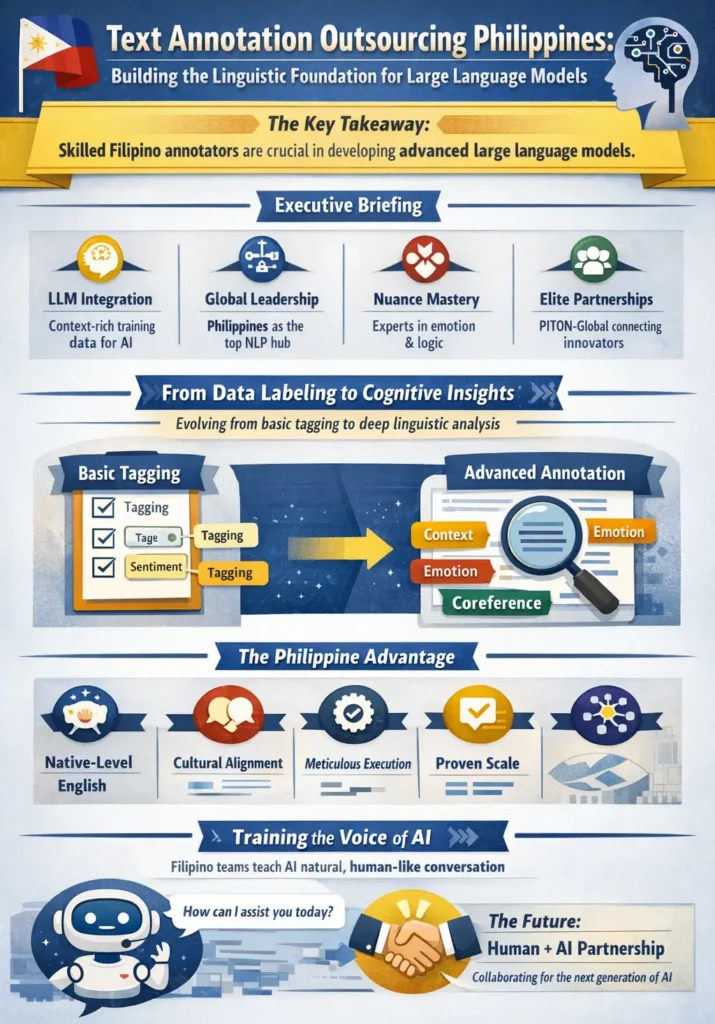
Text annotation outsourcing to the Philippines has transcended basic data entry, becoming a critical component in the development of sophisticated large language models. This evolution is driven by a highly skilled workforce capable of nuanced linguistic analysis, providing the essential human intelligence that powers the next generation of AI.
The rapid evolution of generative AI has turned raw text into a strategic asset that requires sophisticated human interpretation to be useful. Text annotation outsourcing in the Philippines has transitioned from simple data labeling to a high-level cognitive service that provides the logical and emotional framework for modern large language models. By leveraging a workforce with native-level English fluency and analytical depth, developers can move beyond basic keyword tagging to achieve true machine reasoning.
Executive Briefing
- LLM Integration: The surge in large language model deployment has created an urgent need for training data that captures context and intent.
- Global Leadership: The Philippines has secured its status as the primary hub for the intricate linguistic work required by cutting-edge AI.
- Value Shift: Success in modern NLP projects is now measured by the cognitive precision of annotators rather than sheer processing speed.
- Nuance Mastery: Filipino specialists are uniquely positioned to teach AI systems the subtleties of human irony, emotion, and logic.
- Elite Partnerships: PITON-Global streamlines the connection between AI innovators and the top-tier Philippine teams building the future of language.
Executive Summary
The sector of text annotation outsourcing in the Philippines is currently driving the most significant advancements in artificial intelligence. As large language models weave themselves into the fabric of the global industry, the requirement for pinpoint-accurate, contextually aware training data has never been more pressing. With its powerhouse combination of English mastery, cultural intelligence, and a world-class BPO framework, the Philippines has become the definitive center for this specialized craft. This work goes far beyond simple tagging; it involves gifted analysts imbuing machines with a genuine grasp of human discourse. PITON-Global operates at the center of this transformation, matching AI pioneers with the exceptional Filipino talent responsible for constructing the linguistic architecture of tomorrow’s technology.
The Intellectual Evolution of Data Labeling
Early iterations of text processing were largely mechanical, focusing on rote tasks like keyword identification and surface-level sentiment categorization. While those methods sufficed for basic machine learning, they are inadequate for the rigorous demands of current generative models. Modern LLMs necessitate a deeper, more analytical form of annotation that transcends surface labels to capture the “why” behind the words.
This is precisely where the Philippine talent pool excels. The nation’s academic focus on critical thinking and communication has cultivated a workforce of linguistic investigators. These professionals do more than label; they deconstruct complex syntax, detect subtle emotional shifts, and map the invisible threads connecting different ideas within a text. This intellectual leap allows an AI to progress from a simple script-reader to a system capable of fluid conversation and creative problem-solving. The industry has pivoted: it no longer prioritizes the volume of data, but rather the depth of the human insight embedded within it.
Deconstructing High-Fidelity Linguistic Tasks
Understanding the complexity of modern text annotation requires a look at the specialized skills involved. These roles demand a sophisticated grasp of grammar and a sharp eye for detail. Key specializations include:
- Advanced Named Entity Recognition (NER): Beyond identifying names or places, this involves mapping the complex relationships and hierarchies between different entities in a story.
- Granular Emotion Mapping: Specialists identify specific psychological states—such as frustration, sarcasm, or relief—enabling AI to respond with appropriate empathy.
- Coreference and Anaphora Resolution: This ensures the AI understands exactly which person or object a pronoun refers to across long, complex passages.
- Strategic Discourse Analysis: Annotators evaluate the structural flow of information, which is vital for high-quality automated summarization and translation.
“We are witnessing a fundamental change in how machines process human thought, and that change is powered by high-level human intervention. Our partners are looking for more than just workers; they need linguistic strategists to help them bridge the gap between code and conversation. The Philippines is the clear leader in providing this cognitive fuel, which serves as the bedrock for the next generation of AI.” — John Maczynski, CEO, PITON-Global
The Philippine Linguistic Edge: A Strategic Overview
The dominance of the Philippines in this sector is the result of several converging strengths. Chief among these is a pervasive, high-level English proficiency. As a primary language for law, education, and commerce, English is handled with an intuitive grace by Filipino professionals.
Beyond language, the local workforce is characterized by a strong alignment with Western logic and business ethics. This cultural synergy ensures that collaboration between Philippine teams and Western tech firms is seamless and intuitive. Furthermore, the country’s mature BPO ecosystem provides the technical backbone—including high-speed fiber networks and strict security protocols—necessary for large-scale AI projects.
| Advantage | Defining Characteristic | Impact on AI Development |
| Native-Level English | Deep immersion in English from childhood. | Precise detection of nuance, slang, and technical jargon. |
| Cultural Alignment | Natural familiarity with Western social cues. | Reduced friction in communication and higher intent accuracy. |
| Meticulous Execution | A professional culture rooted in quality. | Reliable, error-free datasets that accelerate model training. |
| Proven Scale | Decades of experience in high-volume BPO. | Ability to ramp up massive annotation projects without losing quality. |
Training the Voice of AI: Conversational Excellence
The most visible application of this work is found in the chatbots and virtual assistants that define modern customer service. The natural feel of these interactions is a direct result of the high-quality human feedback provided during the training phase. Philippine specialists are instrumental in teaching models to navigate the complexities of real-time dialogue.
This includes identifying user intent even when phrased ambiguously and maintaining the context of a conversation over multiple turns. The objective is to move past robotic responses and toward an AI that can build rapport and provide genuine assistance. The expertise of Filipino teams in this area is why the world’s most advanced conversational platforms rely on text annotation outsourcing in the Philippines.
The Road Ahead: A Human-AI Partnership
The trajectory of text annotation is shifting toward a more integrated relationship between human intelligence and machine efficiency. As AI models become more capable, the role of the human annotator is being elevated.
In the coming years, automated tools will likely handle the most repetitive tagging, allowing human experts to focus on the highest-level reasoning and edge cases. Humans will increasingly act as mentors and ethical guardians for AI, ensuring that models remain fair, unbiased, and helpful. The Philippines is perfectly positioned to lead this shift, evolving from a service provider into a vital partner in the ethical and technical advancement of artificial intelligence.
Expert FAQs
How does LLM-specific annotation differ from older methods?
Traditional annotation was often binary or simple (e.g., “Is this spam?”). LLM annotation is multidimensional, requiring the annotator to explain logic, resolve ambiguities, and identify complex rhetorical devices that machines cannot yet see on their own.
What qualities define a top-tier text annotation team?
Look for a blend of high-level linguistic education, experience with diverse annotation platforms, and a proven ability to follow complex, evolving guidelines. The best teams act as an extension of your own data science department.
What steps ensure the highest data integrity?
Quality is maintained through a “multi-pass” review system where different experts verify each other’s work. Clear, documented guidelines and a continuous feedback loop between the developers and the Philippine team are also essential.
Where is the text annotation market going?
The focus is moving toward “Reasoning Chains,” where humans help AI break down complex problems into logical steps. This requires a high level of cognitive ability, ensuring the Philippines remains the go-to destination for high-value AI training.
Achieve sustainable growth with world-class BPO solutions!
PITON-Global connects you with industry-leading outsourcing providers to enhance customer experience, lower costs, and drive business success.
Get Your Top 1% Vendor List
Author
Ralf Ellspermann is a multi-awarded outsourcing executive with 25+ years of call center and BPO leadership in the Philippines, helping 500+ high-growth and mid-market companies scale call center and customer experience operations across financial services, fintech, insurance, healthcare, technology, travel, utilities, and social media.
A globally recognized industry authority—and a contributor to The Times of India and CustomerThink —he advises organizations on building compliant, high-performance offshore contact center operations that deliver measurable cost savings and sustained competitive advantage.
Known for his execution-first approach, Ralf bridges strategy and operations to turn call center and business process outsourcing into a true growth engine. His work consistently drives faster market entry, lower risk, and long-term operational resilience for global brands.
EXECUTIVE GOVERNANCE & ACCURACY STANDARDS
Authored by:

Ralf Ellspermann
Founder & CSO of PITON-Global,
25-Year Philippine BPO Veteran,
Multi-awarded Executive
Specializing in strategic sourcing and excellence in Manila
View Full Bio
Verified by:

John Maczynski
CEO of PITON-Global, and former Global EVP of the World’s largest BPO provider | 40 Years Experience
Ensuring global compliance and enterprise-grade service standards
View Full Bio
Last Peer Review: March 11, 2026
This service framework is audited quarterly to meet shifting global outsourcing regulations and COPC standards.