
Back
Sensor Fusion Data Labeling Outsourcing Philippines: The Epicenter of AI’s Next Leap

By Ralf Ellspermann / 15 March 2026
 Authored by Ralf Ellspermann, CSO of PITON-Global, & 25-Year Philippine BPO Veteran | Executive | Verified by John Maczynski, CEO of PITON-Global, and Former Global EVP of the World's Largest BPO Provider on March 15, 2026

Sensor fusion data labeling in the Philippines is the mission-critical process of annotating synchronized multi-modal data—including 3D LiDAR point clouds, 4D temporal vectors, radar, and high-resolution camera feeds—to train autonomous systems. In 2026, the Philippines has transitioned from a generalist labeling hub to a Sovereign Data & Logic Hub, where specialized “AI Pilots” perform complex logic verification and edge-case validation, delivering a measurable “Model Performance Lift” that ensures the safety and reliability of Physical AI.
Executive Briefing
- Beyond Bounding Boxes: Shift from static 2D images to 4D temporal sequences, where objects are tracked across time and multiple sensor modalities simultaneously.
- The “AI Pilot” Paradigm: Filipino specialists now act as Robot Wranglers, using high-AQ (Adaptability Quotient) to resolve “Perception-Logic” gaps that automated tools cannot identify.
- Intelligence Arbitrage: Moving the ROI from “cost-per-hour” to “Disengagement Rate Reduction”—directly impacting the safety and commercial viability of autonomous vehicles and robotics.
- Sovereign Governance: Establishing human-in-the-loop guardrails that align machine decisions with brand-specific logic and global safety standards (e.g., ISO/IEC 5259).
- Fiscal Velocity: Operating under the 2026 CREATE MORE Act (RA 12066), providing a 20% corporate tax rate and 100% deductions for power and AI-specific workforce training.
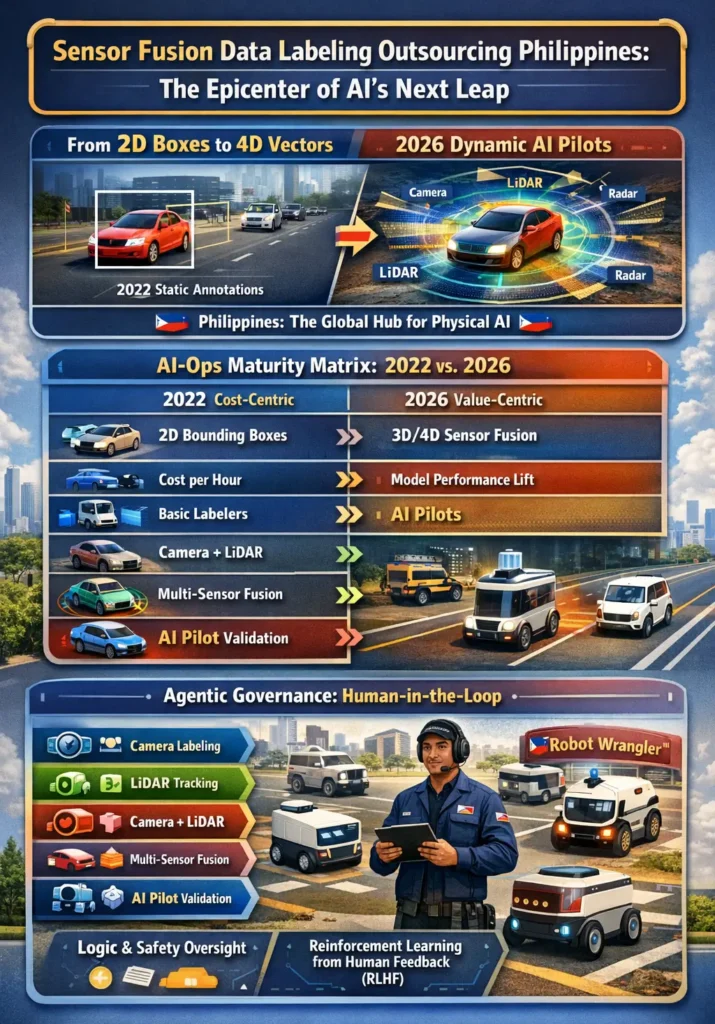
From 2D Boxes to 4D Vectors: The New Frontier
In 2026, the “Physical AI” revolution—encompassing autonomous vehicles, industrial drones, and humanoid robots—demands a rich, temporal understanding of the world. Simple image tagging is no longer sufficient. Sensor fusion involves the meticulous correlation of data: a LiDAR pulse detects a physical volume, while a camera identifies its semantic “meaning” (e.g., a child vs. a cardboard cutout).
The Philippines has emerged as the global leader for this multi-modal synchronization. Filipino perception specialists don’t just “label”; they interpret sensor physics, ensuring that the AI understands object permanence even when a sensor is blinded by glare or obstructed by rain.
“We aren’t selling ‘hours’; we are selling ‘Model Truth.’ The Philippines is now the human firewall against AI hallucinations in the physical world.” — John Maczynski, CEO, PITON-Global
The AI-Ops Maturity Matrix: 2022 vs. 2026
The shift in value is defined by a move from manual execution to strategic logic verification.
| Capability | 2022 State (Cost-Centric) | 2026 State (Value-Centric) |
| Primary Task | 2D Bounding Boxes / Classification. | 3D/4D Sensor Fusion & Temporal Tracking. |
| Core Metric | Cost-per-Asset / Annotator Hours. | Model Performance Lift / Safety Gain. |
| Workforce Skill | Basic manual labeling. | AI Pilots / Perception Specialists. |
| Value Proposition | Labor Arbitrage (Lower costs). | Intelligence Arbitrage (Better AI). |
| Technology | Basic web-based tools. | Advanced LiDAR/Fusion & RLHF Platforms. |
Sensor Fusion Complexity Scoring Chart
PITON-Global utilizes this framework to match project sensitivity with the appropriate level of Filipino expertise:
| Level | Modalities | Temporal Element | Use Case Example |
| Level 1 | Camera Only | Single Frame | Lane marking identification. |
| Level 2 | LiDAR or Camera | Single Frame | 3D Cuboid vehicle detection. |
| Level 3 | Camera + LiDAR | Multi-Frame | Tracking a cyclist through an intersection. |
| Level 4 | Camera + LiDAR + Radar | Continuous Sequence | Predicting vehicle trajectory and intent. |
| Level 5 | All Sensors | Full Drive Log | “AI Pilot” validation of near-miss scenarios. |
Agentic Governance: The Human-in-the-Loop Guardrail
As AI becomes more “agentic”—capable of autonomous planning—the Philippines provides the critical Agentic Governance layer. Filipino “Robot Wranglers” perform Red Teaming and Logic Alignment, ensuring a delivery robot’s behavior is both safe and brand-compliant.
Through Reinforcement Learning from Human Feedback (RLHF), these specialists teach machines the “unwritten rules” of the road—such as interpreting a traffic officer’s hand signals or identifying a “creeping” vehicle at a four-way stop.
Expert FAQs
Why is the Philippines better for Sensor Fusion than other offshore hubs?
The Philippines combines high English proficiency with an “AI-First” workforce (86% adoption rate among knowledge workers). This allows for complex instruction following and the ability to articulate why a model failed, which is critical for the “Logic Verification” phase of modern AI-Ops.
How does the 2026 CREATE MORE Act impact the cost of Sensor Fusion?
Sensor fusion is compute-intensive. The CREATE MORE Act allows BPOs to claim 100% deductions on power expenses and provides a simplified VAT zero-rating on local services, keeping the Philippines 60–70% more cost-effective than onshore operations while maintaining higher infrastructure quality.
What is “Intelligence Arbitrage” in the context of data labeling?
It is the move away from paying for “heads in seats.” Instead, companies pay for the “lift” in model performance. For example, a 5% reduction in “phantom braking” for an autonomous truck fleet represents millions in saved fuel and safety costs—a value far exceeding the cost of the labeling itself.
Can the Philippines handle high-security/sensitive sensor data?
Yes. In 2026, premier Filipino BPOs utilize Zero-Possession Data Architecture. Data is streamed into secure “sandboxes” where annotators interact with the data without it ever residing on local hardware, ensuring full compliance with GDPR and US state-level privacy laws.
Achieve sustainable growth with world-class BPO solutions!
PITON-Global connects you with industry-leading outsourcing providers to enhance customer experience, lower costs, and drive business success.
Get Your Top 1% Vendor List
Author
Ralf Ellspermann is a multi-awarded outsourcing executive with 25+ years of call center and BPO leadership in the Philippines, helping 500+ high-growth and mid-market companies scale call center and customer experience operations across financial services, fintech, insurance, healthcare, technology, travel, utilities, and social media.
A globally recognized industry authority—and a contributor to The Times of India and CustomerThink —he advises organizations on building compliant, high-performance offshore contact center operations that deliver measurable cost savings and sustained competitive advantage.
Known for his execution-first approach, Ralf bridges strategy and operations to turn call center and business process outsourcing into a true growth engine. His work consistently drives faster market entry, lower risk, and long-term operational resilience for global brands.
EXECUTIVE GOVERNANCE & ACCURACY STANDARDS
Authored by:

Ralf Ellspermann
Founder & CSO of PITON-Global,
25-Year Philippine BPO Veteran,
Multi-awarded Executive
Specializing in strategic sourcing and excellence in Manila
View Full Bio
Verified by:

John Maczynski
CEO of PITON-Global, and former Global EVP of the World’s largest BPO provider | 40 Years Experience
Ensuring global compliance and enterprise-grade service standards
View Full Bio
Last Peer Review: March 15, 2026
This service framework is audited quarterly to meet shifting global outsourcing regulations and COPC standards.