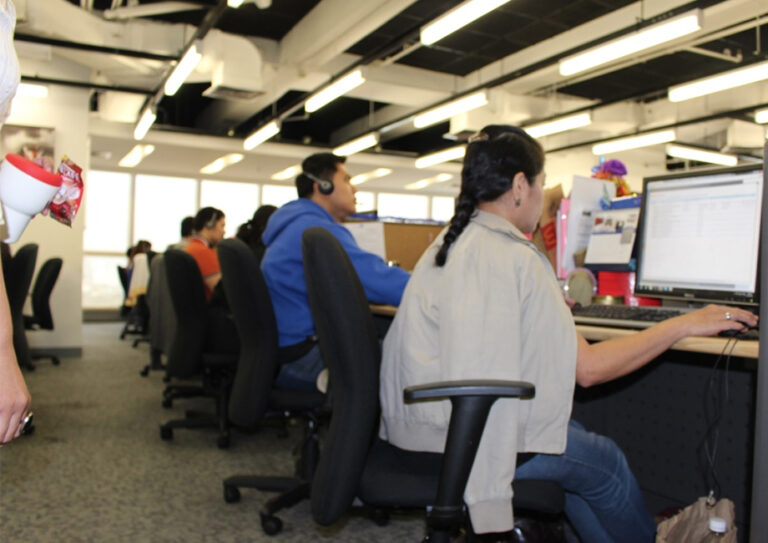

A card gets declined at 2 a.m. in Chicago, a wallet transfer stalls on a Sunday in Denver, and a small-business borrower in Atlanta is locked out before payroll runs. Round-the-clock fintech support in the US is the operating promise that someone qualified answers each of those moments, and many American fintechs now keep that promise with regulated finance operations staffed from Manila. This guide explains what a 24/7 desk has to cover, why the Philippines fits the American clock, and how to build a contact center arrangement that satisfies both customers and examiners.
Why a fintech cannot close at 6 p.m.
Money moves continuously, so the problems it creates arrive continuously too. Card authorizations, instant payments, peer-to-peer transfers and app logins do not pause for business hours, and a customer who cannot reach anyone during a failed transaction rarely waits patiently until morning.
For a traditional bank, branch hours set expectations. A digital-first brand has no branch, which means the app and the support line are the entire relationship. When either goes quiet overnight, customers read the silence as a risk to their money. That perception drives complaints, social posts, chargebacks and, in lending, missed payments that could have been prevented with one conversation.
There is also a regulatory edge. Under Regulation E, a consumer’s timely report of an unauthorized electronic transfer limits their liability and starts the institution’s investigation clock. A fintech that cannot take that report at night is pushing a regulated event into the next business day, and examiners notice patterns like that in complaint data.
What a 24/7 desk actually handles
An overnight desk is not a smaller copy of the daytime queue. The mix shifts toward urgent, security-sensitive contacts, and the team has to be trained and authorized for them.
- Fraud and security events: suspected account takeover, card freeze and unfreeze, suspicious login alerts and one-time-passcode failures.
- Payment exceptions: declined cards, pending transfers, duplicate charges and instant-payment reversals that customers need explained right now.
- Dispute intake: capturing unauthorized-transaction and error claims completely, so the investigation team starts the next day with a clean file.
- Access and onboarding: locked accounts, identity step-up checks and stalled KYC reviews for new customers who signed up after hours.
- Merchant and small-business support: settlement questions, terminal problems and payout delays for businesses that trade on evenings and weekends.
Routine questions such as balance lookups and statement copies are good candidates for chatbots and self-service. The human team earns its cost on the contacts above, where judgment, empathy and a documented decision matter.
How the Manila time zone covers the American night
Manila, like the rest of the Philippines, runs twelve or thirteen hours ahead of US Eastern time, so a normal Filipino day shift lands squarely on the American overnight. That single fact changes the economics of coverage: the hours that are hardest to staff at home are ordinary working hours for the offshore team.
In practice, most providers run three patterns. A night desk in Manila takes US daytime volume, a day desk covers the American night, and a mid-shift absorbs the evening peak when US consumers are home and using their apps. Because the offshore team is working its own daytime on the hardest-to-fill US hours, supervisors, quality analysts and trainers are present on every shift rather than a skeleton crew.
The staffing arithmetic
One seat that must be filled every hour of the week needs 168 hours of coverage. Divided by a 40-hour schedule, that is 4.2 people before vacation, sick days, training and coaching are counted. Building that bench domestically for a single overnight position is expensive and hard to retain; building it inside an established Philippine operation spreads the load across a larger team with shared supervision. PITON-Global’s overview of pooled 24/7 coverage shows how vetted providers structure that bench.
Compliance guardrails for an offshore fintech team
Answering at night is only useful if every answer is compliant. The vendor has to meet the same control standard your sponsor bank and your auditors expect from you, and the contract has to prove it.
- PCI DSS 4.0: the future-dated requirements became mandatory at the end of March 2025, so card data handling, authentication and logging on the agent floor must reflect the current version, not the old one.
- Data protection: Gramm-Leach-Bliley safeguards on your side, and the Philippine Data Privacy Act on the provider’s side, with clear rules about where data is stored and who can see it.
- Consumer-protection scripts: Regulation E and Regulation Z dispute language, fair-lending sensitivities and complaint-capture rules written into the knowledge base.
- Audit evidence: SOC 2 Type II reports, call and chat recordings, access logs and quality scores available on request for your compliance team and your partner bank.
Mature financial-services operations in the Philippines already work to these frameworks for American banks and card issuers. The post on aligning local expertise with worldwide standards covers how providers map their controls to North American requirements.
Technology that keeps the overnight queue under control
Good tooling lets a lean night team handle high-stakes contacts safely. The goal is to automate the simple work and give agents the context to resolve the rest on first contact.
AI assistants and self-service flows should take password resets, balance checks and card status questions. When a contact escalates, the agent needs the transaction history, device and login signals, prior tickets and any fraud flags in one view, rather than toggling across five systems. Agent-assist tools that surface the right policy or script in real time shorten handling time and reduce compliance slips. Analytics close the loop: tagging every overnight contact by reason shows which product defects or unclear screens are generating calls, so the fix happens in the app instead of the queue.
Your provider should run on the platforms your daytime team already uses, or integrate cleanly with them, so a case opened at 3 a.m. is visible and actionable at 9 a.m. without re-keying.
People, training and language
Fintech products change weekly, so the team supporting them must learn continuously. The best providers treat product training as a standing process, not a one-time onboarding course.
Filipino agents bring strong conversational English, familiarity with American consumer culture and a service style customers describe as patient and warm, which matters when someone is anxious about missing money. The EF English Proficiency Index 2025 places the Philippines at rank 28 worldwide with a score of 569, in the high-proficiency band. Beyond language, look for a provider that trains agents on payments basics, fraud patterns, dispute rules and de-escalation, and that uses quality monitoring to coach against your own scorecard. Our article on building world-class financial-services teams explores hiring, certification and career paths in more depth.
Cost and how to evaluate a provider
Coverage from the Philippines typically costs a fraction of a domestic night shift, but the cheapest vendor is rarely the right one for regulated work. Price the full picture, including supervision, quality assurance and the cost of a compliance failure.
As of 2026, the calculator on PITON-Global’s pricing page starts from a $12/hour fully-loaded base rate that already includes team-lead and QA supervision, compared with a US in-house benchmark of $33/hour, and shows 50–70% typical savings versus American in-house teams. Treat those figures as a starting point for your own model rather than a quote.
When shortlisting providers, ask to see live financial-services programs, not just a slide deck. Review their SOC 2 and PCI evidence, test how they handle a mock account-takeover call, and check how quickly they can staff an evening surge. Ask how they measure quality: a vendor that reports only speed metrics is missing the point on regulated contacts. Lean operations matter too, and the article on driving lean operations in financial services shows how process discipline keeps cost down without cutting corners.
Frequently asked questions
Can an offshore team handle regulated dispute and fraud contacts?
Yes, provided the Philippine provider is audited against the controls you need and agents work from approved scripts and decision rules. Most fintechs let the desk in the Philippines take intake and first-line fraud actions, while final dispute decisions stay with an in-house or designated investigations team.
Should the overnight desk be voice, chat or both?
Both, weighted toward chat and in-app messaging for routine issues and voice for fraud and account-access emergencies. Anxious customers who fear they have lost money usually want to talk to a person.
How long does it take to launch 24/7 coverage?
Timelines depend on training depth and your security review, but a well-scoped program with an experienced provider in Manila or Cebu can usually move from contract to live traffic within a couple of months, often starting with overnight hours before expanding.
Is round-the-clock support worth it for an early-stage fintech?
If your customers move money outside business hours, yes. Even a small overnight team focused on fraud, access and payment exceptions protects trust and reduces chargebacks, and it can grow with transaction volume.