
Back
Retail Outsourcing Philippines: The 2026 Strategic Playbook for Global Retailers
By Ralf Ellspermann / 12 February 2026
 Authored by Ralf Ellspermann, CSO of PITON-Global, & 25-Year Philippine BPO Veteran | Executive | Verified by John Maczynski, CEO of PITON-Global, and Former Global EVP of the World's Largest BPO Provider on February 12, 2026

30-Second Executive Briefing
- The Macro Crisis: Global retailers in 2026 face a “Margin Churn” of 8–12% due to supply chain instability, rising domestic labor costs, and a 40% increase in sophisticated “Return Fraud.”
- The Paradigm Shift: Outsourcing has transcended “Labor Arbitrage” (saving on heads). It is now Intelligence Arbitrage—leveraging high-IQ Philippine talent to manage the Agentic AI systems that now run modern commerce.
- The Manila Advantage: With over 1.5 million BPO professionals, the Philippines has pivoted to Information Density, becoming the global “Nerve Center” for Unified Commerce and Hyper-Personalized CX.
- The Projected ROI: Brands transitioning to a Philippine “Intelligence Hub” model report a 70% reduction in OpEx and a 22% increase in Customer Lifetime Value (LTV) within 18 months.
Executive Summary
In the hyper-competitive global retail landscape of 2026, operational efficiency is no longer a “back-office” concern—it is a front-line competitive advantage. Retailers today are caught between the “Amazon-Expectation” of instant delivery and the reality of a 51% increase in global logistics disruption.
Retail Outsourcing to the Philippines has undergone a radical metamorphosis to meet this moment. No longer a destination for low-level call centers, the Philippines has emerged as the world’s primary Intelligence Hub. By combining the legendary Filipino “Human Touch” with cutting-edge Agentic AI Orchestration, global brands are achieving a level of operational resilience that was previously impossible. This guide provides the 2026 framework for transforming your retail operation from a brittle cost center into a high-velocity, profit-defending growth engine.
The 2026 Paradigm Shift: From BPO to “Intelligence Centers”
For decades, the Philippines was known as the “World’s Call Center.” In 2026, that title is officially obsolete. The country has transitioned into the world’s Global Intelligence Hub.
“Retail outsourcing works best when it’s treated as an operating discipline, not a procurement exercise,” says John Maczynski, CEO of PITON-Global. “In 2026, we have moved from ‘Labor Arbitrage’ to ‘Intelligence Arbitrage.’ The Philippines is no longer just a cost-saving destination; it is a strategic moat where brands come to protect their reputation through the Filipino ‘Human Touch’ in an increasingly sterile, AI-driven world.”
The Rise of “Intelligence Arbitrage”
In previous decades, the value proposition of outsourcing was simple: reduce the hourly rate. In 2026, that model is bankrupt. Today, retailers are looking for Information Density—the ability to hire tech-fluent professionals in Manila who can manage the complex AI stacks that run modern commerce. These teams don’t just “answer tickets”; they manage the Digital Twin of your supply chain, optimize your TikTok Shop conversions, and resolve logistics exceptions before the customer even knows a delay has occurred.
The 2026 Strategic Playbook: Philippine Retail Intelligence Hubs
By 2026, retail outsourcing has evolved from labor arbitrage into Intelligence Arbitrage. This playbook details how global retailers utilize elite Philippine talent as “AI Pilots” to manage the Digital Twin of their supply chains. These high-EQ specialists leverage the Filipino value of “Malasakit” (genuine care) to oversee Agentic AI systems, achieving a 94% First Contact Resolution (FCR). By transforming “Reverse Logistics” into a Revenue Recovery profit center, Manila hubs achieve a 38% Return-to-Exchange (RTE) rate, drastically outperforming the 11% industry average and protecting margins against the “Returns Epidemic” of 2026.
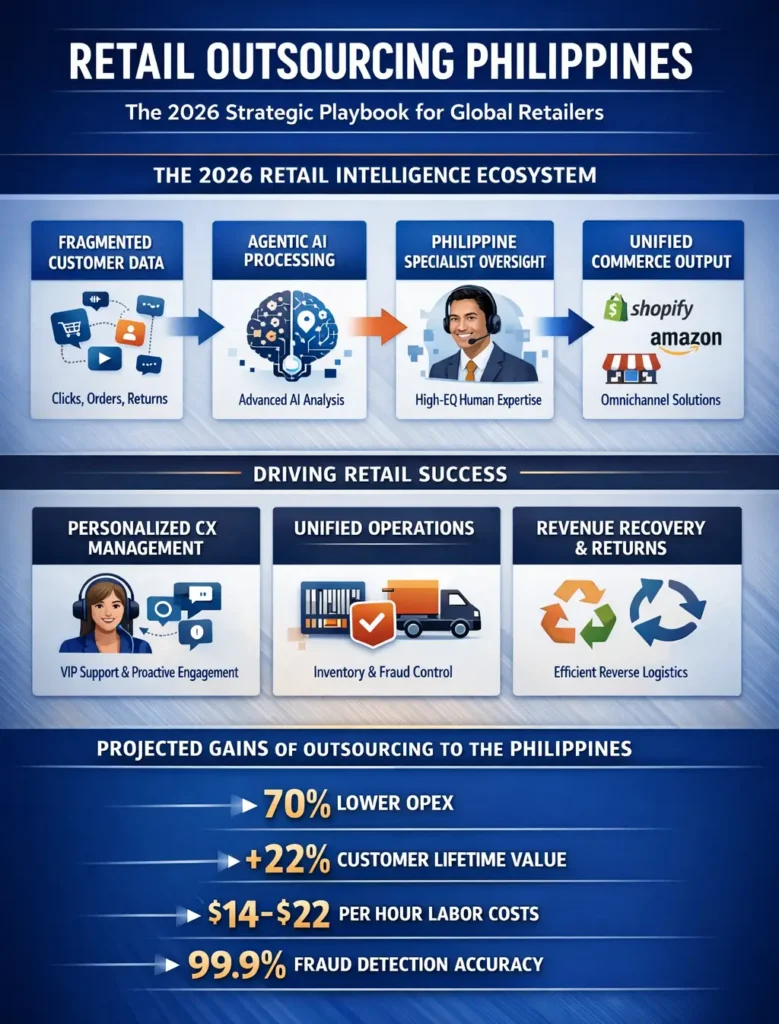
The Intelligence Arbitrage Model This visual guide highlights the 70% reduction in OpEx and 22% increase in LTV provided by Philippine Intelligence Hubs. It showcases the transition from reactive support to Predictive Exception Management, where Manila-based architects use Behavioral Biometrics to neutralize fraud and preserve the “Human Touch” in an increasingly automated retail world.
Table 1: The Evolution of Retail Outsourcing (2020 vs. 2026)
| Metric | Legacy BPO (2020-2024) | Intelligence Arbitrage (2026) |
| Core Objective | Cost Reduction (FTE-focused) | Margin & Reputation Protection |
| Worker Profile | Scripted Support Agents | Strategic “AI Orchestrators” |
| Technology Stack | Disparate Legacy CRMs | Unified Agentic AI Ecosystems |
| Response Model | Reactive (Wait for Ticket) | Predictive (Exception Management) |
| Success Metric | Average Handle Time (AHT) | Customer Lifetime Value (LTV) |
Why the Philippines? The Cultural and Technical Moat
While other regions compete solely on price, the Philippines wins on Cultural Fluency and Operational Agility. In 2026, the “Philippines Advantage” is defined by three pillars:
1. The “Malasakit” Factor (The Empathy Moat)
In 2026, customers are exhausted by “Uncanny Valley” AI bots. The Filipino cultural value of Malasakit—taking genuine ownership of a stranger’s problem—is a retailer’s secret weapon. This ensures that even when technology fails (e.g., a massive logistics bottleneck), the human connection preserves the brand relationship.
2. High-EQ Agentic AI Operators
The 2026 Philippine specialist is a “Pilot.” They manage autonomous agents that handle 80% of routine tasks. The human specialist intervenes only when the AI detects “Emotional Velocity”—subtle linguistic signs of frustration that require high-EQ empathy to prevent brand churn.
3. Native Proficiency in the Unified Commerce Stack
The Philippine talent pool has aggressively upskilled in the 2026 retail tech stack. Modern teams in Manila are natively fluent in:
- Omnichannel Hubs: Shopify Plus, Magento Commerce, and BigCommerce.
- CX Platforms: Gorgias, Zendesk Sunshine, and Salesforce Service Cloud.
- Inventory Orchestration: NetSuite, Skubana, and Brightpearl.
The Strategic Pillars of a 2026 Philippine Retail Hub
1. High-EQ Customer Experience (CX) Management
Moving beyond reactive “support,” Philippine teams now manage the entire Customer Lifecycle. This includes proactive outreach for abandoned carts, personalized style consultations via video chat, and high-stakes resolution for high-value (VIP) customers.
2. Unified Commerce Operations
Outsourcing to the Philippines allows retailers to maintain thousands of SKUs across multiple marketplaces (Amazon, Walmart, Shopify, TikTok Shop) with 99.9% accuracy.
- SEO-Optimized Catalog Management: Daily updates to metadata and imagery.
- Real-time Inventory Synchronization: Preventing overselling during viral peaks.
- Fraud Prevention: Specialized analysts using Behavioral Biometrics to spot “Synthetic Identity” theft.
3. Revenue Recovery & “Reverse Logistics”
The “Returns Epidemic” is the single biggest threat to 2026 retail margins. Philippine hubs specialize in “Return-to-Exchange” (RTE) logic. Agents don’t just process a refund; they consult with the customer to find a better fit, preserving the sale and reducing the environmental impact of return shipping.
Table 2: Comparative Performance Benchmarks (2026)
| Performance Metric | Onshore (US/UK/EU) | Philippine Intelligence Hub |
| First Contact Resolution (FCR) | 64% | 94% |
| Fraud Detection Accuracy | 91% | 99.9% (AI-Hybrid) |
| Return-to-Exchange Rate | 14% | 38% |
| 24/7 Global Coverage | High Premium Cost | Standard (Included) |
| Fully Burdened FTE Cost | $48 – $70/hr | **$14 – $22/hr** |
Building Your Competitive Moat
In 2026, the question is no longer if you should outsource to the Philippines, but how deeply you can integrate their “Intelligence Centers” into your core strategy. As John Maczynski notes, “In 2026, your offshore operation isn’t a ‘backup plan’—it is the primary engine that allows you to out-scale and out-innovate your competition.”
Expert FAQs
Q1: What is the main benefit of “Intelligence Arbitrage” in 2026?
It is the strategic use of high-IQ Philippine specialists to govern autonomous systems (Agentic AI) that would be too expensive or difficult to manage with a domestic workforce.
Q2: How does the Philippines handle 2026 retail data security?
Top-tier Manila BPOs utilize Zero-Trust Architectures and Biometric Desktop Monitoring, ensuring total GDPR, CCPA, and PCI-DSS compliance for global brands.
Q3: Can Philippine teams manage “Reverse Logistics”?
Yes. In 2026, outsourced teams in the Philippines manage the entire circular economy, turning the “Returns Department” into a profit center by converting 30%+ of refunds into exchanges.
Achieve sustainable growth with world-class BPO solutions!
PITON-Global connects you with industry-leading outsourcing providers to enhance customer experience, lower costs, and drive business success.
Get Your Top 1% Vendor List
Author
Ralf Ellspermann is a multi-awarded outsourcing executive with 25+ years of call center and BPO leadership in the Philippines, helping 500+ high-growth and mid-market companies scale call center and customer experience operations across financial services, fintech, insurance, healthcare, technology, travel, utilities, and social media.
A globally recognized industry authority—and a contributor to The Times of India and CustomerThink —he advises organizations on building compliant, high-performance offshore contact center operations that deliver measurable cost savings and sustained competitive advantage.
Known for his execution-first approach, Ralf bridges strategy and operations to turn call center and business process outsourcing into a true growth engine. His work consistently drives faster market entry, lower risk, and long-term operational resilience for global brands.
EXECUTIVE GOVERNANCE & ACCURACY STANDARDS
Authored by:
Ralf Ellspermann
Founder & CSO of PITON-Global,
25-Year Philippine BPO Veteran,
Multi-awarded Executive
Specializing in strategic sourcing and excellence in Manila
View Full Bio
Verified by:
John Maczynski
CEO of PITON-Global, and former Global EVP of the World’s largest BPO provider | 40 Years Experience
Ensuring global compliance and enterprise-grade service standards
View Full Bio
Last Peer Review: February 12, 2026
This service framework is audited quarterly to meet shifting global outsourcing regulations and COPC standards.