
30-Second Executive Briefing
- The Paradigm Shift: In 2026, CX is the “Panoramic View.” It’s not about a single phone call or a fixed ticket; it is the sum of every touchpoint from discovery to unboxing and beyond, which is the scope of customer experience teams for retail brands.
- The Core Strategy: Moving from reactive fixes to Proactive Journey Orchestration. This involves identifying friction before the customer feels it and designing “Effortless” paths to purchase.
- The Manila Advantage: Access to “CX Architects”—specialists who combine data analytics, design thinking, and cultural empathy to manage the entire brand perception.
- The ROI: Comprehensive offshore CX programs drive higher Net Promoter Scores (NPS) and greater Customer Lifetime Value (CLV).
Executive Summary
If Customer Support is the “Safety Net” and Customer Service is the “Heart,” then Customer Experience (CX) is the “Blueprint.” In the 2026 retail environment, brands no longer compete on product alone; they compete on the feeling of the transaction. Retail Customer Experience Outsourcing in the Philippines has evolved into a high-level consultancy and execution hub for global brands looking to master this intangible edge.
The country has moved beyond the contact center model to become a global center for Experience Design. By integrating Filipino talent into the very fabric of the customer journey—from web usability feedback to loyalty program design—retailers are creating a “Frictionless Reality.” This guide explores how an offshore-led CX strategy transforms a retail brand from a mere vendor into a lifelong partner.
Defining the “Trinity”: Support vs. Service vs. Experience
To win in 2026, you must understand where CX sits in your operational stack. While these terms are often used interchangeably, they represent three distinct layers of maturity:
- Retail Customer Support: The Defensive Layer. “My order is missing; please find it.” (Reactive/Technical)
- Retail Customer Service: The Relational Layer. “I love this brand because they treat me like a person.” (Human/Emotional)
- Retail Customer Experience (CX): The Strategic Layer. “The entire process—from the first ad I saw to the ease of my return—was perfect.” (Proactive/Holistic)
“CX is the narrative that binds your brand together,” I often explain. “Outsourcing CX to the Philippines isn’t about finding people to answer phones; it’s about finding architects who can look at your entire data stream and tell you why customers are dropping off at checkout and how to fix the psychological friction behind it.”
Architecting the “Frictionless Reality”: Why Proactive CX Is the 2026 Loyalty Anchor
In 2026, Customer Experience (CX) is the strategic layer that renders “Support” obsolete. This infographic details the Frictionless Journey Loop, a model where offshore specialists move beyond reactive service to Proactive Journey Orchestration. By analyzing heatmaps, click-through rates, and Emotional Sentiment Scores, Manila-based hubs act as “Experience Architects,” identifying and fixing psychological friction points before the customer even feels them. This shift drives higher Customer Lifetime Value (CLV) by ensuring the entire brand narrative—from the first TikTok ad to the final unboxing—is a single, cohesive, and “effortless” experience.
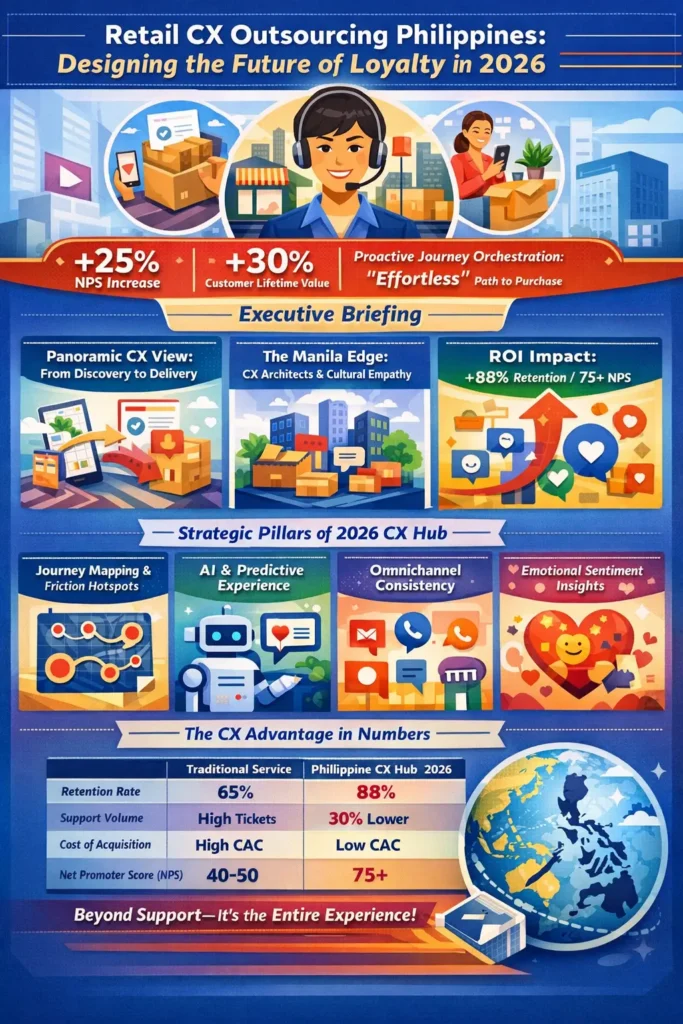
This visual guide illustrates how offshore CX Hubs increase Net Promoter Score (NPS) and boost Customer Lifetime Value (CLV) by shifting brands from reactive ticket resolution to proactive journey orchestration. It highlights the transition from fragmented, channel-based service models to a unified 2026 CX Architecture—where journey mapping, friction hotspot detection, predictive “Next-Best-Experience” logic, and omnichannel narrative consistency operate as a continuous loop.
In this model, Agentic AI identifies behavioral signals and anticipates customer intent at machine speed, while high-IQ Filipino CX Architects provide Human-in-the-Loop oversight—refining emotional tone, ensuring brand voice integrity, and preventing churn before it happens. The result is a prevention-first CX ecosystem that reduces support volume, lifts retention, and transforms the customer journey into a defensible competitive moat built on loyalty, emotional resonance, and long-term value creation.
Strategic Pillars of the 2026 Philippine CX Hub
I. Journey Mapping & Friction Identification
Filipino CX specialists are trained in Behavioral Analytics. They don’t just wait for a complaint; they analyze heatmaps, click-through rates, and “Time-on-Page” data to identify where customers are struggling. By spotting a “Friction Hotspot” early—such as a confusing mobile navigation menu—they can prompt a design change before it ever leads to a support ticket.
II. Agentic AI & Predictive “Next-Best-Experience”
In 2026, CX is powered by Predictive Orchestration. Offshore hubs use Agentic AI to anticipate a customer’s needs. If a customer has bought three items in a specific style, the CX team in Manila manages the AI logic that ensures their next website visit or email is personalized with “Hyper-Relevant” suggestions. This is CX as a Sales Engine. It is also why retail live chat support is measured on conversion.
III. Omnichannel Narrative Consistency
A major CX failure is the “Broken Narrative”—where a brand sounds different on Instagram than it does on the phone. Offshore CX hubs act as the Guardians of Brand Voice. They ensure that every touchpoint—whether it’s an automated WhatsApp notification, a live voice call, or a physical package insert—reflects a single, cohesive brand personality.
IV. Emotional Sentiment Benchmarking
Beyond NPS and CSAT, 2026 is the year of the Emotional Connection Score (ECS). These teams use advanced sentiment analysis to measure the feeling of a customer’s journey. By analyzing the language used in reviews, social mentions, and support logs, the CX hub provides the C-suite with a “Health Map” of the brand’s psychological standing in the market.
The Economics of CX: The Value of Prevention
Investing in a holistic offshore CX hub is a strategic move that pays for itself through “Support Avoidance”:
| Performance Metric | Traditional Service Model | 2026 Philippine CX Hub |
| Primary Focus | Resolving Tickets | Preventing Tickets |
| Customer Retention | 65% | 88% |
| Support Volume | Baseline | 30% Reduction (via UX Fixes) |
| Cost of Acquisition (CAC) | High (Constant Churn) | Low (Referral Driven) |
| Net Promoter Score (NPS) | 40–50 | 75+ |
Infrastructure: Designing the “Invisible” Experience
A 2026 CX operation requires a different tech stack than a traditional call center. Leading providers offer:
- Unified Data Environments: Agents have a 360-degree view of the customer, including non-support data like “Wishlist” items and abandoned carts.
- Real-Time Feedback Loops: A direct API link between the Manila CX hub and the brand’s product/dev team, allowing for “Live Iteration” on the customer journey.
- Ethical AI Frameworks: Ensuring that personalization remains helpful and “delightful” without feeling intrusive or creepy.
CX is the Only Sustainable Moat
In 2026, your products can be copied and your prices can be undercut. The only thing a competitor cannot steal is the Experience your brand provides. An offshore retail customer experience team gives you the talent and the technology to build that experience at scale.
From my perspective, the shift is clear: Stop managing departments and start managing journeys. When the experience is perfect, the “support” becomes unnecessary.
FAQs
How does CX differ from Customer Service?
Customer Service is a subset of CX. Service is the human interaction that happens when a customer reaches out. CX is the broader strategy that ensures they never have to reach out unless they want to.
Can the Philippines handle “High-End” Luxury CX?
Absolutely. In 2026, many of the world’s most prestigious luxury brands use “Boutique CX Hubs” in Manila for their “White-Glove” digital concierge services.
Is CX outsourcing only for large retailers?
No. In fact, mid-market retailers benefit the most because it allows them to have a “Global Command Center” that usually only Fortune 500 companies can afford. The same economics apply to finance functions such as retail accounts receivable.
What is a “Friction Hotspot”?
It’s any point in the customer journey where a user pauses, gets confused, or drops off. A skilled CX team identifies these using data and suggests fixes to keep the “Relational Velocity” high.