
Back
Retail Customer Experience (CX) Management Outsourcing Philippines: Mastering the End-to-End Journey

By Ralf Ellspermann / 12 February 2026

30-Second Executive Briefing
- The Paradigm Shift: In 2026, the “product” is a commodity; the experience is the primary differentiator. Brands are shifting from reactive support to proactive CX Management.
- The Core Strategy: Leveraging high-EQ Filipino “Experience Architects” to oversee Agentic AI workflows, enabling hyper-personalization at an enterprise scale.
- The Manila Advantage: Access to specialized talent that treats CX as a revenue-generating discipline focused on LTV (Lifetime Value) rather than just ticket volume.
- The ROI: Retailers utilizing Philippine-managed CX hubs report a 40% increase in Net Promoter Scores (NPS) and a 25% reduction in Customer Acquisition Costs (CAC).
Executive Summary
In the hyper-competitive global retail landscape of 2026, the boundary between “shopping” and “experience” has effectively vanished. For global retailers, the challenge is no longer just providing a functional product, but managing the emotional and technical journey of every customer across fragmented digital and physical touchpoints. Retail CX Management Outsourcing in the Philippines has emerged as the strategic solution for brands that demand “White-Glove” service at scale.
By integrating the natural hospitality and high emotional intelligence (EQ) of the Filipino workforce with cutting-edge Agentic AI orchestration, retailers can now deliver hyper-personalized experiences that were previously cost-prohibitive. This comprehensive guide explores how Philippine-based CX managers are transforming from “problem solvers” into “Experience Architects,” driving measurable growth in brand loyalty and customer lifetime value (LTV).
Beyond Support: The Era of Experience Orchestration
In the legacy BPO model, “Customer Support” was a defensive play—a way to minimize the damage of a broken process. In 2026, CX Management is an offensive strategy. It is the art of anticipating friction before it occurs and turning every touchpoint into an opportunity for brand reinforcement.
“The most successful retail brands don’t look at the Philippines as a place to ‘hide’ their problems,” says John Maczynski, CEO of PITON-Global. “They look at it as a strategic nerve center where Experience Architects use a blend of data-driven insights and radical empathy to design a journey that makes the customer feel seen and valued. In 2026, CX is the only moat that can’t be easily copied.”
The Rise of the Experience Architect
The role of the “agent” has evolved into the “Experience Architect.” These professionals in Manila and Cebu are no longer tethered to rigid scripts. Instead, they use Intelligence Arbitrage to make high-impact decisions. Whether it’s authorizing a proactive discount for a delayed shipment or identifying a VIP customer through behavioral cues, the Philippine CX team acts as an extension of the brand’s executive vision.
Mastering the Journey: The Philippine Retail CX Model
In 2026, CX is no longer about “fixing problems”—it’s about Experience Orchestration. This infographic details how specialized Philippine hubs utilize Experience Architects to govern Agentic AI stacks. By shifting from reactive “support” to proactive journey management, Manila-based teams deliver a 40% boost in NPS and a 25% reduction in CAC. These high-EQ specialists leverage the Filipino value of “Malasakit” to handle the 20% of high-emotion cases that drive 80% of brand sentiment, while AI agents autonomously resolve routine “WISMO” (Where Is My Order) inquiries, ensuring a hyper-personalized, zero-friction global retail journey.
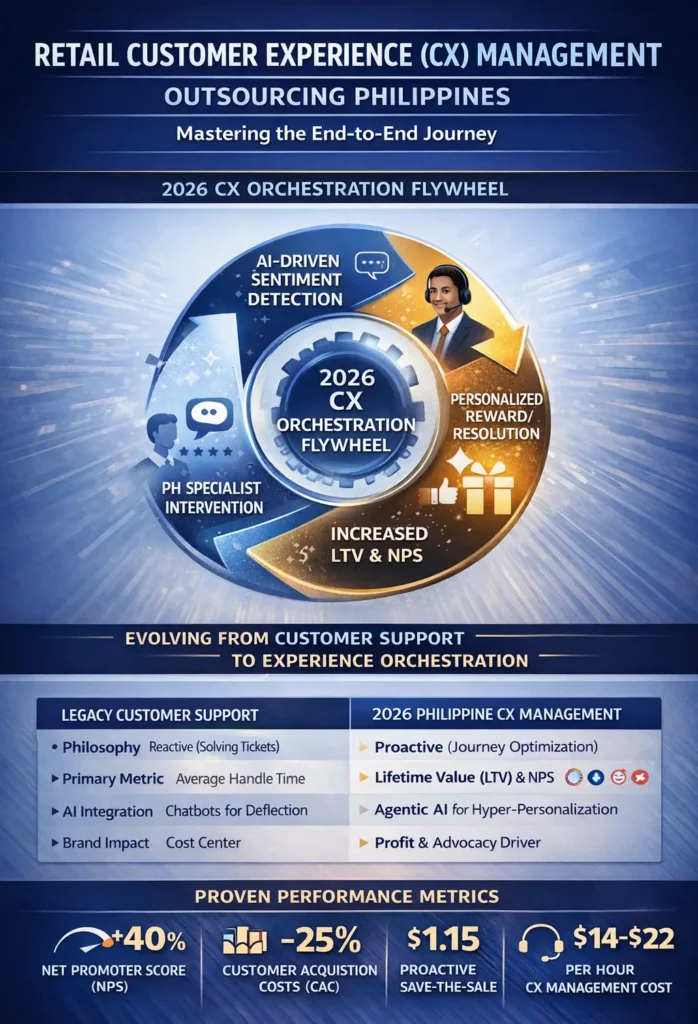
This visual guide highlights the 25% reduction in acquisition costs and 40% higher NPS achieved by Philippine-managed CX hubs. It showcases the transition from legacy “Ticket Deflection” to 2026 Hyper-Personalization, where Filipino architects use real-time sentiment analysis to intercept friction and convert returns into exchanges, preserving both revenue and the customer relationship
Table 1: Reactive Support vs. 2026 Proactive CX Management
| Feature | Legacy Customer Support | 2026 Philippine CX Management |
| Philosophy | Reactive (Solving Tickets) | Proactive (Journey Orchestration) |
| Primary Metric | Average Handle Time (AHT) | Lifetime Value (LTV) & NPS |
| Agent Profile | Generalist / Script-Based | Vertical Specialist / High-EQ |
| AI Integration | Chatbots for Deflection | Agentic AI for Hyper-Personalization |
| Brand Impact | Cost Center | Profit & Advocacy Driver |
Why the Philippines is the Global CX Capital
The “Philippines Advantage” in CX is built on a foundation of cultural alignment and emotional intelligence that cannot be replicated by automation alone.
1. High-EQ “Experience Architects”
Filipino culture is deeply rooted in relational depth and hospitality. In a retail context, this means that when a journey hits a friction point—such as a delayed shipment—the Philippine-based CX manager possesses the cultural intuition to turn a negative event into a “loyalty-defining moment.”
2. Governing the “Agentic AI” Stack
Modern CX requires managing a complex web of AI agents. Philippine teams are world leaders in Human-in-the-Loop (HITL) AI management. While an AI agent might identify a high-risk churn customer, the Filipino CX specialist executes the personalized intervention, ensuring the solution feels authentic rather than automated.
3. Native Cultural Fluency
The Philippines’ deep-seated affinity for Western culture allows CX teams to communicate with “Native-Level” nuance. They don’t just speak the language; they speak the brand. This ensures that a customer in London or New York feels they are speaking with someone who truly understands their lifestyle and expectations.
Strategic Pillars of Philippine Retail CX
I. Omnichannel Sentiment Synchronicity
Retailers now live on TikTok, Instagram, Amazon, and proprietary apps. A centralized Philippine CX hub monitors these signals to ensure the “Brand Voice” is unified. If a viral trend starts on social media, the CX team in Manila is the first to know, adjusting the support strategy in real-time.
II. The ROI of Empathy: Turning Returns into Exchanges
One of the most significant margin-savers in 2026 is Return-to-Exchange (RTE) conversion. Philippine CX managers are trained to consult. By understanding why a customer is returning an item, they can recommend a better alternative, preserving the sale and the relationship.
Table 2: CX Impact on Retail Financial Performance (2026)
| CX Intervention | Execution Cost (PH) | Financial Outcome |
| Proactive ‘Save-the-Sale’ Chat | $1.15 / interaction | 28% Increase in Revenue Recovery |
| VIP Loyalty Orchestration | $14.50 / hour | 35% Higher Repeat Purchase Rate |
| Omnichannel Sentiment Analysis | Integrated | 20% Reduction in Public Brand Risk |
| Agentic AI Personalization | Platform + $12/hr | 18% Increase in AOV (Avg Order Value) |
The New Gold Standard
In 2026, the brands that win are those that treat every customer interaction as an opportunity to reinforce their value. Retail CX Management Outsourcing in the Philippines provides the perfect equilibrium: the scalability of technology with the irreplaceable warmth of the human touch.
Expert FAQs
Q1: How does CX Management differ from traditional Customer Service?
Traditional service is reactive and transaction-focused. CX Management is a holistic, proactive discipline that oversees the entire customer lifecycle, focusing on sentiment, retention, and increasing long-term LTV.
Q2: Can Philippine CX teams manage luxury retail standards?
Yes. Specialized “White-Glove” hubs in Manila are specifically trained for luxury brands, focusing on high-net-worth client psychology and concierge-level service.
Q3: How does Agentic AI work within a Philippine CX hub?
AI agents handle routine tasks like data retrieval. This frees up the Filipino CX specialists to focus on high-value “Emotional Recovery” and strategic personalization that drives loyalty.
Achieve sustainable growth with world-class BPO solutions!
PITON-Global connects you with industry-leading outsourcing providers to enhance customer experience, lower costs, and drive business success.
Get Your Top 1% Vendor List
Author
Ralf Ellspermann is a multi-awarded outsourcing executive with 25+ years of call center and BPO leadership in the Philippines, helping 500+ high-growth and mid-market companies scale call center and customer experience operations across financial services, fintech, insurance, healthcare, technology, travel, utilities, and social media.
A globally recognized industry authority—and a contributor to The Times of India and CustomerThink —he advises organizations on building compliant, high-performance offshore contact center operations that deliver measurable cost savings and sustained competitive advantage.
Known for his execution-first approach, Ralf bridges strategy and operations to turn call center and business process outsourcing into a true growth engine. His work consistently drives faster market entry, lower risk, and long-term operational resilience for global brands.