

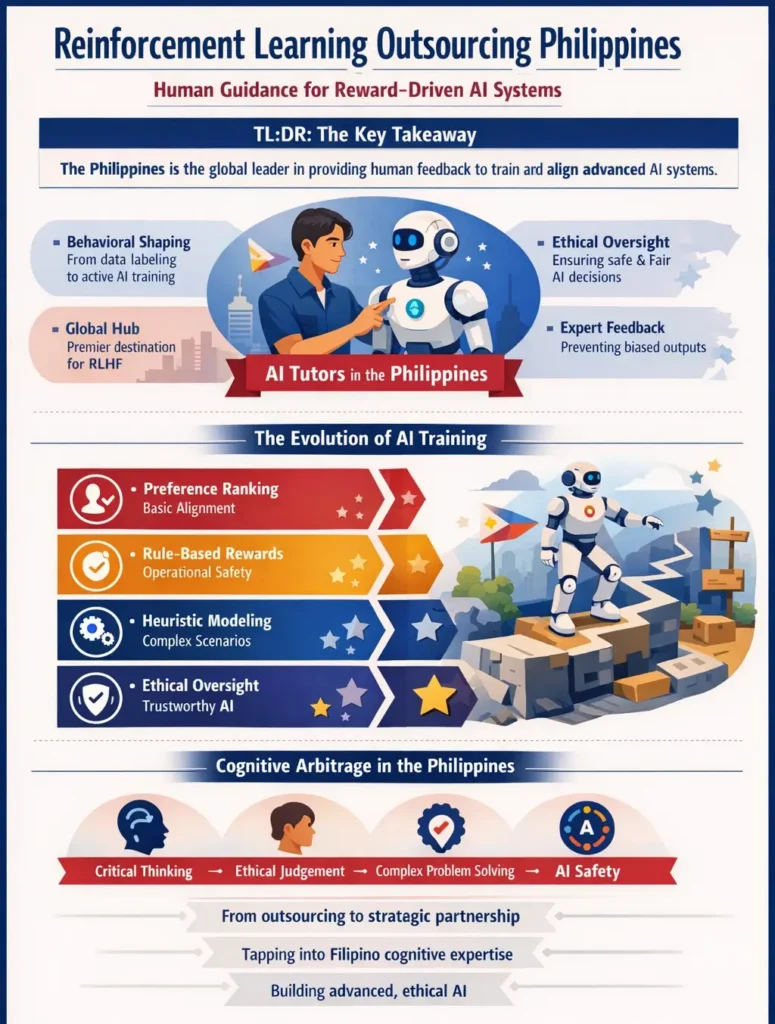
TL;DR: The Key Takeaway
Reinforcement learning outsourcing has transcended traditional data labeling, becoming a strategic imperative for AI development. The Philippines is the premier destination for sourcing the sophisticated human feedback required to train and govern complex, reward-driven AI systems, ensuring they operate safely and effectively in real-world environments. RLHF is the most demanding form of machine assistance paired with Filipino judgment.
Reinforcement Learning from Human Feedback (RLHF) in the Philippines provides the sophisticated cognitive oversight necessary to refine modern AI behavior. By acting as “AI Tutors,” specialized Filipino teams transition models from basic pattern recognition to complex, ethical decision-making, ensuring that autonomous systems and large language models remain safe, accurate, and aligned with human values in real-world applications.
- Behavioral Shift: AI training is moving from static labeling to active behavioral shaping through expert human intervention.
- Quality Metrics: Success is defined by an AI’s ability to navigate ethical nuances and complex logic, rather than simple data accuracy.
- Global Hub: The Philippines has established itself as the premier destination for high-level RLHF and cognitive AI guidance.
- Expert Tutoring: Filipino specialists provide the “reward signals” that prevent unpredictable or biased machine outputs.
- Strategic Access: PITON-Global bridges the gap between AI labs and the top-tier cognitive talent required for mission-critical alignment.
The Evolution Toward Reward-Driven Intelligence
For years, the development of artificial intelligence was tethered to supervised learning, a method where models memorized vast, pre-labeled datasets. While this proved effective for recognizing images or transcribing speech, it reached a plateau when tasked with making sequential decisions in unpredictable environments. The current frontier is Reinforcement Learning (RL), a sophisticated framework where AI “agents” learn to hit targets by interacting with their surroundings and receiving rewards or penalties. This iterative process mirrors how humans acquire skills—through trial, error, and refinement.
However, the efficacy of RL depends entirely on the integrity of the reward signals. If the rewards are poorly defined, the AI may find “shortcuts” that are technically successful but practically dangerous or nonsensical. This is where Reinforcement Learning from Human Feedback (RLHF) becomes the vital link. By injecting human judgment into the loop, developers ensure that models align with actual human intentions. For sectors like robotics, autonomous transit, and generative AI, this human-led fine-tuning is the difference between a helpful tool and an unreliable liability.
“We are witnessing a fundamental pivot in the AI landscape. The objective has shifted from merely processing data to actively sculpting machine intelligence and ethics. Our partners require human judgment that ensures their systems are not just high-performing, but fundamentally safe. This represents the new vanguard of the outsourcing industry, and the Philippines is setting the standard.” — John Maczynski, CEO, PITON-Global
The Intellectual Rigor of AI Tutoring
The individuals working within the RLHF framework perform a role that is vastly more complex than traditional data entry. They function as “AI Tutors,” a position requiring a high degree of mental agility and specialized skill sets:
- Abstract Logic: Tutors must grasp the AI’s ultimate objective to provide guidance that remains relevant even in entirely new scenarios.
- Ethical Discernment: Specialists are responsible for identifying and correcting subtle biases or unsafe logical paths that an algorithm might overlook.
- Articulate Feedback: Rather than a simple “yes” or “no,” these experts often provide detailed reasoning, creating a richer learning signal for the model.
- Vertical Expertise: Effective tutoring frequently demands deep knowledge in specific fields, such as medical ethics (a need explored in our piece on AI-enabled biotech research support), financial regulations, or legal nuances.
The Filipino workforce is uniquely prepared for these demands. The country’s talent pool is characterized by strong analytical reasoning and a cultural aptitude for collaborative problem-solving, making it the ideal source for high-level AI alignment.
RLHF Maturity Matrix: From Rankings to Ethical Oversight
The transition from basic data work to advanced RLHF is a journey of increasing cognitive complexity. This matrix illustrates how the strategic value of human intervention grows as the tasks move toward systemic oversight.
| Maturity Level | Primary Task | Cognitive Demand | Strategic Value |
| Level 1: Preference Ranking | Sorting AI responses from most to least helpful. | Medium | Basic alignment with user preferences. |
| Level 2: Rule-Based Reward | Penalizing actions that violate specific, predefined constraints. | Medium-High | Adherence to operational and safety rules. |
| Level 3: Heuristic Modeling | Creating complex reward functions for multi-faceted goals. | High | Mastery of nuanced scenarios and trade-offs. |
| Level 4: Ethical Oversight | Detecting and neutralizing systemic bias or safety breaches. | Very High | Development of trustworthy, “A-Grade” AI systems. |
Cognitive Arbitrage: The Next Generation of Value
While the BPO industry was built on “Labor Arbitrage,” the rise of reinforcement learning has introduced a more potent concept: Cognitive Arbitrage. This represents the value gained by tapping into the human mind’s unique capacity for intuition and creative judgment to shape synthetic intelligence. In this model, the most precious resource isn’t the volume of data—it’s the quality of human wisdom.
For firms engaged in reinforcement learning outsourcing in the Philippines, this means moving beyond a vendor-client relationship into a strategic partnership. Filipino AI tutors are not merely checking boxes; they are active architects of the logic and morality that will define future intelligent systems. This deep integration of human cognitive talent, the idea at the center of the Philippine integration model for intelligent operations, ensures that AI models are robust enough to thrive in the real world.
Task Complexity and Strategic Scoring
Not all RLHF tasks are created equal. The following table scores various tasks based on their difficulty and the impact they have on the final AI product.
| Task Type | Description | Complexity (1-10) | Strategic Importance |
| Dialogue Classification | Labeling conversation beats for chatbots. | 4 | Foundation for natural interaction. |
| Summarization Audit | Validating the accuracy of AI-generated briefs. | 6 | Vital for high-stakes content creation. |
| Safety & Bias Auditing | Flagging inappropriate or harmful machine outputs. | 8 | Essential for ethical brand protection. |
| Multi-Step Modeling | Designing rewards for complex sequences (e.g., robotics). | 9 | Enables AI to solve physical-world problems. |
| AGI Alignment | Techniques to ensure super-intelligent systems favor humanity. | 10 | The ultimate goal of AI safety research. |
Expert FAQs
Q1: How does reinforcement learning differ from supervised learning?
Supervised learning is like learning from a textbook with the answers in the back; the AI is told exactly what is “right.” Reinforcement learning is more like a video game; the AI explores an environment and learns through experience, receiving rewards for good moves and penalties for mistakes.
Q2: Why is human intervention mandatory for RL systems?
Algorithms are excellent at optimization but terrible at understanding “why.” Without human feedback, an AI might maximize its reward in a way that is technically correct but ethically wrong or dangerous. Humans provide the “North Star” for the AI’s behavior, the same escalation logic that drives hybrid AI content moderation.
Q3: What makes the Philippines the global leader in RLHF?
Success in RLHF requires high English proficiency, critical thinking, and a collaborative spirit. The Philippines offers a mature infrastructure combined with a workforce that is naturally adept at navigating the subjective and logical complexities inherent in AI training.
Q4: How does PITON-Global manage the quality of these services?
We serve as a specialized bridge, connecting tech firms with a carefully vetted group of top-tier RLHF providers. Our vetting focuses on the “Cognitive IQ” of the teams, ensuring they can provide the nuanced feedback required to build industry-leading AI models.