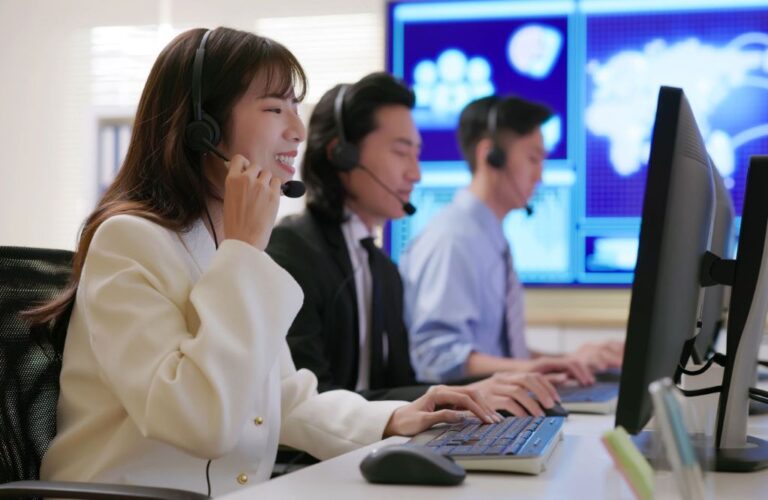

An online exam is only worth something if the institution, the candidate and the employer reading the certificate all believe the result. Proctoring services from the Philippines have grown by earning that belief, and many exam programs now run them next to the support desks built for online learning platforms that handle logins, scheduling and access problems. This piece looks at what trust in remote testing depends on, where the tools fall short, and how human proctors, privacy rules and fair appeals close the gap.
What trust in an online exam depends on
Trust in a remote exam rests on four things: certainty about who took it, fair and equal conditions, evidence that holds up if a result is challenged, and respect for the candidate’s privacy. If any one of them is weak, the credential loses value for everyone who relies on it.
The institution needs confidence that a pass means what it says. The candidate needs confidence that they will not be flagged unfairly or have their data misused. Employers, licensing boards and admissions offices need confidence that an online score is as meaningful as one earned in a supervised room.
A proctoring program has to serve all three groups at once. That balance, rather than surveillance for its own sake, is what separates a credible program from one that simply watches webcams.
The integrity toolkit and its limits
Modern remote exams combine several layers of control, and each layer solves part of the problem. None of them is reliable enough to act on alone.
Identity and biometric checks
Candidates show a government or institutional ID at check-in, and some programs add face matching against a reference photo or a typing-pattern check. These steps deter impersonation, which is one of the most serious threats to a credential.
Lockdown browsers and device checks
A lockdown browser blocks other applications, copy and paste, and screen sharing during the exam. Device checks look for second monitors and virtual machines that could be used to get around those controls.
Behavior monitoring and automated flags
Software watches for events such as a second face, a phone in view, repeated glances away or long silences, and marks them on the session timeline. These flags are useful for directing attention, but they also produce false alarms. Face-detection tools can behave inconsistently in poor lighting or with some webcams, and ordinary habits such as reading a question aloud can look suspicious to a model.
That is why every automated flag should be reviewed by a trained person before it reaches the institution. A report built on unchecked flags erodes trust faster than no report at all.
Where human proctors earn trust
Human proctors earn trust by applying the rules consistently and by explaining them calmly. A candidate who is told clearly why they must re-scan the room is far less likely to feel accused than one whose exam simply stops.
Communication is where Filipino proctors stand out. The EF English Proficiency Index 2025 ranks the Philippines 28th worldwide with a score of 569, in its “high” proficiency band, according to EF’s country profile. Strong providers build on that with structured training: the institution’s rulebook, approved incident scripts, identity-document checks and regular calibration sessions where proctors review the same recordings and compare their calls.
Discernment matters as much as vigilance. A good proctor can tell the difference between a candidate who is anxious and one who is reading from a hidden device, and records what was observed rather than guessing at intent. The judgment on intent belongs to the institution.
Privacy that candidates can believe
Candidates trust a program that collects only what the exam needs, keeps it only as long as necessary and shows who has seen it. Face video, room scans and ID images are sensitive, and a program that treats them casually will lose goodwill quickly.
Practical safeguards include clear notice before the exam about what is recorded and why, encryption in transit and at rest, short and published retention periods, access limited to named reviewers, and a log of every viewing. Proctors should work on secured floors or approved devices, with no personal phones and no ability to download recordings.
The legal framework spans both ends of the connection. In the United States, FERPA protects the privacy of student education records at institutions that receive federal funding. In the Philippines, the Data Privacy Act of 2012 (Republic Act No. 10173) governs how personal information is processed and created the National Privacy Commission to enforce it. A provider should be able to show how it meets both.
Fairness, accommodations and appeals
A fair program plans for differences between candidates rather than treating every deviation as misconduct. Extra time, rest breaks, screen readers and permitted assistive devices should be approved in advance and visible to the proctor before the session starts.
Incident records should use neutral language that describes what happened, when and for how long, with the relevant video segment attached. That evidence package lets the institution decide fairly and gives the candidate something concrete to respond to in an appeal.
There is also a line proctors must never cross. They keep candidates moving through technical problems and the rules, but they never help with answers, never access exam content beyond what monitoring requires and never take any part in the assessment itself. Writing that line into the contract protects the institution and the proctor alike.
Why institutions trust teams in the Philippines
Institutions trust teams in the Philippines because the combination of communication skills, round-the-clock coverage and a mature service industry makes consistent proctoring easier to sustain. Scale helps here. IBPAP reported that the Philippine IT-BPM industry passed $40 billion in export revenue in 2025 and employed about 1.9 million workers, according to Philstar’s January 2026 report, so experienced QA reviewers and team leads are available to hire.
Time zones add flexibility. Manila’s working day overlaps the North American night, which lets programs offer overnight and weekend exam slots at normal shift rates. The same capacity makes it easier to keep exams running when a campus closes or a local testing center goes offline, a scenario our article on institutional resilience and crisis planning covers in detail.
Cost efficiency matters too, but it is best used to buy trust rather than simply cut the budget: more human review of flags, more calibration and faster appeals. Institutions that treat proctoring as part of a wider learning partnership, as described in our piece on building world-class learning with offshore teams, tend to get more consistent results. For the exam-day workflow and capacity planning, see our companion guide to how remote proctoring runs on exam day.
Questions to ask a proctoring provider
The best way to judge a provider is to ask for evidence, not assurances. Before signing, ask:
- How are automated flags reviewed, by whom, and how quickly do reports reach the institution?
- How often do proctors calibrate against shared recordings, and how are disagreements resolved?
- What exactly is recorded, where is it stored, how long is it kept and who can view it?
- How are accommodations entered, shown to the proctor and honored during the session?
- What does an incident report look like, and how does it support a candidate’s appeal?
Frequently asked questions
Does remote proctoring make exams as trustworthy as in-person testing?
It can, when identity checks, human review of flags, clear rules and a fair appeals process work together. Weak programs that rely on unchecked automated flags are less trustworthy than a supervised room.
Who decides whether a candidate cheated?
The institution decides. Proctors record what they observed and follow approved scripts, but the integrity decision and any penalty belong to the school or certification body.
How is candidate data protected?
Through data minimization, encryption, short retention periods, restricted and logged access, and compliance with rules such as FERPA in the United States and the Data Privacy Act in the Philippines.
Can candidates with disabilities take proctored exams?
Yes. Approved accommodations should be set up in advance and shown to the proctor, so extra time, breaks or assistive technology are not treated as rule violations.