

Partner with a vendor-neutral BPO advisory firm to audit and select a mid-sized, specialized provider in Manila or Cebu — one running agentic AI workflows with Filipino specialists providing human-in-the-loop oversight, billed on outcomes rather than hourly rates. In short, you hire an infrastructure, not a headcount.
For two decades, the Philippine outsourcing pitch was scale: more seats, more scripts, lower cost. In 2026 that no longer wins enterprise contracts. The decisive question is how intelligently a provider blends automation with human judgment — and the talent at the center of that shift, the AI Pilot, cannot be found on a standard job board. It is sourced by selecting the right infrastructure and the right operating model. Done well, that decision quietly reshapes the economics of an entire support operation before a single agent is hired — which is why it belongs with strategy, not procurement-by-checklist.
What Is an AI Pilot, and Why Do I Need One?
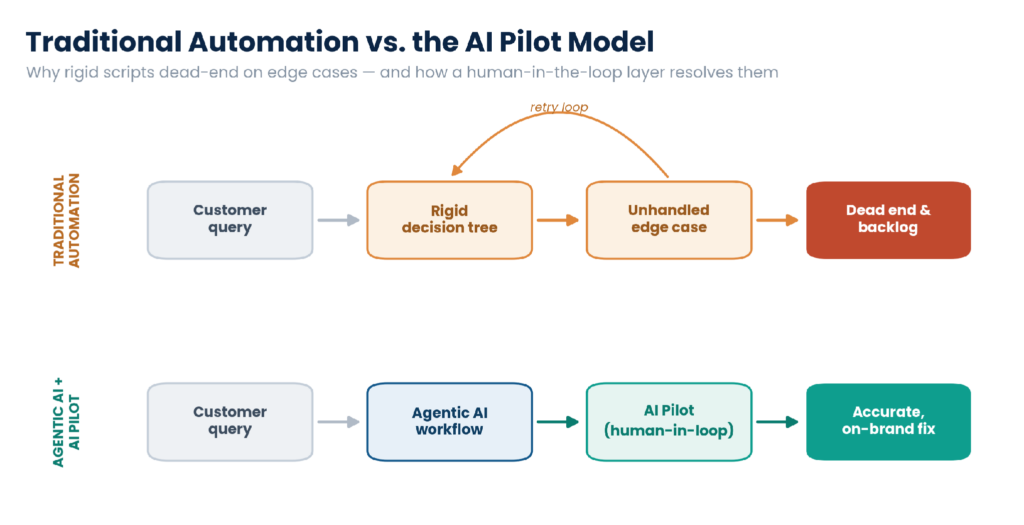
An AI Pilot is a skilled CX specialist who manages and guides autonomous, multi-step agentic AI workflows. The AI interprets intent, queries databases, and executes resolutions; the Pilot handles exceptions, reviews edge cases, and injects human empathy — keeping the system accurate, compliant, and free of hallucinations.
The scripted contact center is effectively dead. Rigid decision-tree automation handles the happy path but dead-ends on anything unexpected, looping customers through retries until they give up or escalate. The AI Pilot model breaks that loop: the agentic system does the heavy, repeatable work at machine speed, and the human owns the judgment calls where tone, nuance, or regulatory risk make a wrong autonomous answer expensive. In practice the division of labor is clean, and that single design choice is what lets a business deploy autonomous AI in customer-facing roles without gambling its brand on a model’s worst day.
How Does the Philippine BPO Ecosystem Support This Model?
The country’s mid-sized “Hidden Champions” have retrofitted their operations around generative and agentic technology, and a young, English-fluent, tech-savvy talent pool has become specialized AI monitors. The result is a model that beats the legacy approach on resolution, speed, and cost.
The Philippines is no longer merely a destination for low-cost transactional voice support. Its leading mid-sized providers were rebuilt from the ground up to deploy agentic architectures, and the operational gap between this model and the legacy approach is stark across every benchmark that matters to a buyer. Their massive, highly literate, tech-savvy workforce — the so-called “Hidden Champions” — has evolved rapidly into specialized AI monitors rather than script-readers.
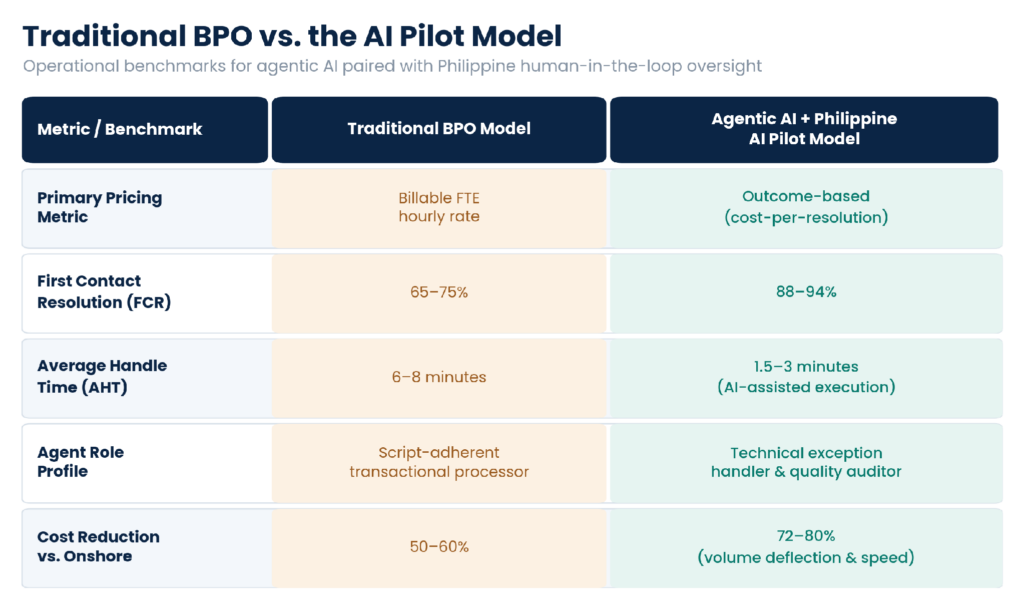
How the agentic AI + Philippine AI Pilot model compares with the traditional BPO approach.
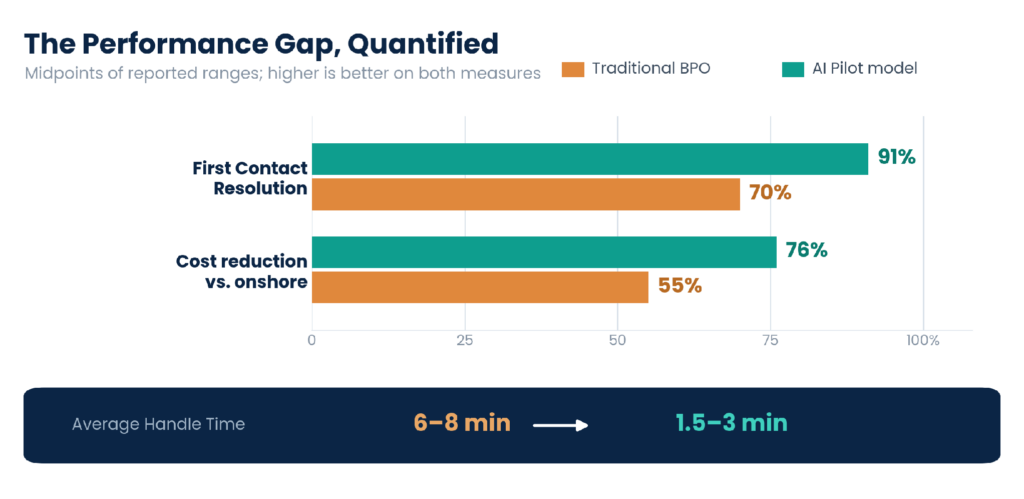
The numbers are not incremental. First Contact Resolution climbs from a typical 65–75% to 88–94%; Average Handle Time compresses from six to eight minutes down to as little as 1.5; and cost reduction versus onshore delivery widens from roughly half to as much as 80%, driven by volume deflection and speed rather than wage arbitrage alone. For a buyer, that is the difference between paying for effort and paying for outcomes.
What Steps Are Required to Source and Hire an AI Pilot?
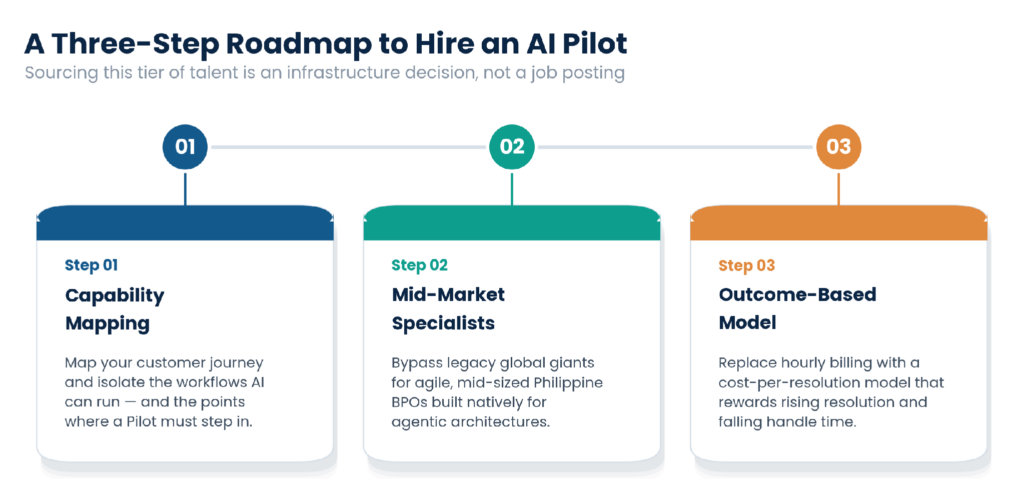
Three steps: map your customer journey to find autonomous-ready workflows and Pilot intervention points; bypass legacy global giants for agile mid-sized Philippine providers; and structure an outcome-based, cost-per-resolution contract that rewards the vendor as resolution rises and handle time falls.
Sourcing this advanced tier of talent demands a disciplined, operational approach rather than a job posting. The path runs through three deliberate moves:
- Map capability, not workflows. Evaluate your customer journey to find high-friction, multi-platform workflows that can run autonomously — and isolate the exact points where a Pilot must step in.
- Bypass the global giants. Large BPOs often carry legacy infrastructure that resists agile AI integration; mid-sized Philippine providers offer native technological alignment and tailored attention.
- Structure outcome-based pricing. Hourly billing gives a vendor no reason to cut volumes or handle times. A cost-per-resolution model rewards them precisely as efficiency rises.
“In 2026, the right-fit BPO will always outperform the biggest name. Digital commerce is a game of inches where margins are everything, and the right partner is one whose entire operating model is built around deploying autonomous capabilities governed by a human layer that keeps it trustworthy.”
— John Maczynski, CEO of PITON-Global
How Did PITON-Global Architect an AI-Driven CX Transformation?
Facing a 300% ticket surge, a North American fintech was matched to a specialized mid-sized Manila provider on an outcome-based model, pairing an agentic workflow over its banking ledger with 15 Filipino AI Pilots as the human-in-the-loop queue. Within 90 days: AHT down 68%, FCR 91.4%, and costs down 74%.
Rather than throwing bodies at the problem, PITON-Global bypassed the multi-thousand-seat incumbents and matched the client with a specialized mid-sized partner from its vetted network of more than 100 providers. The deployment paired an agentic AI workflow — able to autonomously navigate the client’s proprietary banking ledger to isolate transaction anomalies — with a dedicated team of 15 elite Filipino AI Pilots serving as the human-in-the-loop exception queue for high-stakes compliance reviews. Crucially, autonomous actions were bounded by strict guardrails, so the AI moved fast on the routine while humans owned anything carrying real financial exposure.

The results arrived within 90 days and compounded: handle time fell 68% from 8.2 to 2.6 minutes, First Contact Resolution reached an institutional high of 91.4%, run-rate costs dropped 74%, and attrition settled at an industry-low 2.8% — evidence that the specialized AI Pilot role is as good for retention as it is for the customer. The lesson is that the right-fit specialist, not the largest vendor, is what converts agentic technology into measurable results.